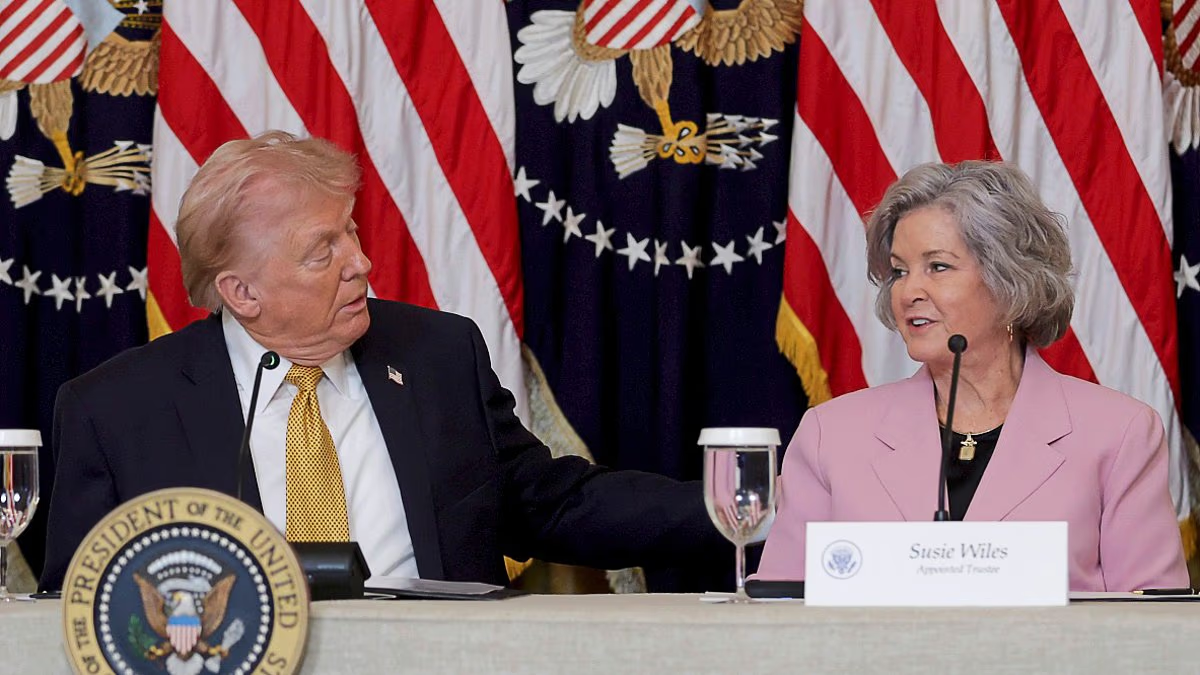

Susie Wiles, President Donald Trump’s chief of staff, has revealed how she navigated a six-month battle with cancer while continuing to manage one of the most demanding jobs in Washington.
Wiles, 69, made history as the first woman to serve as White House chief of staff. She was diagnosed with early-stage breast cancer in March.
After about six months of treatment, she announced on September 16 that she was cancer-free.
In a personal op-ed for USA Today, Wiles described the difficult months of chemotherapy, surgery and medical appointments, all while maintaining her responsibilities to the president.
She said the experience left her with a “deeper appreciation” for her colleagues, her work and “the preciousness of every day.”
“It was a difficult road,” Wiles wrote. “Because chemotherapy is, in a word, a b—-.”
Seeking a distraction from what she called a “brutal and unrelenting” fight, Wiles immersed herself in her work.

In a USA Today op-ed, Wiles detailed her difficult journey through chemotherapy, surgery and doctors’ appointments while continuing to carry out her responsibilities for the president

Wiles was diagnosed with early-stage breast cancer in mid-March and announced on September 16 that she was cancer-free

Wiles shared how she handled cancer treatment while taking on one of the most demanding jobs imaginable
“From the moment you wake in the morning – sometimes even while you sleep – it occupies the conscious and subconscious mind. Treatment. Side effects. Test results. Is the treatment working? What is the prognosis? What comes next?”
“Even the strongest mind can be overtaken by it. At times, mine was,” she wrote.
Like many people undergoing cancer treatment, the White House chief of staff acknowledged that some days required every ounce of her strength simply to confront the illness.
On other days, Wiles said she managed to get dressed, make it to the office and take on “one of the most demanding jobs imaginable.”
“I worked hard not to let breast cancer become the center of everything. Instead, I directed as much of my energy as I could toward doing my job. People depended on me to be strong and clear-eyed, and I was determined not to let them down.”
Determined not to allow the diagnosis to shrink her life, Wiles tried not to judge each day solely by how ill she felt.
“Work did not make the cancer disappear from my mind. However, it reminded me that I was still myself – and that my life was about more than my disease.”
The illness took a toll on Wiles’ energy, concentration, stamina and mobility. She said support from her White House team helped her manage those challenges.

“Work did not make the cancer disappear from my mind. However, it reminded me that I was still myself – and that my life was about more than my disease,” Wiles wrote
“Throughout my fight with cancer, a talented, hardworking and deeply devoted team, inside the White House and outside, made all the difference.”
‘People stepped forward without hesitation, filled every gap, carried additional weight and never allowed me to feel that I was carrying this burden alone.’
Wiles’ two daughters traveled with their mother every step of the road, and she thanked them for their compassion in the op-ed.
She concluded with a message to others who may be going through treatment, or who recently received a devastating diagnosis themselves.
‘Cancer does not have to take away who you are,’ Wiles said.
‘With grit, determination, faith and the support of extraordinary people, it is possible to fight this disease while continuing to embrace the work, relationships and sense of purpose that make you who you are.’


