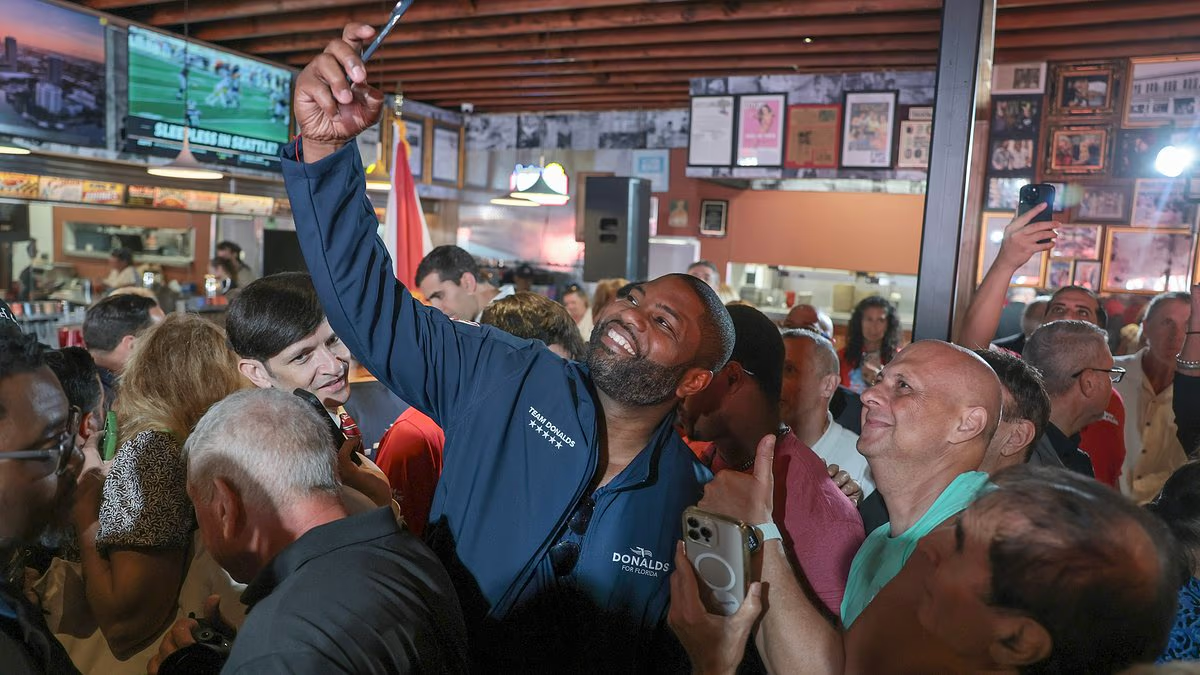

Byron Donalds narrowly won Florida’s governor’s race, making history as the first Black Republican elected governor in the United States.
The 48-year-old congressman edged Democratic nominee David Jolly, a former Republican congressman and attorney, in a contest that remained exceptionally close until the end.
The Associated Press called the race shortly after 9 p.m. Eastern time. With 98 percent of the vote counted, Donalds held 50 percent to Jolly’s 49 percent.
The unexpectedly tight result kept Republicans anxious throughout Tuesday night. Donalds had been expected to win comfortably in a state Donald Trump carried by 13 points just two years earlier.
Despite spending roughly seven times as much as Jolly and raising more than $140 million, Donalds saw his once-secure advantage shrink in the closing weeks as voters focused on the economy, rising prices and the expansion of data centers.
The race to replace term-limited Gov. Ron DeSantis was widely viewed as a referendum on Trump’s influence in his adopted home state, where he is registered to vote in Palm Beach County.
DeSantis remained neutral during the Republican primary, even as his lieutenant governor challenged Donalds. He endorsed Donalds only after the congressman won the nomination.
Trump backed Donalds more than 18 months before Election Day, but the former president’s endorsement may ultimately have become more liability than asset for the Republican nominee.
Voters across the country also expressed frustration with Trump’s policies on Tuesday, helping Democrats pick up seats in both the House and Senate.

Congressman Byron Donalds defeated Democrat David Jolly to become the first Black Republican governor in Florida history

Donalds celebrated his victory at an election-night event alongside his wife, Erika

The couple embraced after Donalds secured his narrow victory
Trump campaigned for Donalds at Florida Gulf Coast University in Fort Myers on October 23 before returning to Daytona Beach on October 30 for a second rally within a week.
Donalds also won the support of DeSantis and Senator Rick Scott, bringing together a Florida Republican Party that had frequently been divided between the governor and the president.
Jolly, who once represented a Tampa Bay congressional district as a Republican, later left the party and emerged as one of Trump’s most vocal critics. He ultimately ran as a Democrat, with former congresswoman Gwen Graham as his running mate.
Jolly captured the Democratic nomination on August 18, the same evening Donalds defeated Lt. Gov. Jay Collins and several other contenders for the Republican nomination.
Former President Barack Obama endorsed Jolly during the final stretch, describing him as “independent minded,” while former President Bill Clinton campaigned for him in South Florida.
Donalds overwhelmed Jolly financially, raising nearly $150 million compared with Jolly’s roughly $22 million. According to OpenSecrets, Donalds entered the final weeks with a $33 million cash advantage.

Democrat David Jolly, right, campaigned with former President Bill Clinton before Election Day

Donalds ran as Donald Trump’s preferred candidate, though the endorsement ultimately proved a burden for his campaign

Florida Republicans closely monitored the count as the candidates remained separated by just over one percentage point
Both candidates made affordability central to their campaigns. Jolly also targeted Donalds over data centers and pledged to halt new construction while the issue was reviewed.
Final polling showed Donalds ahead but vulnerable. A New York Times/Siena survey gave him a 48-to-44 lead, while St. Pete Polls found him ahead 48 to 46.
The margin represented a sharp shift from four years earlier, when DeSantis defeated Charlie Crist by more than 19 percentage points.
By holding the governor’s mansion, Republicans gave Trump a dependable ally to lead the nation’s third-largest state as the party looks toward the 2028 presidential race.
Republicans are expected to cite Florida as evidence that their red-state base held firm even as the national political map moved in Democrats’ favor.
Democrats have not won the Florida governorship since Lawton Chiles in 1994.


