
The Justice Department has launched an accelerated campaign to revoke the citizenship of 40 Americans in just six weeks—an eleventh-hour drive that officials expect to expand substantially in the coming days and weeks.
Attorney General Todd Blanche said the 40 cases filed by the DOJ between August 28 and October 2 amount to the “largest denaturalization effort in modern history.”
The recent surge comes as the department races to file 250 denaturalization cases by the end of October. That would be more than twice the 120 cases brought between President Trump’s return to office on January 20, 2025, and late August.
The ambitious target has raised concerns among immigration attorneys and advocacy groups, who question both the strain on government resources and the strength of some of the cases.
“Under President Trump’s leadership, the Department of Justice will continue to employ the denaturalization process to maintain our national security and protect the American people,” Blanche said Tuesday.
Officials said the people targeted in the latest denaturalization push are accused of crimes across 19 federal districts. They came to the United States from countries including Mexico, China, Iran, Pakistan and the Philippines.
“From an individual convicted of espionage to others convicted of sexual offenses against minors, these defendants concealed critical facts from the U.S. government and represent serious criminal offenders,” Blanche said in a news release.
Many of the cases involve allegations that defendants lied about—or left out—information about their conduct on government forms. The Justice Department argues that those omissions would have made them ineligible for citizenship had the facts been disclosed.

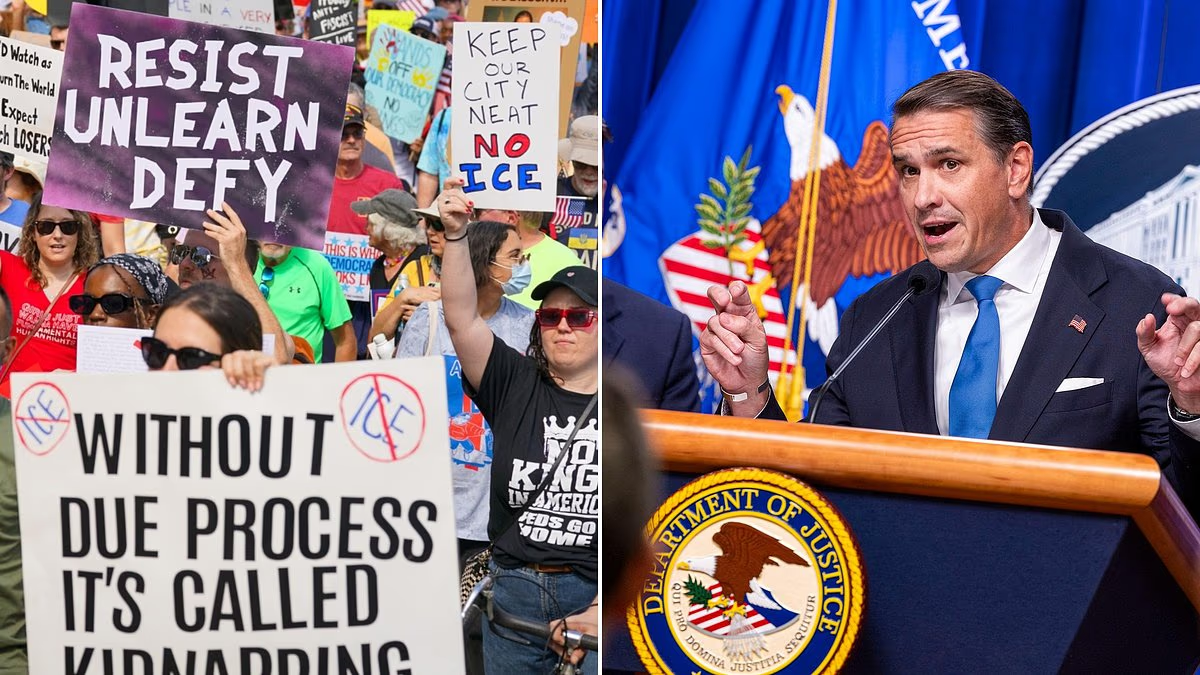
Attorney General Todd Blanche speaks during a press conference at the Department of Justice headquarters

Demonstrators hold protest signs during a march in Atlanta as part of a “No Kings” protest against the Trump administration
It remains unclear whether any of the alleged errors or omissions were accidental, or how many may have been unintentional.
The speed of the campaign—and the scale of its goal—has nevertheless alarmed immigration lawyers and advocates. They fear some of the people involved may not receive a meaningful opportunity to present their cases in court.
The administration’s efforts already far exceed the pace set by previous presidents.
According to Migration Policy Institute data, the Justice Department filed an average of only 11 denaturalization cases per year between 1990 and 2017.
By comparison, the Biden administration filed just 24 denaturalization cases over four years.
“The Trump administration’s second-term approach on denaturalization aligns with much of the rest of its immigration policy agenda: more enforcement, less legal immigration, and harder-to-access citizenship,” Migration Policy Institute analysts Muzaffar Chishti and Colleen Putzel-Kavanaugh wrote in a report.
The analysts also said the administration’s more immediate objective could be to create a climate of fear, particularly because denaturalization proceedings can take years to resolve.
“Creating a climate of hostility is much more achievable than large-scale denaturalizations, as history has shown,” they wrote.
Since taking office last year, President Trump and his administration have made an expansive immigration crackdown a central priority.
So far, the administration has revoked hundreds of thousands of visas held by migrants and green card holders authorized to live and work temporarily in the United States. It has also ended so-called Temporary Protected Status, or TPS, designations for most countries.
rump has also sought to end so-called ‘birthright citizenship’ protections for babies born on US soil via multiple executive orders, despite Supreme Court’s rejection of the effort earlier this year.
His agenda has faced continued push back.
Earlier this week, a federal judge in Boston blocked the Trump administration from imposing ‘astronomical’ fines up to $1.8 million on illegal migrants who fail to leave the US after receiving final deportation orders.
US District Judge George O’Toole, a Bill Clinton appointee, called Trump’s fines – issued to tens of thousands of migrants – unlawful in an order on Monday.

Protesters demonstrate against Trump’s immigration policies in New York Ciry

The fines are part of the president’s hard-line immigration crackdown, and the administration’s broader push for migrants to ‘self-deport’
The fines included maximum penalties of $1.8 million, which would push the migrants into financial ruin, he said.
The judge called Trump’s fines ‘exorbitant’ and said they would hurt migrants, who already ‘live in an economically precarious position.’
DHS did not immediately respond to Our News Outlet’s request for comment. A spokesperson said DOJ is ‘reviewing’ the decision.
The fines are part of the president’s hard-line immigration crackdown, and the administration’s broader push for migrants to ‘self-deport.’
As part of the effort, DHS sent notices last July to thousands of migrants who had final deportation orders.
It notified them of the new financial penalties – which included daily fines of $998 – and gave them just 30 days to contest them.

Then-CBP acting commander Gregory Bovino exits a convenience store of a gas station while conducting an immigration raid in Kenner, Louisiana
The plan also allowed DHS to retroactively impose fines on migrants for a period of up to five years, for a maximum of $1.8 million.
DHS said earlier this year that it had issued more than 100,000 such fines to migrants in the US, bringing the total amount of civil fines to a whopping $84 billion.
A group of migrants brought a class action lawsuit against DHS last November to challenge the fines.
Lawyers for the group argued that the fines violate the Administrative Procedure Act as well as the Fifth Amendment’s Due Process Clause and other protections under the US Constitution.