
As Donald Trump considered launching a new and more punishing attack on Iran, his senior military adviser was privately raising alarms about whether the Pentagon could adequately shield US forces in the region.
Trump said last week that he was prepared to intensify the conflict with Iran, although he suggested Friday, during remarks before the White House Correspondents’ Association, that reaching an agreement would be the wiser course.
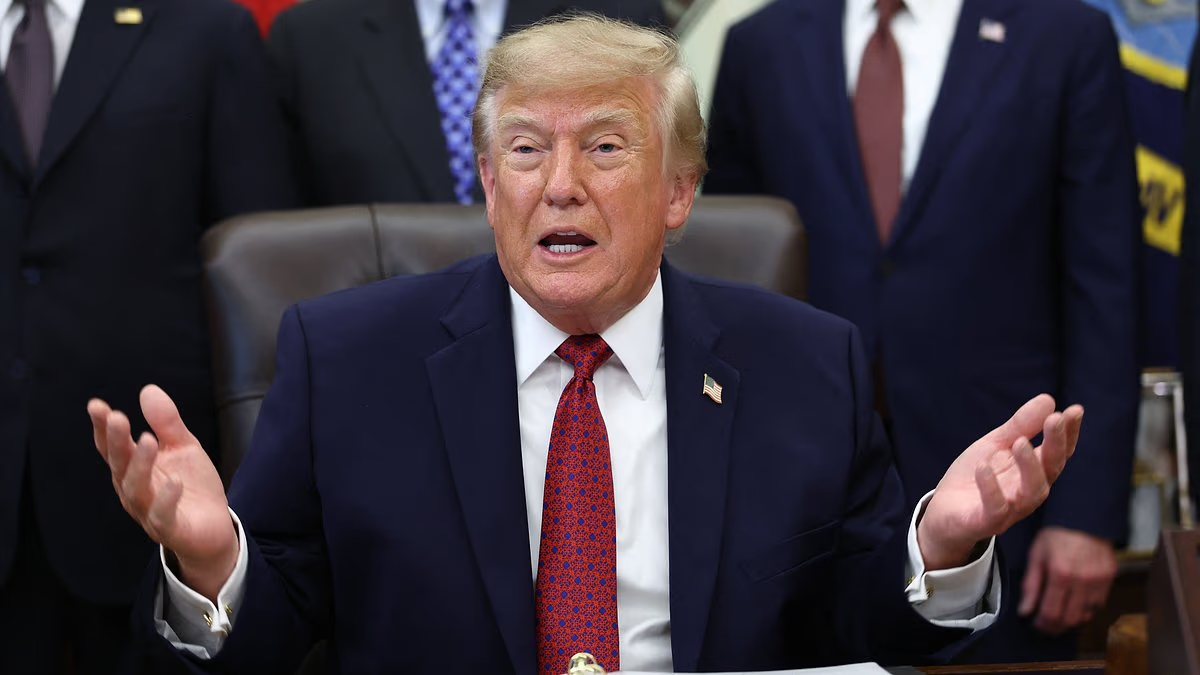
‘There’s a military exit where we just keep going just the way we are, and we can even make it a heavier dose, and it’s knocking out everything they have,’ Trump said Friday.
‘Or there’s a smarter strategy that you make a deal. And they want to make a deal.’
One factor that may have shaped his emphasis on diplomacy was the concern of his top military adviser, Joint Chiefs Chairman General Dan Caine. Officials told the New York Times that Caine viewed the limited stockpiles of air defense interceptors in the Middle East as an added danger if the confrontation continued.
Caine has informed Trump that key military resources in the region are running low, the officials said.
Even as the president reviewed the possibility of a broader military campaign, his top commander in the Middle East, Central Command chief Admiral Brad Cooper, reportedly drew up a range of potential options, including one operation that could have stretched 10 to 14 days.
The United States soon moved additional military assets into the Middle East.

Chairman of the Joint Chiefs of Staff General Dan Caine has reportedly expressed concern over the US resuming full strikes against Iran, given the low supply of US air defense missiles

US air defense systems have been critical to defending US military assets and allies in the Gulf region amid the war. Systems like the Terminal High Altitude Area Defense (THAAD) missile system shown above are crucial in shooting down incoming Iranian drones and projectiles. US officials have expressed concern that their interceptors, and those of other systems, are in low supply

Caine (right) listens as Trump gives an update on the war in April
But Trump’s inner circle held concerns about escalating the war – specifically about whether increased bombing campaigns would prompt the Iranians to return to negotiations.
Some even believed that renewed strikes would have the opposite effect and coalesce a fractured Iranian regime.
Over 600 US service members have been injured since the war began in February, with 18 dead, according to the Pentagon.
Over 3,400 people in Iran have been killed by US-Israeli strikes since February 28, the nation’s Ministry of Health reported last month. Over 26,500 have been injured, according to the ministry.
Though Trump said he was locked and loaded for a big attack against Iran, he appeared to have a change of heart after a Friday military meeting, the Times reports.
At that session, the President was advised of dwindling interceptor supplies for defending US forces across the UAE, Kuwait, Bahrain and Jordan.
US forces were targeted earlier this month in Jordan, leading to three deaths after Muwaffaq Salti Air Base came under an Iranian drone attack.
Officials have said that Iranian military operators have employed new drone tactics to get through US air defenses.
The Times reported in late April that US forces had expended 1,200 Patriot missile interceptors during the Iran war. The interceptors, which cost $4 million each, were in low supply at the time.

Soldiers for the Islamic Revolutionary Guard Corps march in a military parade

US forces have resumed a blockade against Iranian exports and have struck ships alleged to be carrying goods to or from the Islamic Republic
Military officials and experts have long expressed concern about the President’s ability to wage a prolonged conflict if the critical air defenses are in low supply and therefore troops are exposed to increased threats.
Meanwhile, the White House and Trump have maintained that the US military has everything it needs to wage war against Tehran.
The US paused its two-week strike campaign against Iran over the weekend after Trump repeatedly stressed how some Iranian officials want to make a deal after the recent hostilities.
Israel has so far held back on striking Iran since Trump requested that the country refrain from hostilities in late June.
A revised US-Israeli approach to the war may be hashed out this week after Israeli Prime Minister Benjamin Netanyahu and Trump meet in Washington.
The Israeli PM is expected to meet with Trump on Tuesday when Netanyahu is in town for the funeral for Senator Lindsey Graham.
‘I am going to talk to Bibi about the fact that if I weren’t president, Iran would have had nuclear weapons by now and Israel would have been destroyed,’ Trump told Axios of his planned conversation with the Israeli leader.
He also told the outlet that he is not afraid to resume strikes if negotiations fall through once more.
‘We are in very deep talks with Iran. If they don’t work out, we will go back to very strong military action.’