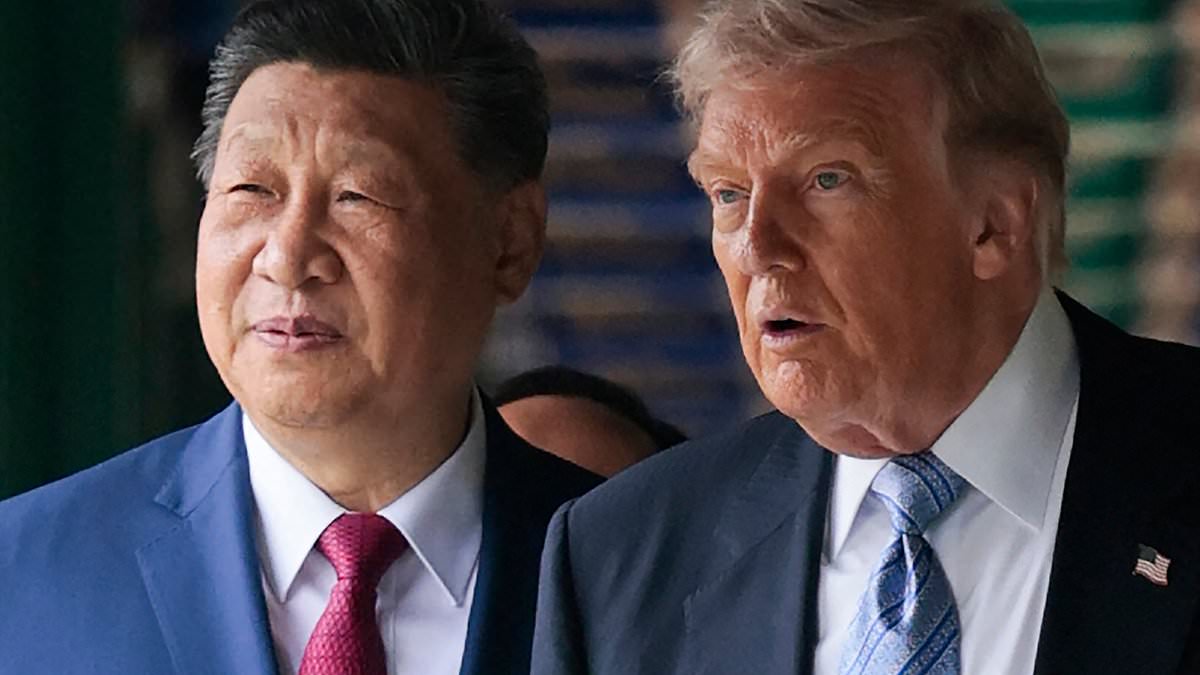

Before concluding his visit to China, Donald Trump received a parting gesture of hospitality from Xi Jinping, who escorted him through the exclusive imperial gardens of his lavish residence.
The two leaders strolled through Zhongnanhai, a heavily secured enclave where China’s top officials both live and work. Photographers documented the moment as Xi led Trump by the hand through a historic archway, revealing a grove of ancient trees that have stood for over 300 years.
During the tour, as Xi described the unique way some of the trees had intertwined over time, Trump interrupted with a direct question.
Turning to his interpreter, Trump asked, “Can you ask the President if he brings other presidents or prime ministers from different countries here?”
With a lighthearted laugh, Xi responded, “Very rarely. For example, Putin has visited here.”
Concluding the tour, Trump took a moment in front of the media to express his admiration for the Chinese leader’s impressive compound, commenting, “I could get used to this.”
The viral moment was one of the few unscripted interactions between Xi and Trump at the high-stakes summit.
Hours later, before boarding Air Force One, Trump’s team dumped gifts and items collected during the trip, a standard precaution against listening devices and other intelligence threats.
As Xi explained how some of the trees had merged together, Trump stopped the tour with a blunt question
President Donald Trump walks with China’s President Xi Jinping at the Zhongnanhai leadership compound, Friday
‘Can you ask the President: when other presidents or prime ministers from other countries visit, does he bring them here?’ Trump said, turning to his translator
Trump’s team dumped the Chinese gifts and items collected during the trip, a standard precaution against listening devices and other intelligence threats
After sitting down for afternoon tea, Xi spoke through a translator and explained why he had invited Trump to Zhongnanhai, a rare invite to outside leaders.
‘I have chosen this place especially to reciprocate the hospitality extended to me in 2017 at Mar-a-Lago,’ Xi said.
Trump smiled and thanked the Chinese leader for the rare invitation.
Trump has faced criticism throughout the summit for showering personal praise on Xi, the authoritarian leader of America’s most formidable rival.
In his opening remarks at the Great Hall of the People, Trump called Xi a ‘great leader’ and said it was an honor to be his friend.
The President went on to predict that the US-China relationship would be ‘better than ever before.’
In a Fox News interview with Sean Hannity, Trump also complimented Xi’s physical appearance by calling him ‘very tall’ and claiming Hollywood couldn’t have cast a better-looking leader of China.
The high-stakes summit gave the two leaders a chance to confront the most consequential issues between their countries: the rise of AI, China’s designs on Taiwan, and the war in Iran.
Donald Trump and Chinese President Xi Jinping tour Zhongnanhai Garden on May 15, 2026 in Beijing
Trump (R) gestures as he poses for photos with China’s President Xi Jinping during a visit to Zhongnanhai Garden in Beijing
Trump (R) shakes hands with China’s President Xi Jinping as he leaves after a visit to Zhongnanhai Garden

Trump speaks with Chinese President Xi Jinping while leaving after a visit to the Zhongnanhai Garden in Beijing, China
China is one of Iran’s closest allies and the largest buyer of Iranian oil.
Xi had previously condemned Trump’s naval blockade of the Strait of Hormuz, the chokepoint that carries one-fifth of the world’s oil.
Near the end of the summit, Trump said Xi had vowed not to supply military equipment to Iran as ceasefire efforts remained stalled, but he wouldn’t say whether China had agreed to help broker an end to the conflict.
‘He said he’s not going to give military equipment, that’s a big statement,’ Trump told Hannity on Thursday. ‘He said that strongly.’
Xi struck a sharper tone on Taiwan, warning Trump that the two countries will have ‘clashes and even conflicts’ if the issue is mishandled.
He called the island the most important matter between Washington and Beijing and claimed that it could jeopardize the entire relationship.