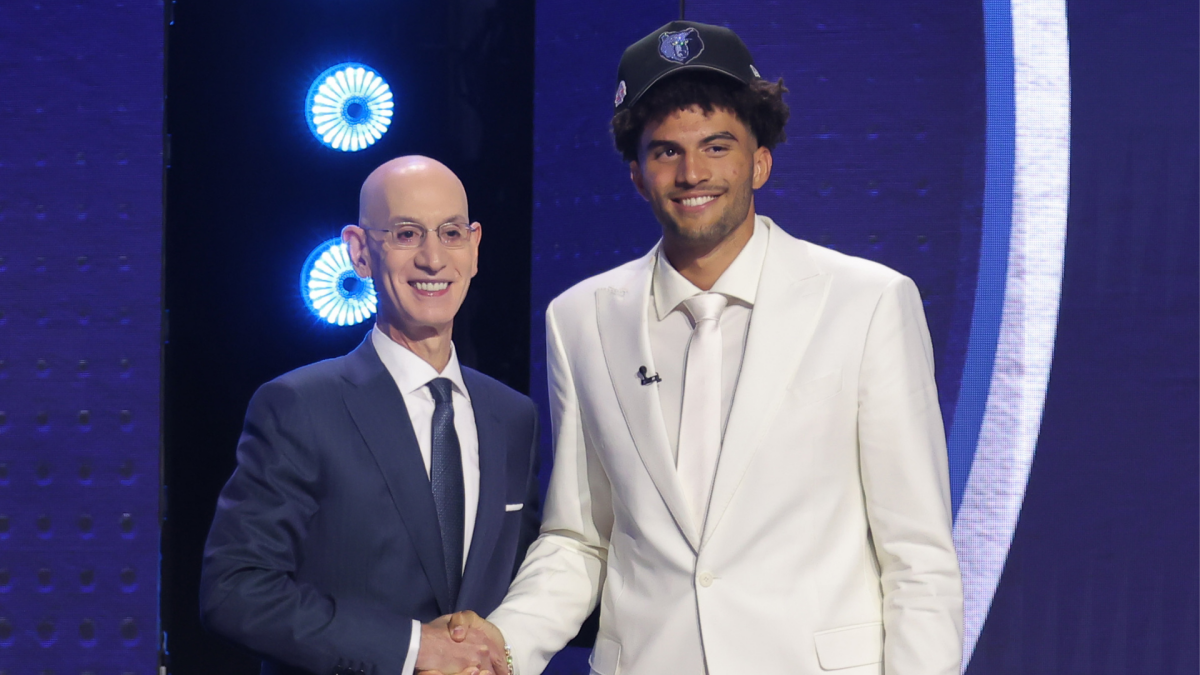

The 2026 NBA Draft is officially complete, with 60 players hearing their names called in Brooklyn earlier this week. It was a class rich in talent but short on major twists, especially at the very top. AJ Dybantsa went first overall to the Wizards, Darryn Peterson followed at No. 2 to the Jazz, while Cameron Boozer and Caleb Wilson completed the top four with the Grizzlies and Bulls, respectively. The next stretch of the top 10 featured a run on guards, before three members of Michigan’s national title team came off the board later in the lottery.
With the league’s newest prospects now matched with their first NBA homes, the next question is already taking shape: who will emerge as the 2026-27 NBA Rookie of the Year? At this stage, that race may be even harder to forecast than the draft order itself.
2026 NBA Draft grades: Full analysis of every pick, from AJ Dybantsa, Darryn Peterson and Cameron Boozer through No. 60
Adam Finkelstein
Boozer enters as the early favorite, largely because he should step into a major role right away in Memphis. Dybantsa and Peterson are also expected to receive plenty of opportunities with rebuilding teams in Washington and Utah. Darius Acuff Jr., selected seventh overall by the Kings, is another name drawing notable attention in the early odds.
NBA Rookie of the Year odds
Via FanDuel as of June 25
Below, CBS Sports’ experts offer their early Rookie of the Year predictions and break down the reasoning behind each pick.
Too-early Rookie of the Year predictions
AJ Dybantsa will reap the benefits of playing for a team that also includes veteran All-Stars Trae Young and Anthony Davis. While it’s certainly possible that he won’t be Washington’s leading scorer as a rookie, he also won’t be the focal point of opposing scouting reports. That will help Dybantsa’s efficiency and allow him to shine as the complete player that he is. There is a reason Dybantsa went No. 1 overall. His combination of size, athleticism, skill and versatility makes him a great bet for 2027 NBA Rookie of the Year.
: While I think Boozer has the pathway to being the most impactful of these rookies in the shortest period of time, the Rookie of the Year award usually comes down to stats. I expect Dybantsa will lead all rookies in scoring, even though he’ll have to share the ball with Trae Young and Anthony Davis (if and when they are healthy). Dybantsa is the most natural scorer in the class. It’s what he does best on the basketball floor. I expect there might be an adjustment period, like there was to start the season at BYU, but he’s going to put up numbers sooner rather than later. Of course, Young will play a key part in this and we have to assume that there were candid conversations had before Washington signed him to that contract. The pace with which Dybantsa can grow into a star in the NBA is likely going to be correlated to Young’s willingness to get off the ball and be content to use his own gravity to create opportunities for his new rookie.
This draft class is overloaded with talent, but talent alone doesn’t win you ROY. Opportunity and role matter just as much. AJ Dybantsa plays for a Wizards team that has designs (possibly fanciful) on making noise in the playoffs. That situation doesn’t seem to lend itself to a rookie being the star of the show and posting outsized numbers. Same with Darryn Peterson, who by all accounts is a bucket but will have to share the backcourt with Keyonte George, not to mention being lower in the pecking order than Jaren Jackson Jr. and Lauri Markkanen on a Jazz team that wants to compete in the West. Compare that to Boozer, who will immediately become the center of attention in Memphis. Whether the Grizzlies find a taker for Ja Morant or not, Boozer is the new face of the franchise. That should come complete with a big usage rate and the attendant supersized counting stats that ROY voters love.
2026 NBA Draft team grades: Report cards for all 30 teams after Round 2
Cameron Salerno
: I’ll join the majority in picking Boozer here. The argument against Boozer among the top 3 in this Draft was that his long-term ceiling wasn’t as high as Dybantsa and Peterson. However, right now he’s the most NBA-ready to go out and produce at a high level immediately — and will be given every opportunity to do so. It wouldn’t be shocking if he averages 20/10 as a rookie (like he did at Duke) and it’s hard to imagine any of the other rookies in this class beating out that production. Rookie of the Year is the award where team success matters the least to voters. We saw this past year with the Cooper Flagg/Kon Kneuppel battle that, ultimately, the guy producing the most wins out over efficiency or contributions to a winner.
Is Dybantsa immediately going to be the first option on a team with Trae Young and Anthony Davis? No, but the Wizards didn’t draft him No. 1 to have him sit in the corner all night. He’s going to get plenty of opportunities to run the show, and playing alongside Young and Davis should make it easier for him when he does. Also, given their respective health histories, it is unfortunately likely that one or both of them will miss some time, which would increase Dybantsa’s usage rate. Ultimately, though, I’m picking Dybantsa because I believe he is the best player in this incredible class, and his talent will shine through.
The No. 3 overall pick is the most pro-ready prospect in this class, but he’s also the one joining the most statistically advantageous situation. AJ Dybantsa is joining a team currently built around two stars who need the ball in Anthony Davis and Trae Young, and Darryn Peterson is joining a team that harbors really playoff ambitions in Utah. There were even some rumors that Peterson hoped to miss the Jazz so as to avoid sharing the ball with their other top young guard, Keyonte George. But Boozer is going to walk into Memphis as the No. 1 option offensively. While young players like Cedric Coward and Zach Edey have shown a lot of promise, Boozer is the unquestioned franchise player for the Grizzlies. This tends to be a statistical award first and foremost, so if Boozer averages 20 points and 10 rebounds, he’s going to be very hard to beat in the Rookie of the Year race.
Acuff is walking into a situation with the Kings in which he will likely be handed the keys to the offense almost immediately. That’s not the case for almost every rookie picked in the lottery. Acuff was an offensive engine at Arkansas and will be given the opportunity to carve out a similar role in Sacramento. I’m tempted to go chalk and take Cam Boozer for ROY because of how productive he was last season at Duke. He also has a game that will translate immediately to the NBA. Still, Acuff will be given the freedom to run the offense and put up numbers every night. It wouldn’t be surprising to see him average 20/5 as a rookie.
2026 NBA Draft winners and losers: Mavericks fail to help Cooper Flagg with low-upside Morez Johnson Jr. pick
Jack Maloney

The historical data hints that you have to be a top-three option on your team to win Rookie of the Year. After scanning the updated depth charts, there are only eight qualifiers on paper at this point: Cameron Boozer, Darryn Peterson, AJ Dybantsa, Darius Acuff Jr., Mikel Brown Jr., Brayden Burries, Keaton Wagler or Caleb Wilson.
But context is vital for an award that leans heavily on counting stats. Dybantsa is ceding shots to Trae Young and Anthony Davis. Peterson has to coalesce with Keyonte George, Jaren Jackson Jr. and Lauri Markkanen. Zach LaVine is primed to take far more shots than Darius Acuff Jr. next season. Mikel Brown Jr. is currently slated to play next to Michael Porter Jr. and Julius Randle.
Boozer and Wilson are the only two rookies who look like the potential No. 1 option. Boozer remains the logical choice because his offensive game is ahead of Wilson’s at this point. Memphis is going to build its entire offense around Boozer. The inverted pick-and-rolls with the Duke star and gargantuan center Zach Edey will be a sight to behold. With huge minutes and the largest usage rate heading his direction, Boozer is primed to produce.