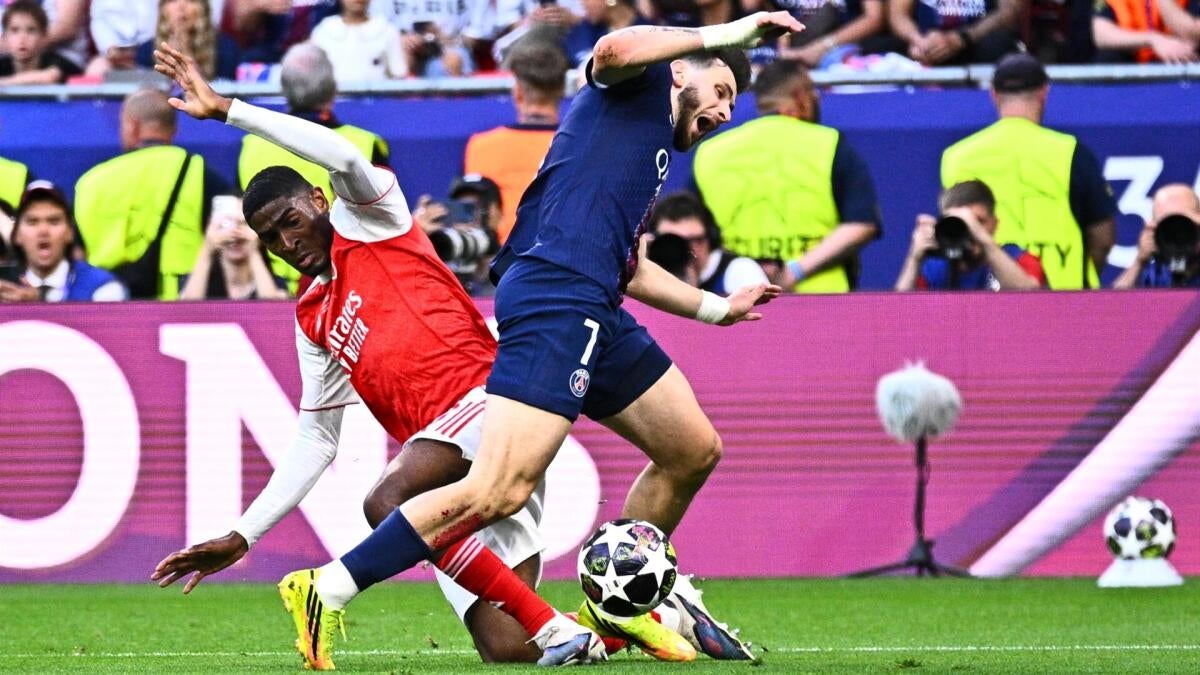

BUDAPEST — Imagine a scenario where Cristhian Mosquera had kept his composure, where Khvicha Kvaratskhelia and Ousmane Dembele, so often in sync, had missed that connection for once. What if the pass had been just a touch off, or Mosquera had managed to deflect it? Instead, Mosquera’s misstep at the 64th minute resulted in a penalty that leveled the score, paving the way for PSG’s eventual victory in the shootout.
This is the question that will linger for Arsenal. Perhaps not indefinitely, since a team of their caliber, with strong organizational structure and market savvy, is likely to return to the grand stage in Madrid in 2027 or Munich in 2028. Arsenal has shown they have the resolve to persevere. However, the harsh reality is that they might not have needed to. Bukayo Saka was spot on when he remarked that the game hinged on moments. There was indeed one pivotal moment for Paris Saint-Germain to counterbalance Arsenal’s.
Was it possible for Arsenal to protect the lead Kai Havertz had earned them so spectacularly? Throughout the 90 minutes, nothing suggested they couldn’t. There were fleeting moments of anxiety—Kvaratskhelia escaping William Saliba, only to falter under pressure and watch his shot ricochet off the post courtesy of Myles Lewis-Skelly. Then, a late surge for a victory in regulation, with Bradley Barcola poised to capitalize on a counter. That, essentially, was the extent of the drama.
Arsenal came tantalizingly close to flawless execution. When they held firm, PSG found no way through. Europe’s most formidable attacking unit was rendered almost ineffective, akin to Burnley in their struggles. That’s a bit hyperbolic, though, given Burnley managed a 1.29 non-penalty expected goals in their recent visit to Emirates Stadium. In contrast, PSG, excluding the Dembele penalty, managed just 0.84 xG over 90 minutes—a rare low for them, only seen in two Ligue 1 matches this season.
CBS Sports
While Arsenal’s expected goals weren’t remarkably high either, Mikel Arteta’s strategy didn’t require his team to relentlessly chase the game. The tactical graphs underscore Arsenal’s discipline rather than the level of their performance. They had one clear mission: to win the Champions League, and they came agonizingly close. It’s not their responsibility to entertain the neutral spectators, though anyone unable to appreciate Arsenal’s meticulous and fierce play might need to reassess their understanding of the game. Ultimately, this contest was a balanced affair that could only be resolved from the penalty spot.
Arteta knew his team had given everything.
“What I said to the players and the staff is that if I tell them thank you a million times, it won’t be enough,” he said. “It’s not because we won the Premier League. It’s not because we played the cup final, because we played the Champions League final in the manner we did. It’s because of the joy and the moments we have lived together, every single day. That’s above anything else.”
Still, they were so close to the best of those days. And maybe closer than many expected. The natural inclination for anyone looking at a game like this is to unleash something along the lines of a combined XI brain. PSG had comfortably the better attack, two-thirds of a superior midfield and fullbacks you’d die for. Why wouldn’t they win this? Well, because this game isn’t attack vs. attack. It’s attack vs. defense. And football history has, at most, a handful of defenses that have sustained Arsenal’s level for this long.
Their rearguard was brilliant. Gabriel was his customary self whenever PSG got the ball in the box, and for a long time, that was an infrequent event. Flying into challenges with the ferocity that so entranced this club six years ago, but that aggression now wholly focused on the ball. Whenever his teammates needed him, he stepped up, dropped back, or hurled himself into the line of fire. He is the Arsenal project writ large: shrewd recruitment, exceptional player development, incredible at set pieces, and a ferocious competitor to the last.
It could not have been crueller that he was the one to miss the decisive penalty, just as it felt brutal that Mosquera should concede the penalty. There was no disputing that he had made a calamitous error; it was just that for so much of the hour that preceded his tackle, Arsenal’s third-choice right back had been infuriating, arguably the best player in this season’s Champions League.
Luis Enrique cements legacy as PSG wins back-to-back Champions League titles
Chuck Booth
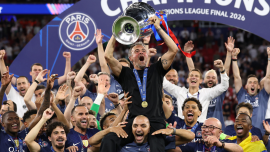
Time and time again, Kvaratskhelia looked for space and found that Mosquera, dropping deep and wide, was only prepared to cede the areas he wanted. If the Georgian wanted to drive to the byline and lob a cross in, he could be Arsenal’s guest. When he did try to drive into the box, he hit a wall. No way around it either, with Saka dropping back to help out. The same was true on the opposite flank, where Leandro Trossard and Piero Hincapie had Desire Doue locked up. This was not even the A team at the back, either. Riccardo Calafiori had been banged up in the week and, despite Arteta’s insistence to the contrary on Friday, Jurrien Timber had not been fit enough to start at right back.
Then again, this was more than just a back four effort. For an hour, Martin Odegaard struggled to get the possession he needed, but his work without the ball was exceptional. As something of the line backer of this Arsenal rearguard, it looked like he was calling out PSG’s deep passes before they came, easing the defensive line from one side to another, gumming up progression lines that went through Vitinha. Havertz too did yeoman’s work with and without the ball.
Should Arsenal have offered more to add to the goal he fired high over Matvey Safonov? Certainly. It is natural that they wanted to go over the PSG man-to-man press at every opportunity, but David Raya going long with 35 of his 37 passes was comfortably in the realms of perverse. Too often, any opportunity to build possession died because Havertz could not win the aerial duel, hold the ball up and bring his teammates into play all at once. When the openings came for Saka late in the second half, he just couldn’t find the guile to get a good shot away.
As was the case last year, the solution to what ails Arsenal when they are beaten by the best teams, they just need a few more of the game-breaking attackers that the other guys have. What this team could do with a Kvaratskhelia of their own. What they did to him, too.
Arsenal, champions of England, a club who have restored hope to a bereft fanbase, really did give themselves an almighty shot at immortality. They demanded perfection of themselves, just as they knew PSG would of them. How close they came.


