
For one afternoon, Paul Scholes and Phil Neville took charge of Salford City, bringing a touch of celebrity to the stark surroundings of a Northern Premier League Division One North match. The fixture was played in a bitter January chill in front of only a few hundred fans.
The club’s incoming managers, a partnership recruited from nearby Ramsbottom United, watched the Salford players from behind one of the goals. After the final whistle, Neville walked over and invited them to say a few words inside the dressing room — or, more precisely, the portacabin — as an introduction.
‘It was dark at full time,’ recalls co-manager Anthony Johnson. ‘I’m not exaggerating. I opened the door and there were cameras and lights everywhere. Nobody had told us there was going to be a documentary.
‘The lights came on and I thought, “S***, I’m under the spotlight here.” There was no training for it and nobody sat us down to explain how it worked.’
Broadcast in a primetime slot on BBC One, Salford’s Class of ’92 initially focused on the Manchester United legends who owned the club. Before long, however, the documentary became just as much about the loud, charismatic personalities of Johnson and Bernard Morley, charting their three promotions through non-League football from 2015 onwards.
Salford remains the smallest club to have been placed at the centre of this kind of sporting storytelling. Today, such documentaries have become a familiar vehicle for the country’s biggest teams.

Co-managers Anthony Johnson (left) and Bernard Morley became the unexpected stars of a BBC documentary about the Class of 92’s ownership of Salford City

The fame of (from left) Paul Scholes, Nicky Butt, Ryan Giggs and Phil Neville contrasted sharply with Salford’s modest facilities
Amazon’s cameras followed Manchester City during their title-winning 2017-18 campaign and later worked with the club to document the closing chapter of Pep Guardiola’s reign.
This season, the crew is across Manchester, amid Manchester United’s worst start to a campaign since the 1980s. Against a backdrop of infighting, public disputes, Michael Carrick’s dismissal and Mauricio Pochettino’s appointment, the streaming platform could emerge as the biggest beneficiary of an astonishingly miserable three months at Old Trafford.
The image of camera operators rushing out of a press conference with Carrick, boom microphone raised, only weeks before his departure offered a vivid illustration of the extra pressure managers can face when commercial ambitions become impossible for executives to resist.
‘You can’t be yourself,’ says Simon Grayson, who managed Sunderland at the beginning of Netflix’s Sunderland ‘Til I Die. The first series ended with the club relegated from the Championship during the 2017-18 season. ‘You never forgot the cameras were there.’
Like Johnson, Grayson had not known the documentary was being planned. David Moyes rejected the concept the previous year while Sunderland manager, as Ruben Amorim would later do at United in 2025.
Grayson refused Netflix access to what he called ‘the inner sanctum’, instead supplying footage of training from a distance. At Wrexham, manager Phil Parkinson has been able to determine where and when crews can film across the 57 episodes of Welcome to Wrexham.
‘I’m a private person,’ Grayson says. ‘I don’t like people seeing what I’m doing. There were times when they tried to push beyond the limits, so you had to restrict where the cameras could go.
‘Even the players said they were nervous and felt it was intrusive. Aiden McGeady told me he was deeply uncomfortable with it, and the rest of the dressing room felt the same.’

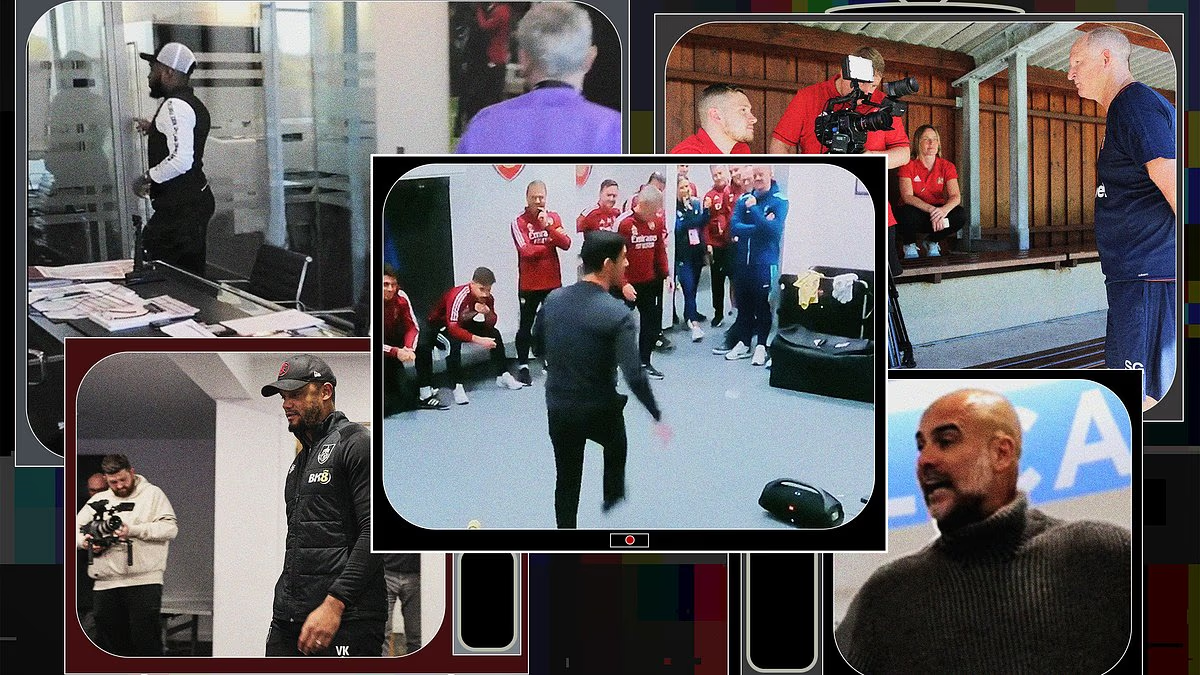
Vincent Kompany was unhappy with being portrayed as a hot-headed figure during his time as Burnley manager

Pep Guardiola gradually accepted the Manchester City filmmakers after they learned where to stand in the dressing room without becoming a distraction
Guardiola ultimately embraced the cameras, but only after making clear that filming could not turn the club into a circus. Amazon’s 2018 production contained little dressing-room material; the main exception was his infamous half-time tirade during a tempestuous FA Cup defeat at Wigan. That changed once City integrated its own production staff into the project.
According to sources, the adjustment took about a year. Camera operators had to learn where they could position themselves without disrupting the players or physically getting in the way.
City have now featured in five documentaries over six years, and Guardiola became so comfortable with the producers that they were treated almost like members of the backroom team. On away trips, they even took on occasional kit-man duties. When he said goodbye last May, Guardiola sent them personal audio messages thanking them for their work.
He also used the production team to assemble montages for pre-match speeches and asked them to film players in slow motion so he could study the movement of those returning from injury. That level of access was possible because the cameras had become part of the club’s everyday environment.
Critics may argue that an in-house production team produces a more sanitised final product. City, however, would point to Guardiola’s emotional breakdowns in A Beautiful Obsession, the account of his final season at the club, as evidence that the footage remained raw and unfiltered.
The format is also shifting towards documentaries released during a season, with regular episodes arriving as events unfold rather than an entire series being published at the end. The approach mirrors the success of similar NFL productions, and A Beautiful Obsession co-director John De Caux believes full-season documentaries are ‘slightly on the wane’.
‘The camera staff kept changing,’ Johnson says of Salford’s annual series during his time in charge. ‘We were losing at half-time in one match and I make no apology for coming in and saying, “Move out of the f***ing way.” In previous seasons, they would have known not to stand there.
‘You found yourself repeating the same conversations. I thought, “Hang on, I’ve already had this discussion.” The people who had worked on earlier seasons understood it, and they had the footage to refer to. Do your homework, just as we all have to in our jobs. At times, it felt a little disrespectful.’

Tottenham’s All or Nothing is remembered for the extraordinary exchange between Danny Rose and Jose Mourinho, filmed without the left back realising the cameras were running

Former Sunderland manager Simon Grayson was unaware that a Netflix documentary was being planned and refused producers access to his inner sanctum
Those are the obstacles Amazon faces at United as it tries to build trust and establish relationships within only a few months before packing up and leaving. The production crew will inevitably be viewed as outsiders.
There is considerable curiosity within the industry about how closely Amazon will document the turmoil at United and whether it will use fly-on-the-wall filming, as it did with Arsenal during 2021-22 and Tottenham in 2019-20.
The Spurs All or Nothing series remains notable for its extraordinary confrontation between Danny Rose and Jose Mourinho, during which the full-back did not realise the cameras were recording.
Mourinho’s predecessor, Pochettino, took a very different approach. Sacked by Tottenham in November 2019, he barred cameras from his office and was never enthusiastic about the documentary. He barely appears in the series, with his dismissal arriving in the opening episode — perhaps an indication that the filmmakers gained little from him.
It will be intriguing to discover whether Pochettino allows cameras into his inner sanctum at United.
Because of the streaming agreement, United have had to double their media commitments this season. The club has nevertheless been reluctant to arrange sit-down interviews with players, telling Amazon that the production team must develop those relationships independently.
Some clubs have even handed over access without charge. Sky Sports, for example, took two seasons of Mission to Burnley without paying. The motivation is often promotional: clubs want to strengthen their brands. Under Alan Pace, Burnley now face the possibility of relegation to League One.
Vincent Kompany, who was Burnley manager at the time, is understood to have been frustrated by his depiction as a furious screamer. Brendan Rodgers is unlikely to have been thrilled by Being: Liverpool, which ended with him being publicly mocked and compared with David Brent. Players at other clubs have privately admitted hiding from the cameras.

‘You can’t be yourself — you never forget the cameras are there,’ Grayson says of his time filming Sunderland ‘Til I Die

Salford co-manager Anthony Johnson delivers a dressing-down to his players in the BBC documentary
Joey Barton is still waiting for his own documentary to reach the screen — and may be waiting for a long time yet. Fleetwood Town commissioned a production charting his early managerial career, with streaming giant Dazn acquiring the rights.
The programme came close to broadcast. Fleetwood even staged a premiere at Highbury Stadium for 100 guests, including the local mayor. But one of Barton’s encounters with law enforcement in the days that followed led to the release being suspended. Lengthy legal proceedings eventually killed off the project, while Dazn’s licensing period expired.
The documentary was later revived, partly to cover the fraud trial of then-Fleetwood owner Andy Pilley. A crew followed him into court on the first day, but the project was shelved again after he was found guilty. Meanwhile, cameras continue to track clubs throughout the EFL, from Birmingham and Cambridge to Sheffield Wednesday.
Grayson, meanwhile, refused to let the crew film his drive home from training. He now suspects that the unflattering edit he received may have been partly because he did not give the production company the access and material it wanted.
‘I gave a presentation to the players using a flip chart, and everyone assumed it had taken place an hour before a league match,’ he says. ‘In reality, it was at 11.30am before a pre-season game.
‘That was the reason I allowed them to film it. It was a friendly and had no real significance. But the documentary presented it as though it had happened before the opening game of the season.
‘As part of my severance agreement after being sacked, I still had to do some work for them. I recorded three separate, staged interviews in a London hotel, wearing different shirts, as if they had been filmed at the time.
‘People told me, “You didn’t seem very passionate about the club.” Why would I have been? I was filming in November, after I had already been sacked. One interview discussed transfer deadline day, even though I had already recorded something about that in August.
‘I think they felt some sympathy for me, but if they had really sympathised, they would not have asked me to do it. I’ve spoken to managers since and they’ve said, “F***ing hell, you did well to put up with that.”’
Grayson watched only four episodes of the series and has heard that his successor, Chris Coleman, was also portrayed unfairly.

Fabian Delph leads Manchester City’s inquest after the FA Cup defeat at Wigan — the only dressing-room scene included in Amazon’s documentary on the 2017-18 season

Mauricio Pochettino barred cameras from his office during his final days at Tottenham. Will he take the same stance at Manchester United?
By his own account, Johnson found the experience more enjoyable than Grayson did. One former Salford player claimed that almost nothing was removed from the series apart from a fight during a team-bonding night out. It was candid, chaotic and largely unfiltered.
That changed when Johnson and Morley’s time at the club came to an end.
‘We won the league and still ended up being sacked,’ Johnson says. ‘We went to meet Gary (Neville) and the board at Hotel Football, and a cameraman followed us upstairs. Clearly, they knew what was happening. But when we reached the meeting room, they would not allow the camera inside.
‘It still makes me smile. The documentary had followed Bern and me everywhere — eating, travelling, whatever we were doing — but when the day came to sack us, they suddenly did not want the camera in the room.
‘The conversation itself was fine, but I imagine the view from outside would have been: “What the f*** is that all about?”’


