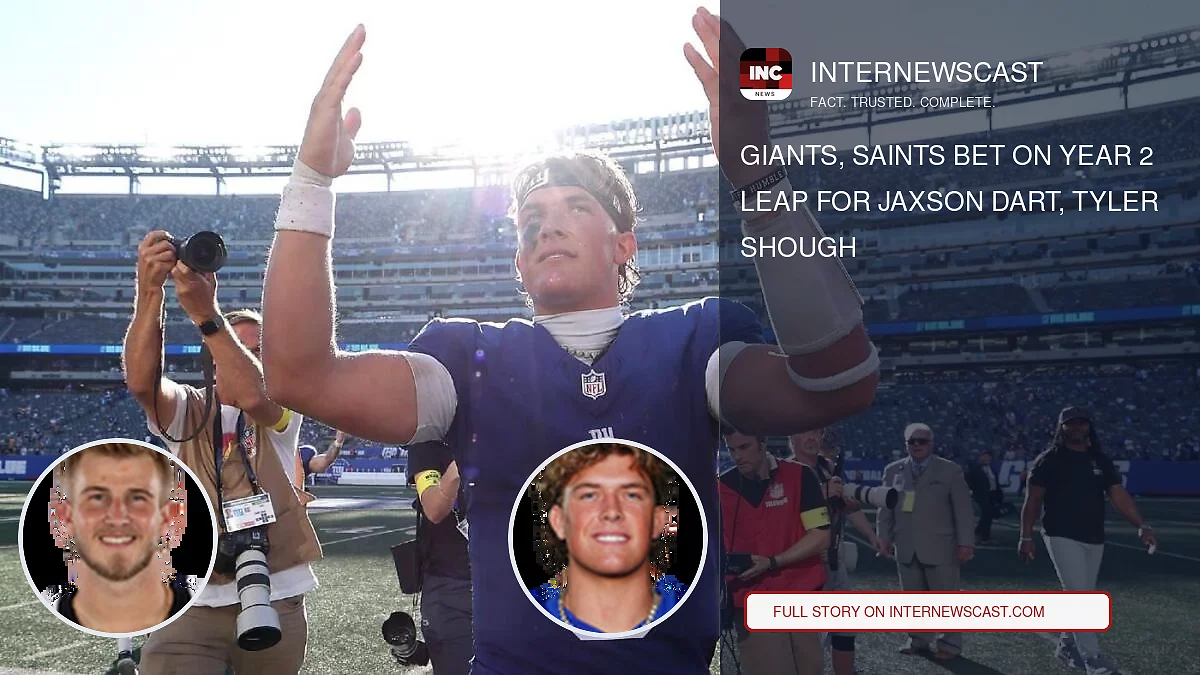

For most of the past decade, the Giants have been trying to identify the true successor to Eli Manning. The Saints have been on a similarly long search for stability after Drew Brees. Different franchises, different timelines, but the same urgent question now hangs over both: have they finally found the quarterback who can end the search?
New York moved through Daniel Jones, Tommy DeVito and Russell Wilson before putting the offense in Jaxson Dart’s hands. New Orleans took its turns with Teddy Bridgewater, Jameis Winston, Derek Carr and Spencer Rattler before shifting to Tyler Shough. Each decision arrived with cautious hope. Each one, until now, left the job unresolved.
This time, the conversation carries a different weight.
That does not mean Dart or Shough is certain to become a long-term franchise answer. It means their 2025 rookie seasons included the kinds of signs that have often preceded meaningful Year 2 jumps from young quarterbacks. Giants and Saints fans have been sold optimism before, but this evaluation is rooted in more than hope.
Quarterback breakouts rarely begin with a rookie immediately piling up 4,000 passing yards. More often, the foundation shows up first: efficient decision-making, controlled mistakes and traits that can scale once the system and supporting cast improve. The star-level production usually comes later, when the rest of the environment catches up.
To better understand what a second-year leap can look like, every quarterback since 2010 who started at least eight games as a rookie was examined to see how his sophomore season unfolded.
Sophomore season expectations
There is no single blueprint for a Year 2 breakout, but recent history reveals several familiar paths.
The lesson isn’t that every quarterback falls into one of these distinct categories. It’s that context matters as much as talent.
Herbert built on an outstanding rookie season. Lawrence took off once Jacksonville got the coach right. Prescott regressed when the offense around him regressed (Ezekiel Elliott was suspended, the offensive line was banged up). Mac Jones lost momentum after an offensive overhaul that included losing coordinator Josh McDaniels. And Griffin’s trajectory changed because of injury late in his rookie season. Development is rarely linear, and it’s almost never isolated from what’s happening around the quarterback.
So where does that leave this year’s class? If there’s one quarterback I’d bet on to make a Year 2 leap, it’s Dart. What surprised me most was how consistent the results were. Whether I looked at historical comparisons or projections, they kept pointing back to the Giants quarterback.
Why Jaxson Dart is the best bet to make a Year 2 leap


The Giants didn’t spend Dart’s rookie season trying to hide him. Once he became the starter, Brian Daboll asked him to run the offense, push the ball downfield and consistently make big-boy NFL throws. As the season progressed, Dart looked increasingly comfortable doing exactly that. And while it didn’t always work, the results were encouraging.
Dart’s rookie numbers were modest: 2,272 passing yards, 15 touchdowns and a 91.7 passer rating across 12 starts. The more encouraging story lived beneath those numbers. Dart consistently challenged defenses downfield while protecting the football — just five interceptions on 339 attempts — even after Malik Nabers was lost for the season in Dart’s first NFL start.
By November, Daboll wasn’t calling games like he was trying to protect a rookie. He was calling them like he expected Dart to make NFL throws. (And, yes, also like he was trying to save his job. Both things can be true.) Dart rewarded that trust. The game never felt too big, and that’s a common thread for many successful Year 2 quarterbacks.
Dart’s closest historical rookie matches
Dart’s closest rookie profiles produced a variety of successful Year 2 seasons. Bo Nix’s statistical output most closely resembles Dart’s projected production, while Russell Wilson and Marcus Mariota represent more efficient versions of that same developmental path.
The point isn’t that Dart will become Wilson or Mariota; it’s that his closest historical comps generally built on their rookie seasons instead of plateauing or regressing.
Dart’s projected Year 2 range
|
Passing yards
|
4,050
|
3,600–4,500
|
|
Touchdowns
|
31
|
26–34
|
|
Interceptions
|
12
|
9–15
|
|
Passer rating
|
91.0
|
85–96
|
|
EPA per dropback
|
+0.07
|
-0.08 to +0.22
|
These aren’t projections carved in stone; they’re a range of likely outcomes based on how quarterbacks with Dart’s rookie profile have historically developed. The takeaway is simpler: quarterbacks who looked like Dart as rookies usually became legitimate NFL starters, not placeholders. That’s the standard in New York — finding a quarterback good enough to stop searching.
Tyler Shough: The quiet case for a franchise quarterback


If there’s one quarterback I think we (and “we” is doing a lot of work here — I mostly mean “me”) may have underestimated, it’s Shough. His rookie season hinted at something the box scores couldn’t fully capture.
Dart has the higher ceiling, but Shough may have the higher floor. The NFL saw an older, often-injured quarterback coming out of college, and that’s why he lasted until the second round. But his rookie season suggested something more interesting: a quarterback who already played the position with surprising efficiency. He completed 67.6% of his passes, averaged 7.3 yards per attempt and posted a 91.3 passer rating over nine starts for a Saints offense that never quite established a consistent identity around him.
Continuity matters, too, with the second-year quarterback returning alongside his second-year coach. There is no learning a new offense. Instead, Shough can grow within the one he already knows.
Shough’s closest historical rookie matches
|
Derek Carr
|
3,987
|
32
|
13
|
91.1
|
0.02
|
|
Gardner Minshew
|
2,259
|
16
|
5
|
95.9
|
0.08
|
|
Andy Dalton
|
3,669
|
27
|
16
|
87.4
|
-0.01
|
|
Teddy Bridgewater
|
3,231
|
14
|
9
|
88.7
|
0.02
|
The names tell an interesting story. Carr, Dalton and Bridgewater: two second-round picks and a late first-rounder, all multi-season starters. Not an All-Pro among them (there are eight Pro Bowls), but all proved they could win in the league. Carr and Dalton started for nearly a decade. Bridgewater was on his way before a devastating knee injury changed his career. Even Minshew carved out multiple productive seasons despite being a Day 3 pick.
As for Shough, his historical comps aren’t built around superstardom — their superpower is stability.
Shough’s projected Year 2 range
|
Passing yards
|
4,100
|
3,700–4,500
|
|
Touchdowns
|
28
|
23–31
|
|
Interceptions
|
12
|
10–15
|
|
Passer rating
|
93.0
|
88–98
|
|
EPA per dropback
|
+0.03
|
-0.12 to +0.18
|
New Orleans doesn’t need an MVP. It needs a quarterback it can stop replacing every offseason. For a franchise that has most recently cycled through Carr, Rattler and Haener, stability would be a revelation. Shough does not need to become Brees. He just needs to become the quarterback the Saints stop trying to replace.
Where Cam Ward and Shedeur Sanders fit in
The focus here is on Dart and Shough because they’re the quarterbacks the historical analysis kept pointing back to. That doesn’t mean Cam Ward and Shedeur Sanders won’t become good NFL starters. It just means their rookie seasons produced much wider ranges of possible Year 2 outcomes.

Ward belongs in the conversation because he was the No. 1 overall pick and started all 17 games as a rookie. Sanders belongs because he could very well open 2026 as Cleveland’s starter. Neither, however, produced the same combination of historical matches and Year 2 projections that made Dart and Shough stand out.
Ward’s rookie season looked different from Dart’s and Shough’s: he threw for 3,169 yards and finished with an 80.2 rating that undersold how much the Titans offense asked of him. The closest Year 2 path is Lawrence: improvement without automatic stardom. Lawrence’s second season was cleaner and more productive, but it did not instantly turn Jacksonville into a juggernaut.

Sanders is the opposite. In eight starts, Sanders threw seven touchdowns and 10 interceptions, flashing enough ability to keep Cleveland curious — and enough volatility to keep everyone guessing. He has the widest range of outcomes in Year 2 because he showed flashes that make you think there’s more there. He was also more inconsistent than Dart, Shough and Ward.
Sure, Sanders could turn into a functional starter, but he could also remain a high-variance player. Neither outcome would be shocking.


