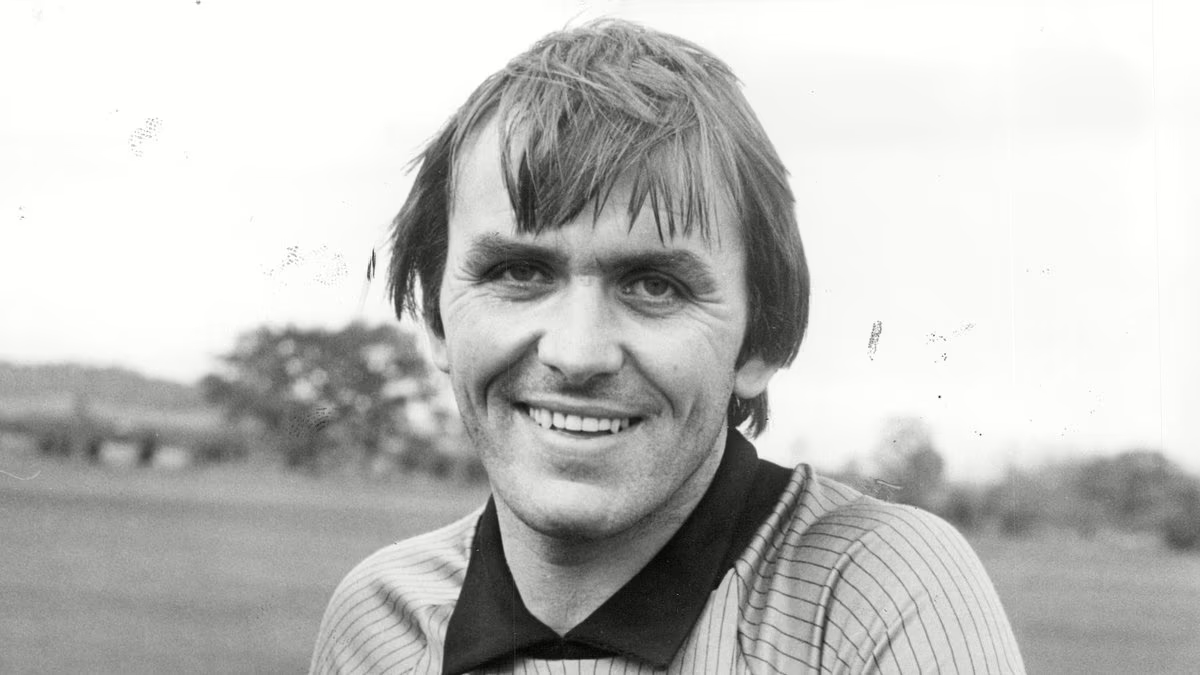

Right to the end, Jimmy Rimmer remained the embodiment of modesty, a man who never seemed comfortable placing himself at the heart of any football tale.
He liked his own company, often perfectly happy nursing a beer in the corner of a Swansea pub, in the city he eventually called home. The thought that regulars might simply see him as “that quiet fella in the corner who used to be famous” rather appealed to him.
Yet Rimmer was among the finest goalkeepers of his generation. Gordon Banks once ranked him the 20th best in the world, a verdict Rimmer accepted as a compliment rather than questioning how the England great had found 19 names to place above his. Had fortune been kinder, his renown might have stretched far beyond what it did.
For Rimmer, the memory of his Manchester United first-team debut was always enough. It came a few months before the final, after Alex Stepney was injured for an Easter Monday meeting with Fulham at Old Trafford. With 64,000 inside and another 10,000 locked out, Rimmer calmly did what was required, making one save and claiming a few crosses in a 3-0 victory.

Former Aston Villa and Manchester United goalkeeper Jimmy Rimmer has died aged 78

Rimmer was forced off injured during Aston Villa’s famous 1982 European Cup final victory over Bayern Munich
His career later took him on loan to Swansea and then to Bertie Mee’s Arsenal, where he became a fixture in the side during the mid-1970s. European Cup glory came into view again when Aston Villa reached the 1982 final against Bayern Munich, but five days before the match Rimmer collided with Swansea’s Bob Latchford in a league fixture, landed heavily on his neck and was left in severe pain.
Villa’s medical staff tried everything they could, and on the night of the final he received heavy doses of cortisone in his shoulder and neck. But after only nine minutes, Rimmer knew he could not continue and signalled to the bench. He retreated to the dressing room in tears as Nigel Spink came on to play the defining match of his career. Until then, Rimmer had missed only one Villa game in five years.
The many sports journalists who ventured to ask Rimmer had he regretted that decision to depart the scene were always cut short by him. ‘You can’t do that,’ he’d always say. ‘We got to the final as a team. I couldn’t be the Jimmy Rimmer people would expect me to be.’
That ‘Jimmy Rimmer’ was a quite exceptional player, a graduate of United’s Busby school who took every word the old man instilled in him to heart. ‘He treated you like a man,’ Rimmer said of Sir Matt in later life. ‘You knew not to do silly things because if you did that with him, you were going upstairs for a chat in the office.’
But it was Harry Gregg, the former Manchester United goalkeeper and reluctant hero of the Munich disaster who, as a goalkeeping coach, had imbued him with the wisdom which served him best. ‘Catch the ball. Get some shape in your hands. Cover your near post. They’re not so good at the near post these days.’ It was also Gregg who talked a 23-year-old Rimmer into a loan move at Fourth Division Swansea, then told Arsenal scout Gordon Clark to sign him in April 1974.
Rimmer proved a fine successor to Bob Wilson, who retired at the end of that season and, once elevated to No1, missed only three Arsenal games in three years – a period in which he secured his solitary England cap, against Italy in 1976. Rimmer had Ray Clemence and Peter Shilton ahead of him in the order: more evidence of an absence of serendipity in his long football career.
In a wonderful interview with Daily Mail Sport’s Matt Barlow two years ago, Rimmer delighted in telling against himself a story about his arrival as an unsophisticate at Arsenal in 1974. After his debut in a 1-0 win at Liverpool, he thought he was on the receiving end of a wind-up when offered prawn cocktail or smoked salmon on the bus home. ‘At United, the bus driver would go and get fish and chips, and now there’s two fellas asking me what starter I’d like, whether I want steak or chicken and red or white wine,’ he said. ‘That’s why they’re called the Arsenal. It’s nothing but the best and I’d come from Man United.’

The goalkeeper started his career at Manchester United after joining the club as just a boy
He’d make occasional mistakes, like any keeper, though it was perhaps the nature of the man that he tended to internalise them more than most. ‘I’d go into my own world when I made a mistake,’ he reflected. ‘I used to hold them in and think about them for too long. Harry Gregg would say, “Oh, you’re the only one who ever made a mistake, are you?” But you can’t go around telling people about all the great saves you made.’
For all that, he was an adventurer, spending three years coaching goalkeepers in China, after finishing his playing days at Swansea, whom he managed twice as caretaker. He lived rent-free in a suite of the Shangri-La in Beijing and had only planned to go for three months but loved the culture there and respected it, which always said that was why he lasted there so long. Rimmer being Rimmer, he didn’t put it down to his technical capabilities.
After suffering a heart attack which left him a coma for 11 days, 18 years ago, while living in Vancouver, he returned to South Wales to be closer to his son David, one of his three children. He followed Swansea City, was an occasional speaker in their matchday lounges and when extending a hand of friendship would apologise for no longer possessing him a firm grip, explaining that several artificial joints were the penalty for his career between the posts.
Rimmer would not have had the game’s slings and arrows any other way. He always liked to reflect that he’d played for the biggest clubs in North West England, London the Midlands and Wales. ‘People call me a legend but I don’t see it like that,’ he said in later years. ‘I played with legends though – that’s for sure.’


