
Share this @internewscast.com
Ask Liam Rosenior about his biggest takeaway from managing Strasbourg in France, and he’ll likely emphasize the importance of ‘adaptability’.
After parting ways with Hull City, just missing the play-offs, the 41-year-old found himself quickly adjusting to new challenges when BlueCo sporting directors Paul Winstanley and Laurence Stewart recruited him in the summer of 2024.
The transition involved adapting to a different club and league, as well as embracing a new country and culture. Even the language posed its own set of challenges and delights during his year and a half in France.
For Rosenior, this was an entirely new chapter, one requiring full commitment. Despite being a father of four, he took the leap without his family, although he wasn’t alone in making such a sacrifice.
His trusted assistants, who have since joined him at Chelsea, also endured personal sacrifices. Justin Walker and Kalifa Cisse left their own children behind, and analyst Ben Warner’s son was just a month old when he moved to France. These personal costs fueled Rosenior and his team to ensure their professional success justified their personal sacrifices.

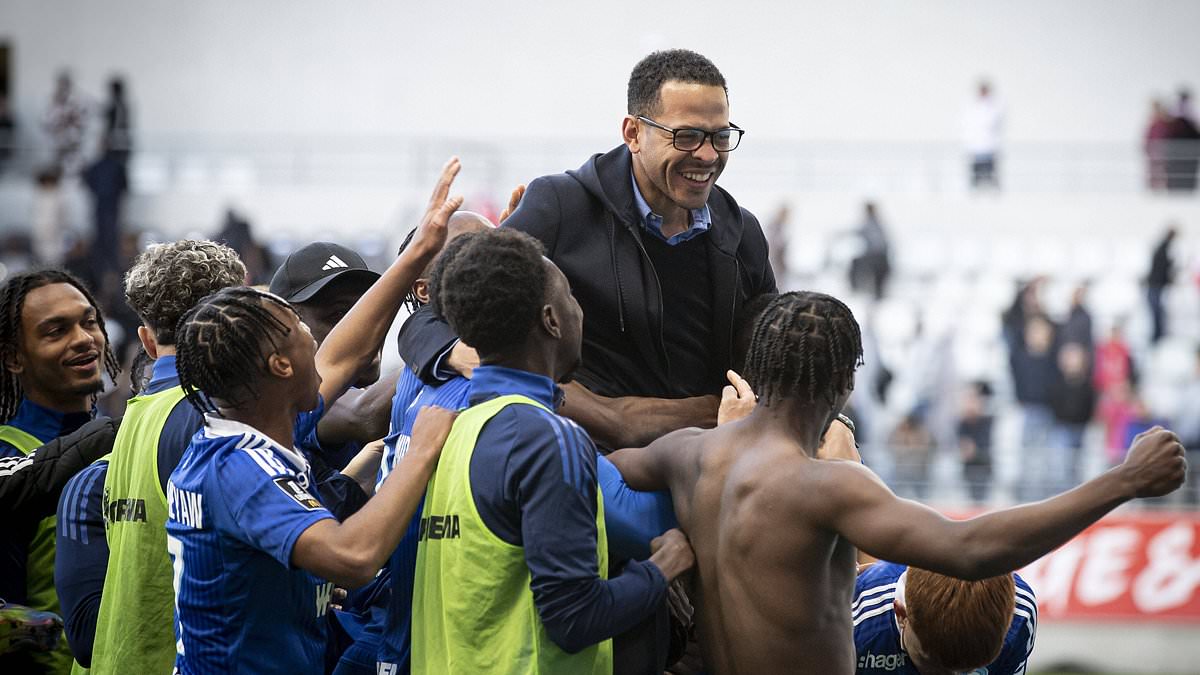
Liam Rosenior replaced Patrick Vieira in 2024 and in his debut season led Strasbourg into Europe for only the second time in 20 years

Rosenior and his assistants Justin Walker (left) and Kalifa Cisse (furthest right) all have children of their own but made the sacrifice to join Strasbourg
Within just three months, Rosenior felt he gained more in France than he might have in five years managing in England. As he adjusted to life in Ligue 1—a league he argues is underrated by those fixated on the Premier League—Strasbourg, in turn, had to adapt to his approach.
Rosenior immediately signed up to intensive French lessons. He found it a beautiful language. What we call French toast, the locals say pain perdu, meaning ‘lost bread’, for example. Yet for all of its poetry, it was tough. Even after reaching a stage where he had a good grasp on it, Rosenior believed his team-talks lost their emotive edge if conducted in a second language.
He stuck to addressing his players in English, with his French assistant and former Reading team-mate Cisse translating if required in meetings, training and press conferences. Rosenior also thought it was useful for Strasbourg’s players to get used to English in case they were ever signed by a Premier League club.
A fair few have already been beamed up to the BlueCo mothership that is Chelsea, such as Andrey Santos and Mamadou Sarr and, soon enough, Emmanuel Emegha and Mike Penders will join them in London.
With that, there are a fair few Strasbourg supporters who will tell you they feel like Chelsea’s ‘B team’ or ‘feeder club’ and that was another learning for Rosenior – how to handle an unhappy fanbase. While the odd demonstration has been staged outside of Stamford Bridge, Strasbourg supporters have been much more blatant in displaying their dissatisfaction.
Rosenior did not mind taking them on occasionally, including when the Strasbourg ultras showered captain Emegha with abuse for signing a pre-agreement to switch to Chelsea in the summer of 2026.
Before leaving Strasbourg for Chelsea himself, Rosenior flew back to France to hold one final press conference, partially out of respect for his former club but also because the optics were not the greatest. He stood his ground at that media briefing, as he often did.
Rosenior admired the French approach to reporting because he believed they thought more tactically than elsewhere, including in England. The newspapers might not only report that Strasbourg were rubbish in losing 1-0. They would try to explain why it happened, and Rosenior is a believer in educating fans so they can understand the game better.

Rosenior worked with several of his Chelsea players at Strasbourg – including Andrey Santos (right) and captain Emmanuel Emegha (centre), who is moving to Stamford Bridge this summer

Strasbourg fans protested strongly against the club’s BlueCo ownership after losing Rosenior and several key players to sister club Chelsea
Rosenior did find French football too hierarchical for his liking upon his arrival. Initially, there was some surprise that he would take time to speak with the lady whose job it was to serve drinks in the Strasbourg canteen, ask how her family were doing, where she went over the weekend, et cetera. Rosenior did not want to be seen as above anyone despite France holding head coaches in the highest esteem and regularly seeing them as disciplinarian figures to fear.
Not once did he fine one of his footballers while at Strasbourg. Rules? They create conflict. Curfews? They are for children. Professional players need only know that if they do not behave properly, then they will only do damage to themselves and their game time.
He learned that trust was key, and connecting with people was paramount to them buying into what he was selling.
Strasbourg helped convince Rosenior that he was not wrong in how he thought football ought to be played. At Hull, he tried to implement a philosophy with which the players struggled. The Championship club’s owner Acun Ilicali told us so himself, explaining how Rosenior was settled on a ‘style for me that can only be done with very high-quality players’ in an interview with Daily Mail Sport recently.
At Strasbourg, he had technically gifted footballers, and at Chelsea, they are another level above, and now come Paris Saint-Germain in the Champions League. Rosenior has had some good tussles with PSG. Of his three meetings with them as a manager, he’s won one, drawn one, lost one. He hopes it will end up a happy return to the land which helped make him the manager he is.