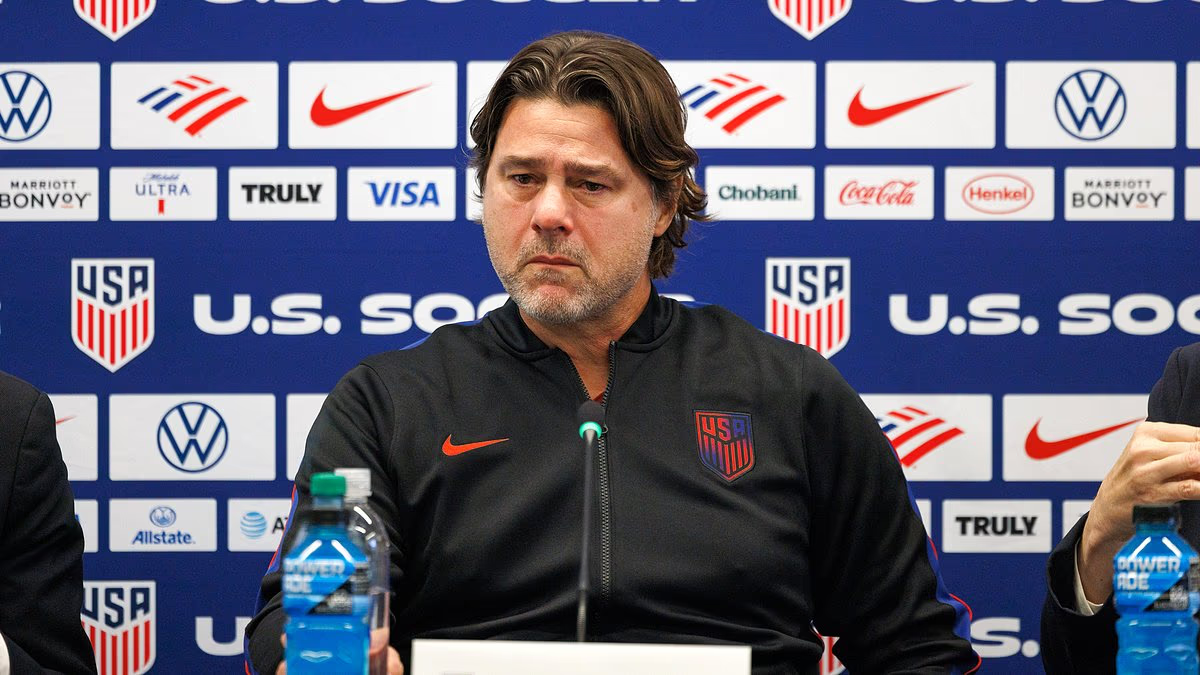

Calling Mauricio Pochettino’s tears “performative” may be overly cynical, even unfair. Still, they were the first thing that came to mind—followed by “unexpected” and, perhaps, “a little excessive.”
Only four months ago, the Argentine agreed to remain in charge of the United States men’s national team through 2030, extending a tenure that began in 2024.
“We want to try to have a lasting impact on the sport in the country that has welcomed us so warmly and for that impact to extend beyond results on the field,” Pochettino said when the extension was announced.
Yet after just a few more months and one international window, that long-term project is over. Pochettino may have cried because he developed a genuine affection for the United States, but he was not dismissed. Instead, he has left to take charge of one of football’s biggest names: Manchester United.
That leaves the USMNT facing a difficult question: what, exactly, is Pochettino’s legacy? Many American soccer writers and supporters point to the intensity he brought to the group and the energy he injected into a team weighed down by the shortcomings of previous regimes.
The results, however, offer a far less convincing case for success. The World Cup performance was no better than those delivered by his predecessors, his record against the strongest opponents was poor, and he departs as the first full-time USMNT manager in almost three decades not to win a trophy.

Mauricio Pochettino cried while leaving the United States’ top job for Manchester United

Pochettino’s USMNT produced entertaining football but ultimately failed to move beyond the usual standard

Any prospect of continued progress disappeared when the Argentine chose to return to England
By most accounts, Pochettino’s biggest achievement was creating a demanding, all-or-nothing mentality within a squad emerging from a major scandal and a disappointing 2024 Copa America campaign.
But his approach also frequently left some of the USMNT’s most important players on the margins. Instead of establishing a reliable core, Pochettino appeared determined to alter his lineup from one international window to the next.
The record reflected that lack of stability. In the buildup to the World Cup, Pochettino’s team faced 12 opponents ranked among FIFA’s top 30. The United States won only three of those matches, drew one and lost the other eight.
At the same time, speculation continued to link Pochettino with a return to Europe. He insisted during his farewell press conference that he had “never said I wanted to go back to the Premier League,” but the Premier League clearly wanted him—particularly Tottenham.
By the time the World Cup arrived, the USMNT finally appeared to be coming together, displaying an exhilarating style rarely seen from the national team.
That momentum collapsed after the Round of 32 meeting with Bosnia, when Folarin Balogun’s red card was overturned in a decision that even this American would describe as devious. The controversy and surrounding noise were followed by a humiliating defeat to Belgium on home soil.

A summer of exciting USMNT soccer followed years of resets and inconsistent results

The campaign unraveled in a heavy defeat to Belgium, leaving Pochettino without a major achievement
Few expected the Americans to advance much beyond the last 16. But declaring Pochettino’s tenure a success solely because of that World Cup run gives him too much credit—particularly because each of the previous four managers to lead the United States at the tournament also reached that stage.
With his exit confirmed, Pochettino becomes the first USMNT manager since Steve Sampson left in 1998 to depart without winning silverware. Sampson, notably, had never worked as a professional manager before taking the job.
Results were limited, but Pochettino’s leadership and his ability to help players develop were widely praised—and those contributions should not be dismissed.
Middlesbrough midfielder Sebastian Berhalter said: “He’s meant so much to me and he’s helped me develop as a player and as a person. And as a player, that’s all you can ask for, to have that trust and have that belief in you.”
Still, not every player within the system appeared eager to work under Pochettino. Christian Pulisic, for instance, spent the entire summer of 2025 resting ahead of the World Cup, only to fail to score in his home country.

The possibility of further progress under Pochettino vanished when Manchester United made its approach
Even so, there were genuine reasons to believe the project could succeed. By extending Pochettino’s contract, US Soccer had an opportunity to preserve the work ethic, culture and leadership he had begun to establish.
The new deal also gave Pochettino a chance to build a lasting foundation within American soccer—one capable of producing success for years, even decades, to come.
That opportunity has now disappeared. Pochettino’s time in charge is more likely to be remembered for its unrealized promise than for transforming the culture. After all, how can a culture endure when its principal architect walks away?
US Soccer must now choose between pursuing another superstar appointment—Pep Guardiola, if the rumors are to be believed—or selecting a coach who views the role less as a stepping stone and more as a long-term cornerstone.
Despite the tears on Friday, Pochettino never seemed to fully embrace the United States. He is heading to Old Trafford and a Manchester United team consumed by years of disappointment, while leaving behind the biggest “What If?” in the still-developing history of American soccer.


