
Share this @internewscast.com
The storied journey of a rugged footballer unfolded from Glasgow’s Cambridge Street to London’s iconic King’s Road, culminating at a ranch in Tennessee, his own version of Valhalla.
Yet, it was the real-life adventures of Eddie McCreadie, the athlete who transitioned from the streets of Cowcaddens to the life of a cowboy, that truly captivated. McCreadie, who passed away at 85, epitomized the spirit of his era.
One moment, he was playing for East Stirlingshire; the next, he was making a name for himself at Chelsea. His infamous clash with Billy Bremner during the 1970 FA Cup final replay is legendary, with the referee allowing play to continue despite the incident. Known for his wild escapades on the King’s Road in the 60s and 70s, he eventually found his calling in faith across the Atlantic.
These were simpler times, far removed from the extravagant world of today’s English Premier League.
McCreadie’s rise began in 1962 with East Stirlingshire, after stints at Drumchapel and Clydebank. Chelsea’s manager, Tommy Docherty, discovered him while scouting another player, and promptly signed the 22-year-old defender. McCreadie expected a gradual introduction to the team but ended up playing consistently for 12 seasons. He amassed over 300 appearances before injuries forced his retirement.

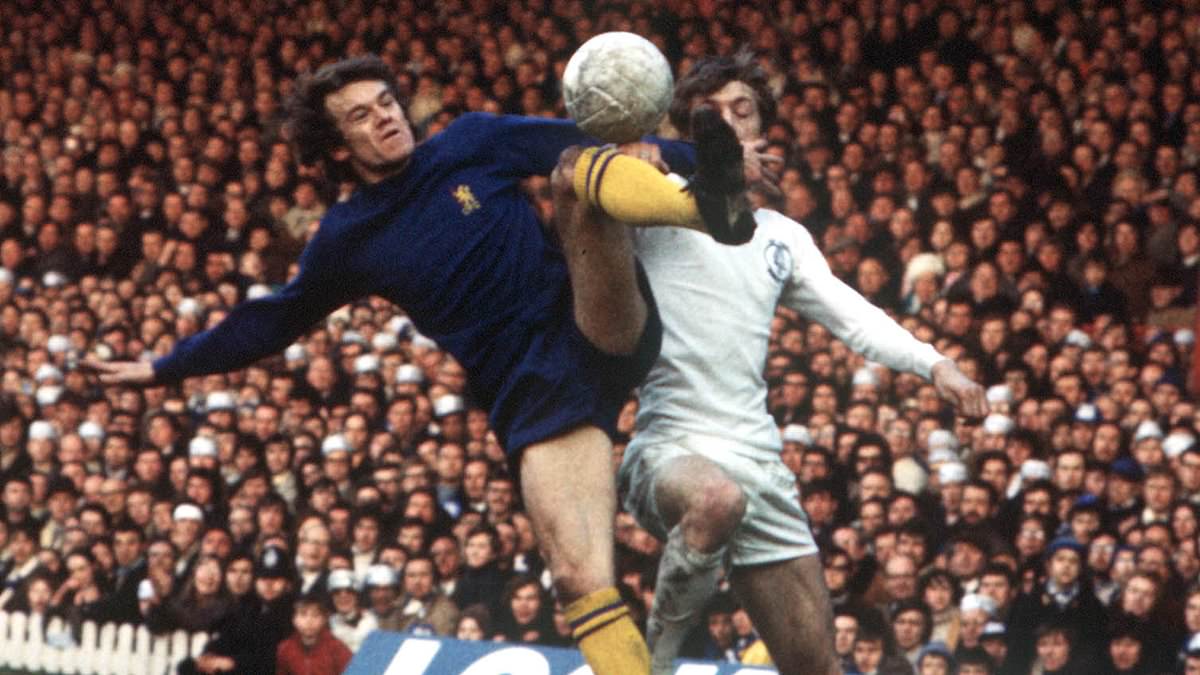
Chelsea’s Eddie McCreadie battles for the ball with Leeds Allan Clarke in notorious FA Cup final replay of 1970

A young McCreadie went straight from East Stirlingshire into the Chelsea first team

McCreadie leaps on top of Law, Baxter and Lennox after the latter scored against England at Wembley in 1967 victory
Acquired for a mere £5,000—a sum that pales in comparison to a week’s wages for a modern Chelsea academy player—his transfer included a promise to play two friendly matches between the clubs. Only one took place, leading to a light-hearted request from East Stirlingshire in 2014 for the second match, which was ultimately declined.
McCreadie had obvious strengths. He was quick, tough and brave. But he was also versatile and adventurous. The modern, overlapping full-back was coming into fashion and he was perfect for the role with his pace, stamina and precise delivery.
Alan Hudson, his technically-gifted team mate, always proclaimed that the Scot had the attributes to play as a winger or in the centre of midfield. Indeed, in the first leg of the 1965 League Cup final, McCreadie was used as an emergency centre forward and scored a goal that would prove decisive in the tie against Leicester City.
He arrived when Chelsea were in the second division but the club won promotion immediately and he became one of their stalwarts. With Ken Shellitto initially at right back and the Glaswegian on the other flank, Docherty’s side became irresistible, their attacking prowess delighting fans and confounding opponents.
Their buccaneering style, however, was not constrained by touchlines. The King’s Road was their routine playground but a trip to Blackpool was the end for some of the roisterers. Docherty expelled most of them, yet retained his fellow Scot.
It was Dave Sexton who took Chelsea to more tangible success, winning the FA Cup in 1970 and the European Cup-Winner’s Cup the following season. McCreadie missed the European triumph through injury but was outstanding in the FA Cup final and its subsequent replay. The wonderful Eddie Gray tormented the Chelsea defence at Wembley but then, as in the replay at Old Trafford, McCreadie stood firm as others seemed to crumble.
The 1970 final was a brutal fight where occasionally football would break out. This was a mark of the times. Chelsea had the delightful talents of such as Hudson, Charlie Cooke, the divine Scot, and Peter Osgood. Leeds had the gifted Bremner, the accomplished Johnny Giles, the explosive Peter Lorimer, and, of course, the peerless Gray. So how did it become so violent?

McCreadie, surrounded by young autograph hunters became a legend at Chelsea, the club he served as player and manager

McCreadie refuses to be intimidated by presence of Leeds defender Jack Charlton during 1970 FA Cup final

McCreadie, above left, and Ron ‘Chopper’ Harris cut dapper figures in their Chelsea days
The easy answer, of course, was football in this era was routinely aggressive. The first match had also raised tempers and fuelled resentments. There was, too, a surfeit of players on both sides who were prone to getting their retaliation in first. Chelsea’s captain that night was Ron ‘Chopper’ Harris. He didn’t earn this nickname because of his choice of bike.
Mayhem ensued under the floodlights and McCreadie’s unwitting impersonation of Bruce Lee went unpunished. His flying kick decked Bremner inside the penalty area. The referee immediately gestured to players to get on with it as the Leeds midfielder lay prone, and even Chelsea’s players seemed briefly chastened by events. This can also be viewed on YouTube but, advisedly, not in the presence of children.
This high point – pun intended – for McCreadie was followed by a gradual decline through injury. He could point to great days, though, in the blue of Chelsea and Scotland. He won 23 caps, most notably playing in the 3-2 victory over England, then the World Cup winners, at Wembley. McCreadie was solid playing behind Jim Baxter, architect of that spectacular victory, on the left flank.
He left Chelsea in 1973 and played briefly in the USA before returning to Stamford Bridge as manager in 1975. Chelsea were struggling in the second division. He established the team and then led them to promotion the next season.
McCreadie was decisive as a leader. He dropped four of his former team-mates on his return to the club and handed the captain’s armband to a then 18-year-old Ray Wilkins. However, he was involved in a dispute with the board on the eve of the return to the top division. It was reported and later widely promulgated that this was a result of the refusal of a club car.
McCreadie, in an interview with The Scotsman in 2014, denied this version of events but would not be drawn further. In truth, he had too much respect for the club to rake over the coals of dissension, but it seemed like a mundane collision between manager and board.

McCreadie and Geoff Hurst go for the ball during Scotland’s legendary 3-2 win at Wembley

McCreadie receives deep heat treatment, and his later years at Chelsea would be plagued by injury

Chelsea fans didn’t like the way McCreadie and the club parted company when he was manager, and often chanted for him to return to Stamford Bridge
Even so, he stayed away from Stamford Bridge for decades, indeed declined politely to join up with the club when they toured the USA under Jose Mourinho in his first era at the club.
The Scot’s life had moved far from the playing field. He stayed with his wife, Linda, on a ranch in Tennessee. He spoke of his love for God, his regular attendance at church, and his decision to give up alcohol decades earlier.
His reluctance to travel back to the Bridge was overcome in 2017. Always a hero with the fans, McCreadie appeared at the stadium to support the publication of a book on his career.
McCreadie had been regularly invoked in his absence in the song – to the tune of Jimmy Mack by Martha and the Vandellas – ‘Eddie Mac, Eddie Mac, Eddie Mac when are you coming back’?
He returned to rapturous applause. Home was the hero. The warrior was back where battles had been fought and glory found.