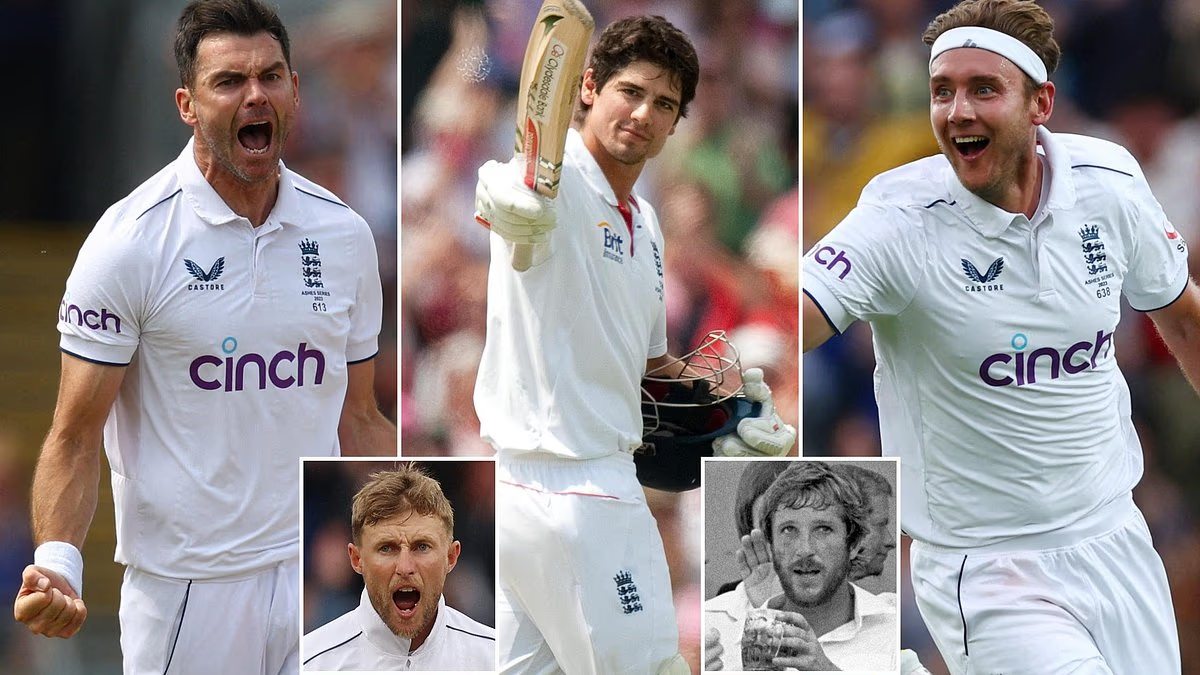

Sir James Anderson is preparing to bring his playing career to a close after Lancashire decided against offering the England great a contract for the 2027 season. The decision marks the likely end of a remarkable, record-setting journey for one of the country’s greatest cricketers.
Now 44, Anderson remains England’s leading wicket-taker in both Test cricket, with 704 dismissals, and one-day internationals, where he claimed 269 wickets. He represented his country from 2002 until 2024.
With the Burnley-born fast bowler’s retirement revealed by Daily Mail Sport on Wednesday, the debate turns to his place among England’s greatest-ever players. Where does the man nicknamed the ‘Burnley Express’ belong in the national cricket pantheon?
Here, LAWRENCE BOOTH selects his top 10 men to have represented England.
1. Ian Botham
Tests: 102, Runs: 5,200 at 33.54, Wickets: 383 at 28.4
Only Anderson and Stuart Broad have taken more Test wickets for England than Botham’s 383. Yet his legacy was built on far more than bowling: he also made 14 Test centuries and remains inseparable from the extraordinary 1981 Ashes series.
His peak influence was extraordinary. During the 1980 Jubilee Test against India in Mumbai, Botham claimed six for 58, struck 114 in England’s total of 296 and later returned figures of seven for 48 after bowling 26 relentless overs.
He was England’s ultimate all-round powerhouse.

Ian Botham was England’s towering all-round force, capable of changing the course of a series almost single-handedly
2. Jack Hobbs
Tests: 61, Runs: 5,410 at 56.94
Decades before Sachin Tendulkar inherited the title of ‘Little Master’, Jack Hobbs was cricket’s original ‘Master’. The elegant opening batsman combined class with remarkable endurance, scoring 12 centuries against Australia — still an England Ashes record.
Of his 199 first-class hundreds, approximately half came after he turned 40, and he was still appearing in Test matches at the age of 46. Hobbs scored a substantial share of his 43,554 first-class runs for Surrey at The Oval, where the gates have been named in his honour.

Jack Hobbs (left) heads out to bat for Surrey; cricket’s first ‘Master’ enjoyed extraordinary longevity
3. WG Grace
Tests: 22, Runs: 1,098 at 32.29, Wickets: 9 at 26.22
WG Grace was a divisive figure, using gamesmanship at a time when the practice was far less openly accepted and occasionally pushing the boundaries with umpires.
Even so, his first-class career, which ran from 1865 to 1908, established him as England’s first sporting superstar. Grace stood so far above many of his contemporaries that the familiar argument about whether past players could thrive in the modern game seems almost irrelevant in his case.
He mastered both front- and back-foot batting when most players specialised in one style, amassed more than 54,000 runs and took over 2,800 wickets. Across any era, WG Grace was a giant of the game.
4. Joe Root
Tests: 169, Runs: 14,287 at 50.45, Wickets: 74 at 48.09
The only name on this list still playing, Root needs just 1,644 more runs to overtake Tendulkar and become Test cricket’s most prolific scorer of all time.
His 41 red-ball hundreds are eight more than anyone else has managed for England, and he averages over 50 in both Tests and one-day internationals.
Oh, and he’s just become captain again for the second time, answering England’s SOS after the chaotic retirement of Ben Stokes.

Joe Root’s 41 Test hundreds are eight more than anyone else has managed for England, and he averages over 50 in both Tests and one-day internationals
5. James Anderson
Tests: 188, Wickets: 704 at 26.45
No fast bowler of any nation has more Test wickets than Anderson’s 704, and only two spinners – Muttiah Muralitharan and Shane Warne – are ahead of him on the list.
Other bowlers were faster, but few were more skilful at working out a batsman, then working him over. In Asia, he took 92 wickets at 27, settling the argument that he needed English conditions to thrive.
Now that he has called it a day, taking 1,193 first-class wickets with him, the leading current bowler is South Africa and Essex spinner Simon Harmer, with 1,068.

No fast bowler of any nation has more Test wickets than Jimmy Anderson’s 704, and only two spinners – Muttiah Muralitharan and Shane Warne – are ahead of him on the list
6. Walter Hammond
Tests: 85, Runs: 7,249 at 58.45, Wickets: 83 at 37.80
But for Don Bradman, Hammond would have been the undisputed No1 batsman in the world for the decade before the Second World War, and possibly for a few years after it.
His cover drive remains one of the great exclamation marks of English strokeplay, and he once averaged 563 in a two-match series in New Zealand.
On the 1928-29 Ashes tour, he scored four hundreds among his 905 runs – still an England record for a Test series.

But for Don Bradman, Walter Hammond (right) would have been the undisputed No1 batsman in the world for the decade before the Second World War, and possibly for a few years after it
7. Len Hutton
Tests: 79, Runs: 6,971 at 56.67
Hutton was the last England player to hold the individual Test record for runs in an innings, scoring 364 against Australia at the Oval in 1938, and one of only three English captains – along with Mike Brearley and Andrew Strauss – to win the Ashes both home and away.
As a Test opener he made 6,721 runs at 56: no one of any nationality has made more at a higher average.
Had World War Two not intervened, he would probably have broken all sorts of records, and he was not deterred by an injury in the gym which, after surgery, meant his left arm was two inches shorter than his right.

Len Hutton (right) walks out to bat against Australia at the Oval in 1938. He would go on to break the world record for most runs in a Test innings, with 364
8. SF Barnes
Tests: 27, Wickets: 189 at 16.43
Even now, well over 100 years since he signed off from Test cricket with a 14-wicket haul at Durban, Barnes’s figures take the breath away: 189 wickets at 16, including 49 at 10 in that final series in South Africa.
He was not fast, but deadly accurate, and he would snap at anyone who suggested he bowled cutters: ‘I spun it!’
He was an awkward customer, and preferred outsourcing himself to the highest bidders in the northern leagues rather than waste too much time in county cricket. But what a bowler.
9. Alastair Cook
Tests: 161, Runs: 12,472 at 45.35
It’s tempting to wonder how close Cook might have come to Tendulkar had he not quit Test cricket at the age of 33, especially after he signed off with scores of 71 and 147 against India at the Oval in 2018.
That left him with 12,472 Test runs, second in England’s pantheon and over 3,500 clear of third-placed Graham Gooch, once his mentor.
Cook’s talent lay in the marshalling of unglamorous resources: a strong back-foot game, a clip off the hip, and unbreakable concentration. His 766 runs at 127 helped England win in Australia in 2010-11 for the only time since the late 1980s.

Alastair Cook’s 766 runs at 127 helped England win in Australia in 2010-11 for the only time since the late 1980s

Stuart Broad (right) sneaks into the top 10 – not only by sheer weight of numbers but also because he turned it on when it mattered
10. Stuart Broad
Tests: 167, Runs: 3,662 at 18.03, Wickets: 604 at 27.68
With apologies to Ken Barrington, Denis Compton and Fred Trueman, Broad sneaks into the top 10 – not only by sheer weight of numbers (only Anderson has more than his 604 Test wickets) but also because he turned it on when it mattered.
After announcing himself with an Ashes-clinching five-for at the Oval in 2009, his eight for 15 against Australia on his home ground at Trent Bridge in 2015 is arguably the most memorable spell of fast bowling in England’s Test history.


