
Share this @internewscast.com
Traders on prediction platforms Kalshi and Polymarket are increasingly forecasting a likely U.S. government shutdown by the end of the week. This prediction surge follows widespread public outrage over a recent incident involving a Border Patrol agent who fatally shot a legally armed protester on Saturday.
On the prediction marketplace Kalshi, the probability of a government shutdown spiked by 10 percentage points, exceeding 75 percent. This shift came in the wake of the shooting of Alex Pretti by Border Patrol agents in Minneapolis, highlighting the event’s impact on market expectations.
The power to prevent a government shutdown primarily lies with Senate Democrats. Approving spending bills requires a 60-vote majority, necessitating support from Democrats even if all 53 Republican senators align with the measures passed by the House.
Without intervention from the Senate, government funding is set to expire at the end of January, specifically this Saturday.
In the previous shutdown resolution last November, seven Democratic senators broke ranks to support Republican efforts: Catherine Cortez Masto, Dick Durbin, John Fetterman, Maggie Hassan, Tim Kaine, Jacky Rosen, and Jeanne Shaheen. Independent Senator Angus King of Maine, who typically aligns with Democrats, also supported the measure.
This time, the situation is complicated by contentious Department of Homeland Security funding, placing moderate Democrats in a challenging position as they navigate the ongoing negotiations.
King told CBS’s ‘Face the Nation’ on Sunday: ‘I can’t vote for a bill that includes ICE funding in these circumstances, what they are doing in my state, what we saw yesterday in Minneapolis.’ He noted he ‘hates’ shutdowns and helped negotiate the solution to end the last one.
Rosen called for Homeland Security Secretary Noem to be ‘impeached and removed from office immediately’ in a Sunday post on X, calling her ‘an abject failure.’

The moment that the firearm of a man identified as Alex Pretti is retrieved from a waistband holster by a federal officer (in light grey jacket, crouched) as another officer (in green) draws his weapon, before Pretti was fatally shot in Minneapolis, Minnesota, U.S., January 24, 2026 is seen in a still image of a video obtained by Reuters

Senator Catherine Cortez Masto, a Nevada Democrat, speaks at a press conference with other Senate Democrats who voted to restore government funding, in Washington, DC on November 9, 2025

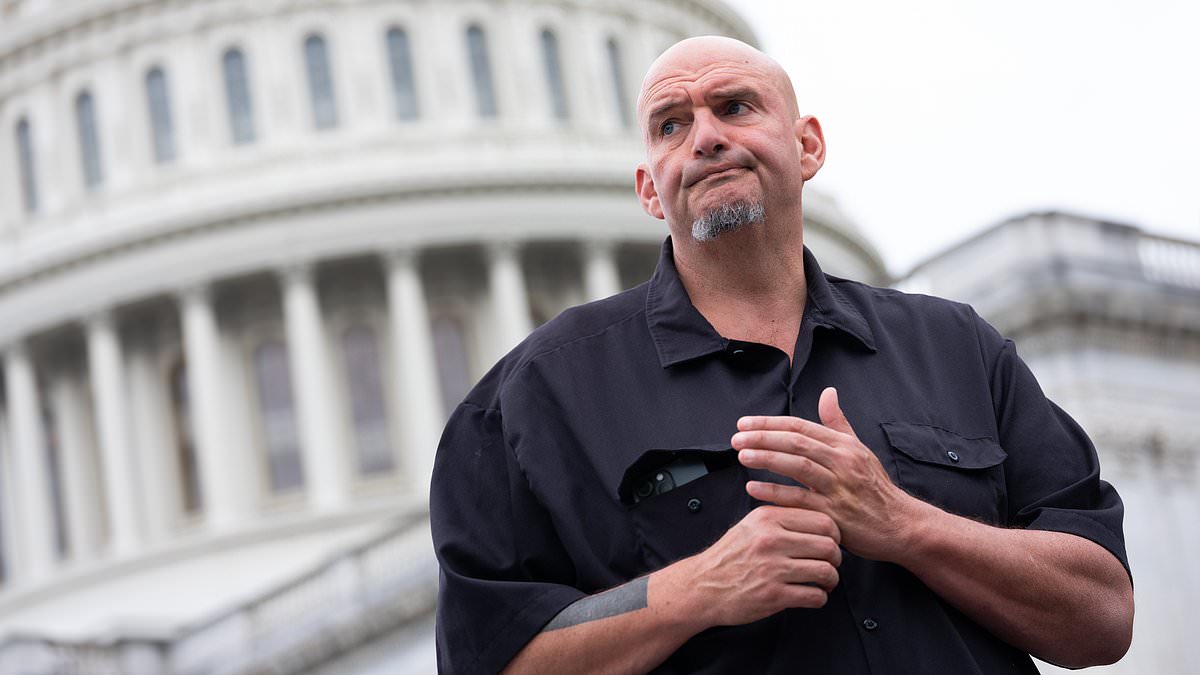
Senator John Fetterman, a Democrat from Pennsylvania, is seen at the US Capitol, in Washington, DC, on September 30, 2025
Even before the Pretti shooting, Kaine raised concerns Friday about the House funding bills, objecting to six bundled bills forced into a single up-or-down vote.
Fetterman has defended ICE agents, saying they ‘are just doing their job, and I fully support that,’ while criticizing Democrats who ‘treat them as criminals.’ His approval rating hit 51 percent Monday, according to the latest Morning Consult poll. In a Monday afternoon statement, Fetterman noted that he wanted DHS funding stripped from the package of government funding bills.
House Democrat Tom Suozzi told supporters in a Monday campaign email that he ‘failed’ by voting for the DHS bill, saying he ‘failed to view the DHS funding vote as a referendum on the illegal and immoral conduct of ICE in Minneapolis.’
Some Republicans are also skeptical. Rep. Michael McCaul and Sens. Thom Tillis, Bill Cassidy, Susan Collins, and Lisa Murkowski have pressed for more information, signaling bipartisan concern.
House Homeland Security Committee Chairman Andrew Garbarino requested testimony from ICE, Customs and Border Protection, and U.S. Citizenship and Immigration Services leaders, saying his ‘top priority remains keeping Americans safe.’