
Share this @internewscast.com

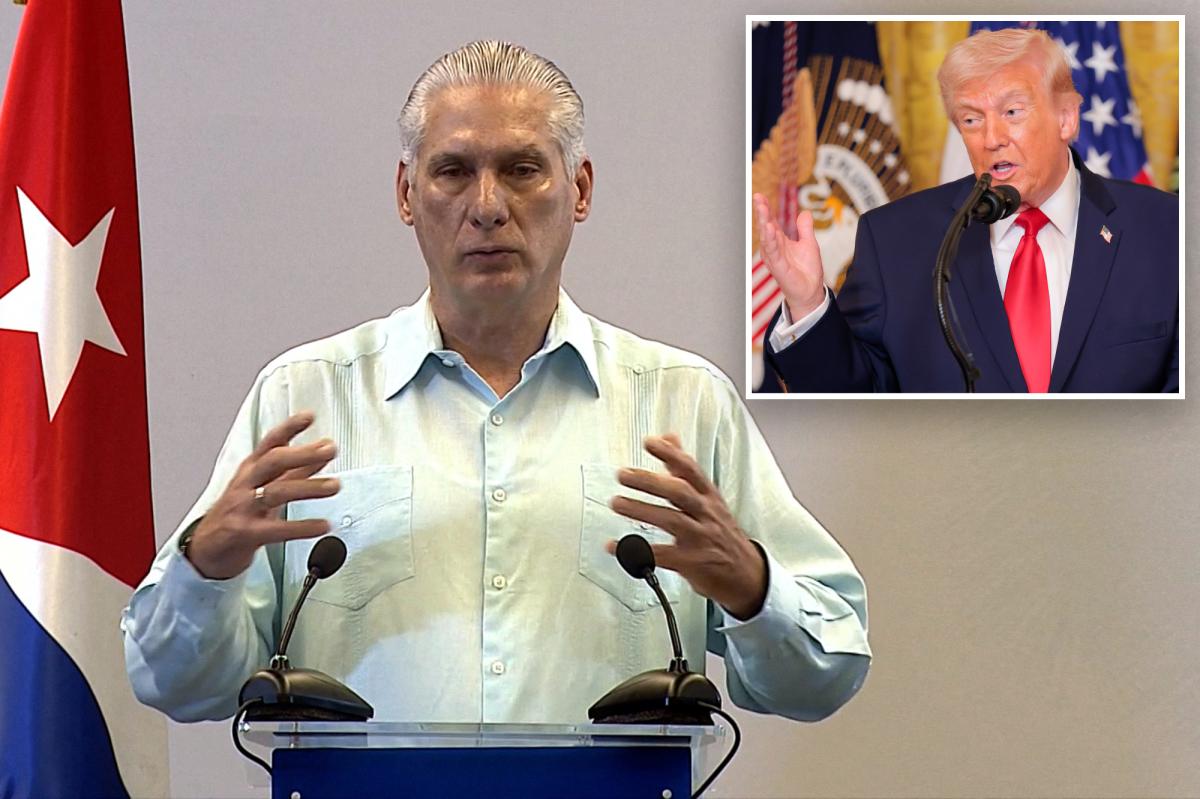
WASHINGTON — Cuban President Miguel Díaz-Canel announced on Friday that negotiations are underway with the United States, following an idea by President Trump about a possible “friendly takeover” of the island nation.
“Our discussions have been centered on addressing the bilateral differences between our countries through dialogue,” Díaz-Canel stated during a televised address. “There are international circumstances that have paved the way for these conversations.”
He further emphasized that the discussions are taking place “with mutual respect and recognition of each nation’s political systems, sovereignty, and the right to self-determination.”
During a later press conference, Díaz-Canel, who is 65 years old, highlighted that Cuba has not received any fuel shipments for three months, which has led to an “unstable” electrical grid, according to a report by Reuters.
In a move seen as conciliatory, the Cuban government released 51 political prisoners shortly before the President’s statement.
Previously, Trump had halted discounted oil supplies from Venezuela to Cuba following his January 3 operation in Caracas that resulted in the ousting of Nicolás Maduro, a key ally of Havana. Additionally, Trump had warned of imposing tariffs on any nation that continues to supply oil to Cuba.
“It may be a friendly takeover. It may not be a friendly takeover,” Trump said Monday. “It wouldn’t matter because they’re really in — they’re down to, as they say, fumes. They have no energy. They have no money. They’re in deep trouble on a humanitarian basis.”
The US president made similar remarks last month, saying: “We could very well end up having a friendly takeover of Cuba after many, many years.”
Trump also said such a “takeover” would be “very positive for the people that were expelled, or worse, from Cuba that live here” in America, and that “it’s really right now a nation in deep trouble, and they want our help.”
Cuba’s state-run economy has struggled for decades, but is in an increasingly desperate position since Trump swapped out Maduro for his vice president, Delcy Rodriguez — who has complied with US oil dictates.
Díaz-Canel’s statement followed several indicators that discussions were in progress.
Secretary of State Marco Rubio met on Feb. 25 with Raúl Guillermo Rodríguez Castro — the 41-year-old grandson of Cuba’s former leader Raúl Castro, 94, who handed the presidency to Díaz-Canel in 2019 — during a Caribbean nation conference on the island of St. Kitts.
The Treasury Department said the same day it would allow the sale of Venezuelan oil to Cuba, but only if it benefited the private sector, which would require internal reforms weakening the Communist Party’s power.
Cuba has been a single-party state for more than six decades — and was ruled for most of that time by Fidel Castro, who overthrew a corrupt US-backed government in 1959 before declaring a socialist state, jailing dissidents, and expropriating American assets.
Castro yielded power to his brother Raúl in 2008, dying eight years later at the age of 90.