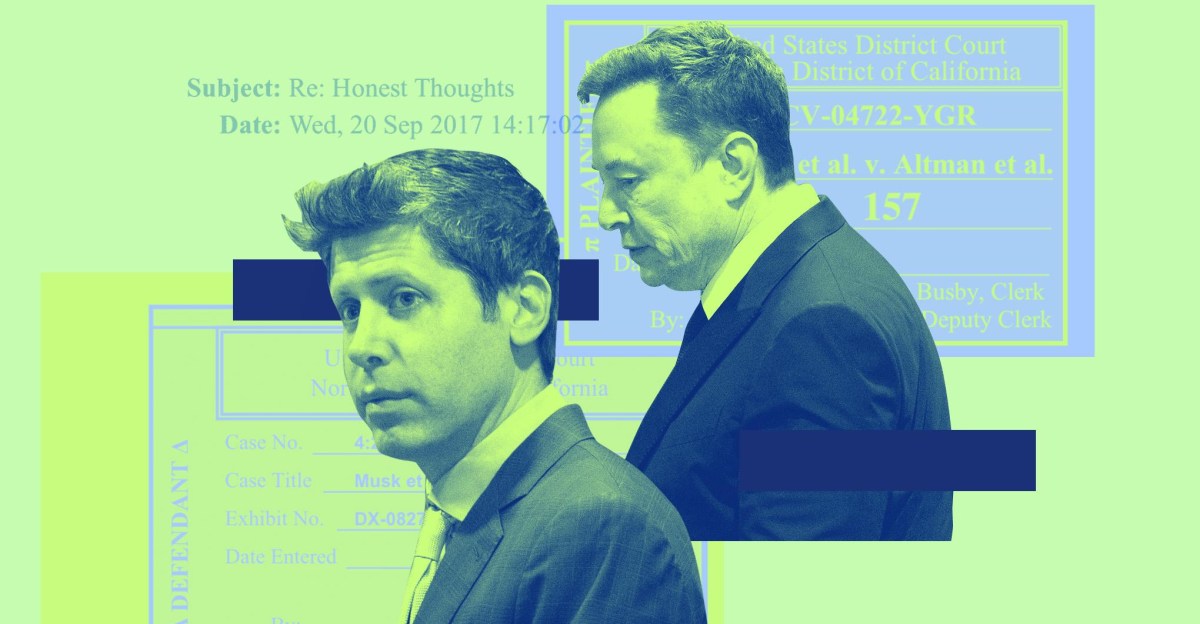

Today, the closing arguments in the Musk v. Altman trial took place and it was nothing short of a spectacle. Steven Molo, representing Elon Musk, seemed to struggle throughout his presentation. At one point, he mistakenly referred to co-defendant Greg Brockman as Greg Altman. He also incorrectly claimed that Musk was not seeking financial compensation, prompting the judge to correct him. Although Molo emphasized the dishonesty of several individuals involved, he failed to provide substantial evidence to support Musk’s legal assertions.
On the other hand, Sarah Eddy, the attorney for OpenAI, presented a straightforward yet effective argument by organizing the company’s evidence in a chronological manner. She refrained from asserting the reliability of anyone involved in this trial but delivered a memorable line regarding Musk: “Even the mother of his children can’t back his story.” Following her, William Savitt highlighted the numerous instances where Musk claimed to “not recall” vital details and questioned how such an experienced businessman could overlook a straightforward four-page term sheet from OpenAI.
Amidst these proceedings, I found myself pondering the significance of this trial. Let’s shift to the real intrigue—the behind-the-scenes drama. Here are some highlights worth mentioning.
While the trial’s intention was to penalize Altman, it inadvertently revealed a key takeaway: Elon Musk’s apparent shortcomings in the realm of artificial intelligence.
Musk has repeatedly predicted OpenAI’s failure, attempting to undermine it and poach its talent, successfully attracting Andrej Karpathy, a founding team member, to Tesla. But what about xAI, Musk’s own AI initiative? It seems to be a financial sinkhole now absorbed by SpaceX, with a dwindling team. One of its major data centers is being leased to Anthropic instead. There are talks of acquiring Cursor to compete with programming tools from Anthropic and OpenAI. xAI’s clients, whether governmental or corporate, seem coerced into using its services. The effectiveness of its CSAM machine, Grok—also controversially dubbed MechaHitler—appears to stem from utilizing models developed by others.
In a 2018 note, Zilis expressed that Brockman and Sutskever felt Musk lacked a thorough understanding of AI and AGI, raising concerns about collaborating with him. After observing this trial, it seems these parties might deserve each other’s company, though Brockman and Sutskever’s assessment of Musk appears accurate. The question now is whether potential investors in the forthcoming SpaceX IPO have taken notice or if it even matters to them.


