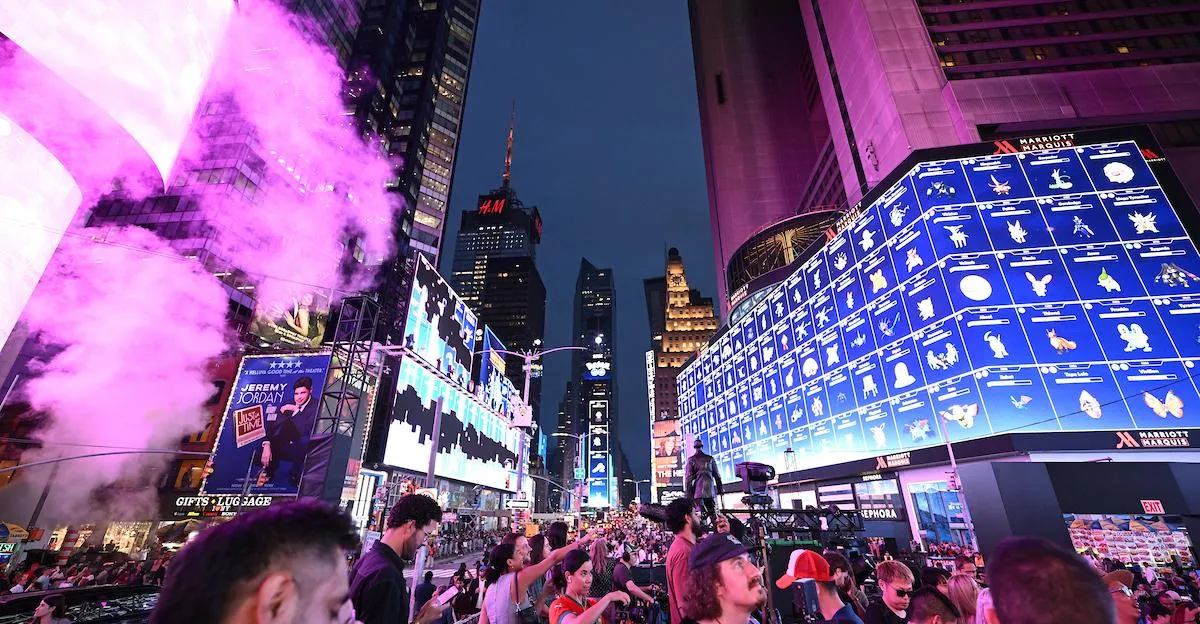

When Niantic released the first Pokémon Go trailer back in 2015, the idea of crowds of players coordinating in the real world to capture a legendary pokémon like Mewtwo felt almost impossible to picture. At the game’s 10th anniversary celebration in New York City this week, Pokémon Go finally delivered that vision at full scale. Nearly 2,000 players — including many well-known Pokémon Go creators — gathered in Times Square on Thursday night for a special battle. The moment was striking: Times Square briefly went dark, its giant screens then lit up to reveal an escaped Mewtwo Mega Evolving, and the crowd brought to life the exact fantasy the original trailer had promised.
When Pokémon Go launched in 2016, most players had never encountered a mobile experience quite like it, but the premise was easy to understand from the start. The game encouraged people to step outside, follow location-based prompts, and rush to real-world places where wild pokémon might appear. The early trailer suggested the game could be a relaxed solo adventure, but it also included dramatic scenes of large groups joining forces against formidable pokémon. Raids were not yet part of the game, though Niantic’s ambitions were already clear: catching legendary pokémon was meant to feel like a major shared event.
In a press release, Michael Steranka, Scopely’s vice president of product — Scopely acquired Niantic’s games business last year — said the anniversary event was designed as a fulfillment of that original promise. “When we first dreamt what Pokémon GO might become a decade ago, hosting more than a thousand people in a single, local raid battle was just a pipe dream,” Steranka wrote. “Seeing that vision become a reality in Times Square was the perfect way to celebrate 10 years of playing together with our community.”
The Times Square gathering stood in sharp contrast to the game’s first major live event in 2017, when thousands of fans arrived in Chicago only to see their plans derailed by overloaded networks and software problems — failures Niantic ultimately accepted responsibility for. Steranka joined Niantic that same year to help manage the troubled Chicago event, and during a press briefing this week, he admitted that, at the time, he believed he “should have been fired” over how the event unfolded.
“I also quickly discovered from this experience that the Pokémon Go team does not point fingers,” Steranka said. “Instead of trying to find someone to blame, everybody came together, and we spun up an offsite in Seattle to learn what went wrong and how to fix things.”
That decision to lean harder into real-world, community-centered events has helped fuel Pokémon Go’s long-term growth. Scopely says the game has been downloaded more than 800 million times since launch, and that Go generated $1 billion in 2025 alone. Niantic spent years trying, and largely failing, to reproduce that success with other augmented reality games built around major properties, including Harry Potter: Wizards Unite and Catan: World Explorers. What makes Pokémon Go’s durability especially notable is that its basic gameplay loop has not changed dramatically. Scopely games president Ed Wu, however, says the game’s endurance comes from the company’s increasing focus on building and sustaining player communities.
“What started as an invitation to explore the world around you has become something that brings players together across cities, countries, and cultures, from neighborhood meetups to celebrations that draw hundreds of thousands of people together,” Wu said in a press statement. “As we look ahead, our commitment remains unchanged: to keep evolving the game in ways that turn everyday places into opportunities for discovery and connection.”
Scopely views Pokémon Go as a game with no obvious expiration date, thanks both to the franchise’s constantly expanding lineup of creatures and to the steady arrival of new players, particularly younger fans discovering it for the first time. Each new mainline Pokémon release brings another wave of potential players into the broader ecosystem. Asked how his team intends to develop Pokémon Go going forward, Wu avoided specifics, but said Scopely is exploring how different generations — such as children and parents — introduce one another to Pokémon and how gyms might play a larger role in strengthening local communities.
This Saturday and Sunday, millions of people are probably going to be out and about participating in 2026’s global Pokémon Go Fest that will see the map light up with even more Mewtwo encounters and challenges that require players to work together. It’ll be the game’s most ambitious event yet, but with a set of new mainline Pokémon titles dropping next year, Pokémon Go will still have room to grow.


