
Despite all the hype around generative AI’s potential to transform filmmaking, the technology has yet to produce many projects that feel like genuine, ticket-worthy entertainment. Most AI video tools still generate only brief stretches of footage, often with glaring visual inconsistencies. At the same time, several high-profile Hollywood partnerships involving AI have fallen apart, raising fresh doubts about whether studios can count on Silicon Valley’s latest tools. For now, much of what major production companies have managed to make with generative AI resembles disposable short-form content. But that outlook may begin to shift if studios pay attention to some of the more inventive experiments unveiled at this year’s Tribeca Film Festival.
It remains hard to imagine generative AI creating a truly compelling feature film on its own. Still, a number of Tribeca entries suggested that the technology can be effective when used as a tool in the hands of skilled filmmakers.
Not every AI-assisted project at the festival made a strong case for the medium. While none were as chaotic or low-quality as the flood of AI video clips pushed online by companies such as OpenAI and xAI, some highlighted why generative work can still feel flat when compared with art shaped more directly by human creators. Roar, an animated short from Illuminai Studios, played more like an unsettling collage of AI-generated imagery than a fully formed film. Asteria Film Co.’s ChikaBOOM!, meanwhile, did not have the visual or audio refinement needed to fully immerse viewers in its fast-moving fantasy story about a magician in training.
The rough edges of Roar and ChikaBOOM! appeared to reflect the technical constraints built into their AI-heavy production methods. Other films, however, pointed to more promising possibilities. Google DeepMind’s Dear Upstairs Neighbors and OpenAI’s Mauvais Soleil showed that filmmakers can work around many of those limitations when generative AI is used with greater care and creativity.
Written and directed by Pixar veteran Connie Qin He in collaboration with Google DeepMind researchers, Dear Upstairs Neighbors centers on Ada, an exhausted young woman simply trying to get some sleep. Played by Márcia Mayer, who also produced the short, Ada wants only a few quiet hours of rest before returning to work. But each time she starts to drift off, loud commotion from the apartment above snaps her awake, leaving her to wonder what on earth her neighbors are doing in the middle of the night.
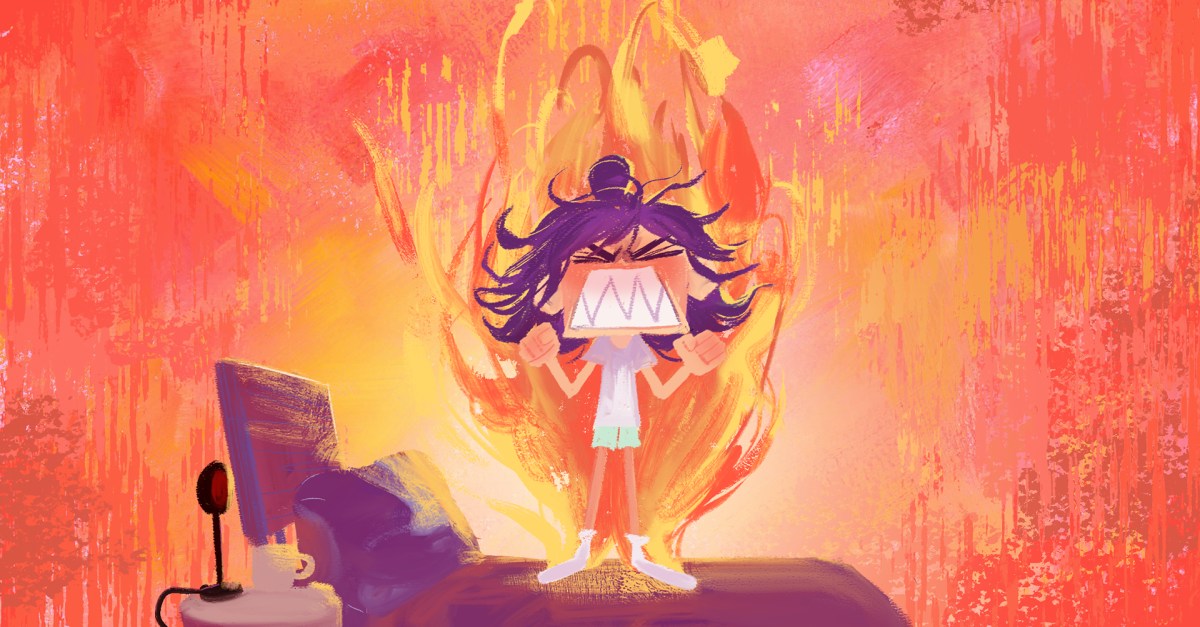
To give the film a distinctive visual identity, He brought in Pixar production designer Yingzong Xin, who created concept art in Photoshop and with acrylic paint on paper. That expressive, painterly look was central to the film’s fantastical tone, but it also posed a major technical hurdle. Most AI video models struggle to translate illustrated styles into footage that remains visually consistent from shot to shot. To address that, DeepMind engineers built customized versions of Veo and Imagen tailored specifically for the project, giving the creative team more control over the final output.
You can see how filmmakers have to work around some of gen AI’s more typical limitations.
Because the customized models were trained on Xin’s concept art, they could consistently generate shots that adhered to He’s vision for the project. The text-to-video models were great at reproducing certain stylistic details, like the way sound is visualized when objects interact with one another. But to really build Dear Upstairs Neighbors’ scenes in a way that would tell a cohesive story, the short’s creative team had to do things a bit more traditionally. By creating rough animations with Autodesk Maya (the industry standard for 3D rigging and VFX), Dear Upstairs Neighbors’ production team could ensure that scenes would unfold exactly how they wanted them to. And by feeding those roughs into Veo, the artists could create scenes that were more visually polished and ready to be further enhanced with additional stylized assets generated with Veo and Imagen.
More than any other film at Tribeca, Dear Upstairs Neighbors felt like a case study in how generative AI can be used as a bespoke tool that actually assists artists as they develop their ideas. The film’s entire workflow relied on human-made art and people making the kinds of nuanced creative decisions that text-to-video generators aren’t capable of on their own. It’s important to bear in mind that Dear Upstairs Neighbors would not be nearly as visually impressive if it had been produced with vanilla versions of Google’s various models. The models worked well for this particular short, but that’s to be expected for a project that’s also very much a commercial for Google’s technology.

Image: Google DeepMind
Dear Upstairs Neighbors was a much more enjoyable watch than the films OpenAI brought to this year’s festival. Alice Gu’s semi-autobiographical drama Smoked used Sora to re-create the Palisades Fire, and Youssef Michraf’s Mauvais Soleil features a number of photorealistic scenes generated with OpenAI’s creative tools. Watching both films, you could see how their respective filmmakers had to work around some of gen AI’s more typical limitations. Wide shots in Smoked’s fiery scenes looked a bit cartoony, but the effect worked somewhat better in close-ups — which were filmed using a Volume-like setup — of a woman and her son trying to escape the blaze in their car. Most of Mauvais Soleil’s shots last for just a few seconds and the only speaking character is an unseen narrator, but the film’s story about how a man’s life is being warped by artificial intelligence makes those details feel like intentional artistic choices.
OpenAI’s presence at Tribeca was somewhat surprising given the company’s recent decision to shut Sora down entirely. Sora’s sudden shuttering is what led to OpenAI’s feature-length film Critterz not being able to make its debut at this year’s Cannes Film Festival. It seems like OpenAI might be pivoting away from video-focused applications of its tech, but there are still other players in the gen AI space building tools that filmmakers can use to realize their projects.
These workflows really only function well when they’re guided by human artists.
With just $2,000 spent entirely on computing costs, writer / director Ash Koosha was able to singlehandedly produce Dreams of Violets, a docudrama focused on the nationwide protests that have rocked Iran throughout the past year. Using Kling AI, Claude, Gemini, and Nano Banana, Koosha tells a fictionalized story about a group of people who find themselves trapped in an alley as police stalk the streets brutalizing civilians. The project took Koosha just a few weeks to finish by himself, and while it’s supported by a powerful narrative, it doesn’t break any ground visually.
Watching all of these films, I got the distinct sense that there is no future where studios are cranking out commercially viable projects by feeding prompts to gen AI models. That kind of content probably isn’t going to go away, but it’s not the kind of stuff Hollywood’s heavyweights would want to put their names on. What seems much more likely is bigger AI firms like Google partnering with studios to build bespoke models that are tailored to very specific workflows. And those workflows really only function well when they’re guided by human artists with very clear creative visions.


