

As the proprietor of CelebrityNetWorth, I’ve developed a habit of keeping a close watch on the site’s live analytics throughout the day. This vigilance allows me to swiftly respond to significant events, such as an athlete clinching a major title, a high-profile celebrity facing legal troubles, or the unfortunate passing of a renowned figure. These events lead to a surge in interest, and my job demands I stay ahead of these spikes.
Interestingly, about once a month, I notice a sudden and pronounced increase in searches for “Jordan Belfort net worth.” By now, I’m quite familiar with what triggers this. It’s not news of his demise, an arrest, or any championship victory. Typically, it signifies his appearance as a guest host on a FOX News show or a viral podcast clip circulating on platforms like Twitter or YouTube. More often than not, Belfort is seen critiquing Democrats, denouncing socialism, or sharing his views on how the economy, society, or government should function.
Yet, one must question whether Jordan Belfort is the ideal figure to advise on matters of financial, ethical, or societal conduct.
Let us not forget, Jordan Belfort orchestrated a colossal financial scam that inflicted severe harm on numerous individuals. His criminal activities landed him a 22-month prison sentence, from which he emerged in 2006. His prison term could have been significantly longer had he not opted to cooperate with authorities by informing on former business partners and subordinates.
What truly irks me is the fact that while Belfort is busy dispensing advice on responsible capitalism and financial prudence, he still owes his victims a staggering $100 million.
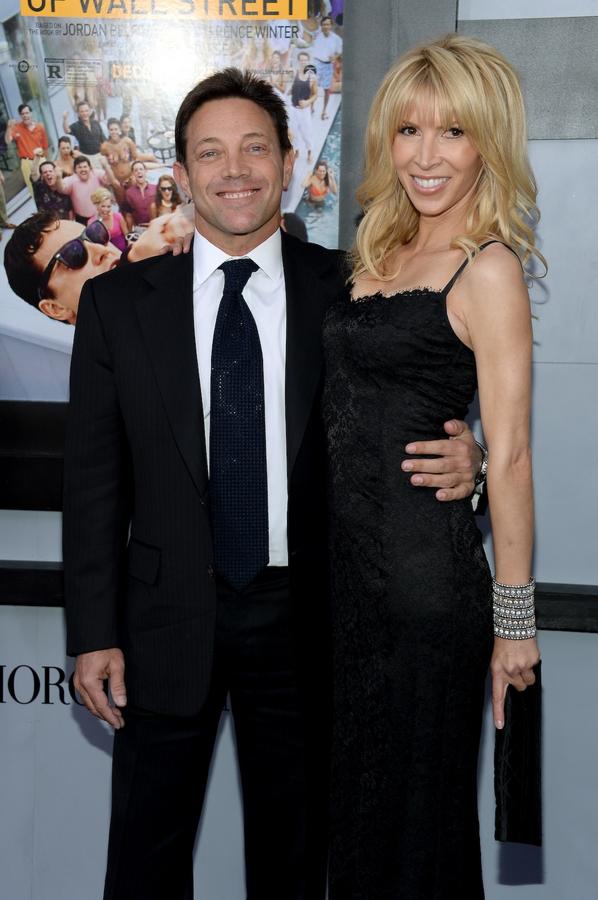
Via Getty
A Made-Up Nickname
Jordan Belfort shot to international fame largely due to the 2013 Martin Scorsese film “The Wolf of Wall Street.” This movie, funded in part by money embezzled from the Malaysian government, was based on Belfort’s memoir of the same name. As depicted, he earned his notorious moniker during the apex of his career when Forbes featured him on their cover in 1991 with the headline “The Wolf of Wall Street.”
That is false.
The actual Forbes article was titled, “Steaks, Stocks – What’s the Difference?” – a reference to the fact that before becoming a stockbroker, Belfort sold steaks and seafood door-to-door on Long Island.
Later, the article described Jordan as a “twisted Robin Hood who takes from the rich and gives to himself and his merry band of brokers.” The article also described his business model as “pushing dicey stocks on gullible investors.” At no point is he referred to as a “wolf.”
Jordan gave himself the nickname when he wrote his memoir while sitting in a jail cell with Tommy Chong of Cheech and Chong. That’s real. Apparently, it was Tommy who encouraged him to write the memoir in the first place.
Restitution Status
At his 2003 sentencing, Jordan was ordered to pay $110.4 million in restitution to roughly 1,500 victims. That’s roughly half the total amount his victims reportedly lost. Some of the 1,500+ victims were retirees, small business owners, and working-class investors who lost life savings while Jordan was crashing yachts and popping Quaaludes. The government was immediately able to generate roughly $11 million towards the restitution by selling real estate Jordan agreed to relinquish at sentencing.
From that point on, he was supposed to pay 50% of his gross annual income to his 1,513 victims.
- Between 2007 and 2009, he paid $700,000 towards his restitution.
- He paid zero dollars in 2010.
- In 2011, he sold the film rights to his two memoirs for a total of $1.045 million. You might assume he paid his victims around $500,000 from that? Nope. He paid $21,000.
- In 2012, he paid $158,000.
In 2013, for reasons I can’t quite fathom, the government agreed to adjust the restitution plan from 50% of all gross earnings to a minimum of $10,000 per month for life.
If you remove the $11 million worth of real estate that was relinquished at sentencing, to date, Jordan has only repaid around $3 million of the $110 million. In other words, he still owes his victims $100 million. And at his current bare minimum pace of $10,000 per month, $120,000 per year, it will take 70 years for Jordan to pay off his full debt. He is 63 years old. At that pace, Belfort would be 133 years old before his debt is repaid in full.
A Major Flaw in the Movie
I understand why people enjoy the movie “The Wolf of Wall Street.” It’s a debaucherous romp with lots of pretty people and insane cars/yachts/drugs/jets/parties. It has a 90% Rotten Tomatoes score.
However. It is unfathomable to me that this movie exclusively glorifies Jordan while providing not an OUNCE of perspective from his victims. How did Martin Scorsese, Leonardo DiCaprio, and screenwriter Terrence Winter (writer/director/producer of “The Sopranos,” creator of “Boardwalk Empire”), or anyone else involved in the movie, at any point say, “Are we just making a bad guy look really, really cool?”
Not only did that question apparently NOT occur to anyone, but they even gave Jordan a cameo in the film! That cameo and the film’s success allowed Jordan to spend the last 20 years working as a public speaker, TV pundit, cryptocurrency promoter, social media influencer, and frequent YouTube/Podcast guest.
Let me put it this way:
Imagine if no one had ever heard of Bernie Madoff when he was convicted of orchestrating a $17 billion Ponzi scheme. Imagine if he quietly served his time, wrote a memoir from prison, and then a decade later, Martin Scorsese made a movie called “The King of New York” starring Timothée Chalamet as Madoff. And in that movie, we never see a single victim. It’s just two hours of Chalamet-as-Madoff throwing parties at mansions in the Hamptons, Manhattan, and Palm Beach. Sailing around on one of his three yachts. Dropping tens of thousands on luxury watches. Flying private jets to Europe. All while living large on stolen money, without ever showing a single retiree who lost everything. No charities wiped out. No emotional wreckage. No consequences. Just Bernie having the time of his life.
That would be strange, right?
Bottom line, I don’t think we should be celebrating or looking to Jordan Belfort as a folk hero or capitalist icon.
(function() {
var _fbq = window._fbq || (window._fbq = []);
if (!_fbq.loaded) {
var fbds = document.createElement(‘script’);
fbds.async = true;
fbds.src=”
var s = document.getElementsByTagName(‘script’)[0];
s.parentNode.insertBefore(fbds, s);
_fbq.loaded = true;
}
_fbq.push([‘addPixelId’, ‘1471602713096627’]);
})();
window._fbq = window._fbq || [];
window._fbq.push([‘track’, ‘PixelInitialized’, {}]);