
Share this @internewscast.com
President Donald Trump has once again criticized Australia for its lack of support in the U.S. conflict with Iran.
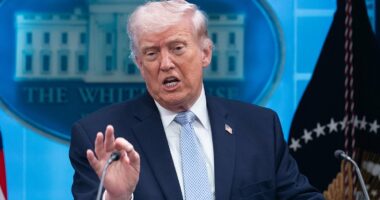
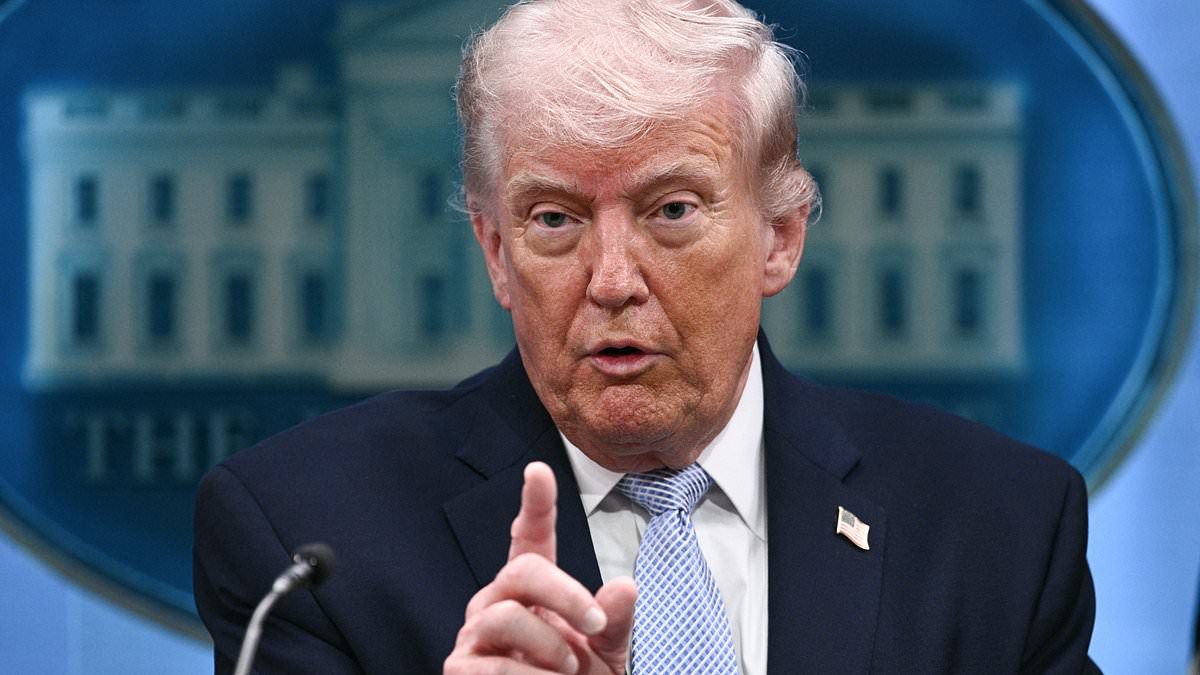
During a White House press briefing held overnight, Trump remarked, “You know who else didn’t help us? Australia didn’t help us.”
He continued his critique by adding, “Japan didn’t help us, Australia didn’t help us, South Korea didn’t help us!”
In a broader attack on the NATO alliance, Trump expressed his dissatisfaction with the organization, highlighting their failure to align with U.S. military goals in Iran. This sentiment was echoed throughout the latter part of the 90-minute press conference.
“I’m very disappointed in NATO, very,” Trump stated. “I think it’s a mark on NATO that will never disappear in my mind. They’re coming to see me on Wednesday, and all of a sudden, they want to send things.”
Trump further elaborated, “They made it clear from the start when I spoke to the UK. I said we’d appreciate a little help, and they replied, ‘No sir, we’d rather wait until you win.'”
He went further: ‘NATO is a paper tiger. We didn’t need them by the way, we didn’t need them obviously because they haven’t helped at all, just the opposite. They actually went out of their way not to help.’
The US president had held the briefing to discuss new details about the daring rescue mission to extract a wounded US airman who spent almost 48 hours stranded in Iran.

Donald Trump called out Australia directly for not helping the US in the war against Iran

Anthony Albanese previously said it was ‘not clear what more needs to be achieved’ in Iran

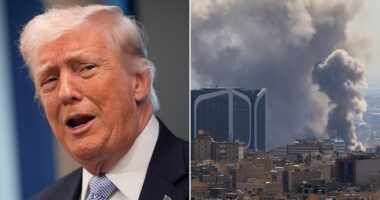
The US-Israel military campaign against Iran has now entered its sixth week (pictured a man walks beside destroyed buildings in Tehran, Iran)
Trump lauded the US forces who’d swooped into mountainous terrain in southern Iran to rescue the weapons systems officer (WSO) whose F-15E fighter jet went down on Good Friday.
‘He scaled cliff faces, bleeding rather profusely, contacted his platoon, treated his own wounds and contacted American forces,’ Trump said of the still unidentified officer, who was rescued on Easter Sunday.
The pilot was rescued the day of the crash after both airmen ejected over enemy territory, but the WSO had remained missing.
Trump also lashed out at the media for reporting that the second airman was still missing, accusing outlets of alerting the Iranians to a target.
He warned that ‘the person who reported the story will go to jail’ if they refuse to reveal their source – and as it was unclear which reporter Trump was referring to, speculation ran rampant online.
Trump’s comments are not the first time Australia has been singled out by the President, having come under increased attack in recent weeks after failing to join the war in Iran.
On Monday morning, Attorney General Michelle Rowland wouldn’t be drawn on Trump’s comments, and instead reiterated the Albanese government’s desire to de-escalate the conflict.
‘The United States, of course, is one of our longest and most important allies. But I will say this – Australia is not taking offensive action in this war,’ Rowland told 7’s Sunrise.

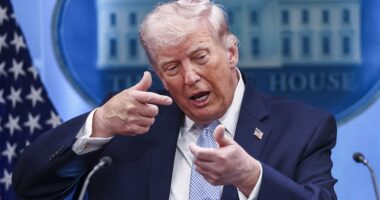
During the briefing, Trump vividly described the daring rescue mission to extract a wounded US airman who spent almost 48 hours stranded in Iran
‘We will not be deploying troops. The actions that we have taken are defensive ones. Noting that this has come in response to requests from the Gulf states, and it’s designed to protect Australian citizens who are there.
‘But again, I reiterate how important it is to continue to have a relationship with the United States. But I think all of your viewers would agree that this war cannot end soon enough.’
It follows comments made by Prime Minister Anthony Albanese last month after he repeatedly said he had not received any direct requests for help from Trump.
‘I said I wasn’t going to comment on all of his commentary on a day-to-day basis, but I again reiterate that there is no request being made to Australia that has not been agreed to,’ Albanese said.
‘President Trump, it’s up to him to explain his comments, but of course, I make the point as well that Australia wasn’t consulted before this action was undertaken, and I respect that that’s a matter for the United States.’
More to come.