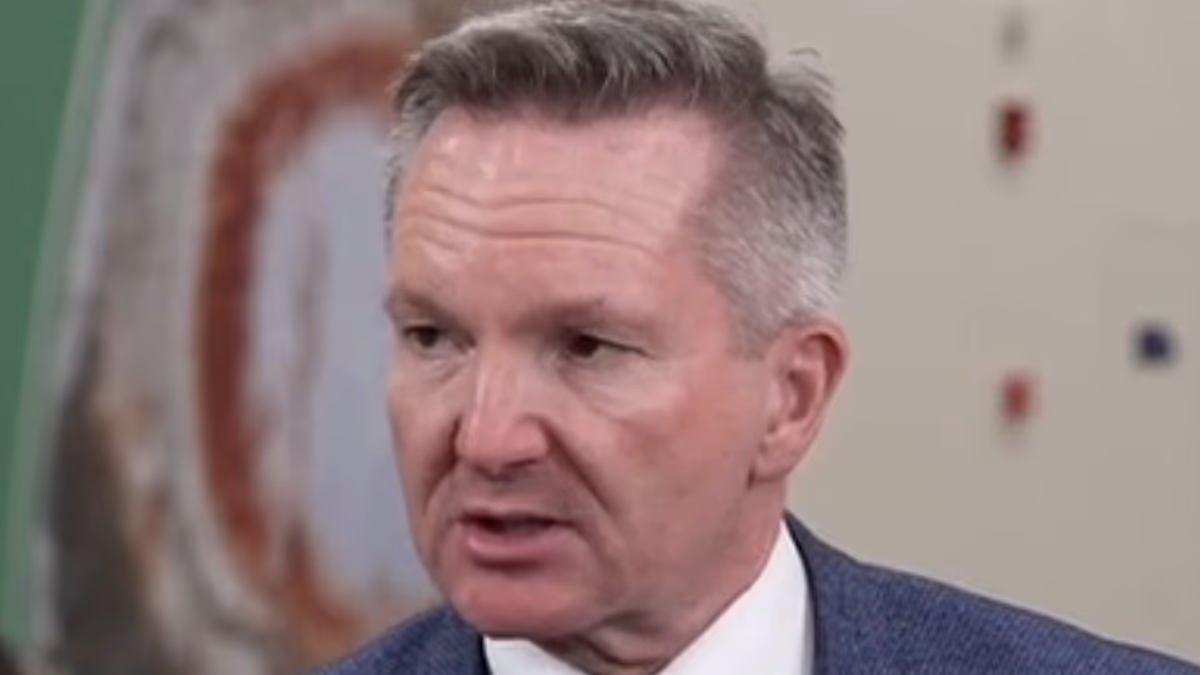

Climate Change Minister Chris Bowen and Prime Minister Anthony Albanese have promoted Australia’s renewable energy transition on the international stage, even as a new report warns that constrained power supplies could drive up energy costs domestically.
On Wednesday, Bowen appeared alongside Albanese at the United Nations COP31 climate conference in Antalya, Turkey, which is being held from November 9 to 20.
After avoiding Australian journalists for much of the day, Bowen spoke with British CNN journalist Becky Anderson and highlighted Labor’s plan to move the country away from fossil fuels.
‘There will be no new coal-fired power stations in Australia,’ he said.
However, Anderson later questioned Bowen about the apparent tension between his role in leading the climate negotiations as COP31 co-president and Australia’s position as one of the world’s largest coal exporters.
Australia ranked second globally for thermal coal exports last year, behind only Indonesia, while remaining the world’s biggest exporter of metallurgical coal.
‘Generally, yes – we’re a coal mining country. Many countries depend on our coal, both metallurgical and thermal,’ he said.
The interview took place as energy consultancy Rystad Energy warned that Australia’s shift to renewable power could push wholesale electricity prices close to double their current level by 2029.

At COP31, Climate Change Minister Chris Bowen told CNN he was proud Australia had no plans for new coal-fired power stations, but did not mention the country remains one of the world’s leading coal exporters

Australia does not plan to replace its aging coal-fired power stations. Yallourn Power Station in Victoria is due to close in 2028
During the CNN interview, Bowen promoted Labor’s target of generating 82 per cent of Australia’s electricity from renewable sources by 2030 and called on other countries to pursue similar goals.
‘We need to tell boardrooms around the world to keep investing, because governments will continue on this journey,’ he said.
‘We also need to make that case because, in domestic politics in almost every country, there are deniers and delayers.’
Bowen insisted Australia remained on track to meet its renewable energy target.
‘So 82 per cent by 2030 is pretty ambitious from our point of view, up from 33 per cent in 2022.
‘That’s a significant increase. Some people in Australia say it cannot be done. I believe we can get there.’
Earlier on Wednesday, Bowen repeatedly avoided questions from journalist Sophie Elsworth about the findings of the Rystad report.
His brief response was: ‘Engagement on matters of climate change is very important. Thank you.’

Rystad Energy forecast on Wednesday that wholesale electricity prices could nearly double by 2029 as government support for coal power is withdrawn without enough replacement renewable capacity
Rystad said wholesale power prices were likely to rise because Labor was reducing support for coal generation more quickly than it was bringing replacement renewable projects online.
The consultancy forecast prices could climb from about $60 per megawatt hour to $110 as available supply tightened.
It noted that household electricity bills would not necessarily double, because wholesale power represents only one part of the final price. Network charges, retail costs and other expenses also contribute to the amount consumers pay.
Even so, any sustained increase in wholesale prices would likely pass at least some additional costs on to households in the years ahead.
Speaking at COP31, Albanese addressed concerns about future supply by pointing to the rapid expansion of rooftop solar.
‘In just six years,’ he said, ‘Australia has doubled its renewable generation, which now provides half of our electricity mix.
‘We are proud to have one of the world’s largest rooftop solar and battery markets.
‘More than 600,000 home batteries were installed in the past year alone. That is extraordinary for a nation of just 28 million people.’

Prime Minister Anthony Albanese is welcomed after arriving at Antalya airport

Albanese told COP31 delegates that Australia’s renewable generation had doubled in six years
Scientists warn that global temperatures are likely to rise more than 1.5C above preindustrial levels.
The 1.5C limit was established as a key objective under the 2015 Paris Agreement and remains central to international climate negotiations.
Leaders from several of the world’s biggest-emitting nations, including the United States, China and India, did not attend the COP31 summit.
UN Secretary-General António Guterres used his opening address to urge the leaders who were present to take stronger action on climate change.
‘Climate action is about more than a dispute over a number or a thermometer. We are fighting for our lives and the future of our children,’ he said.
Guterres set out four priorities for the negotiations: ending dependence on fossil fuels, preparing for a warmer world, increasing financial assistance from wealthy nations to countries confronting climate impacts, and choosing international co-operation over conflict.
Join the discussion
What is your view on rising energy costs as Australia moves away from coal-fired power?


