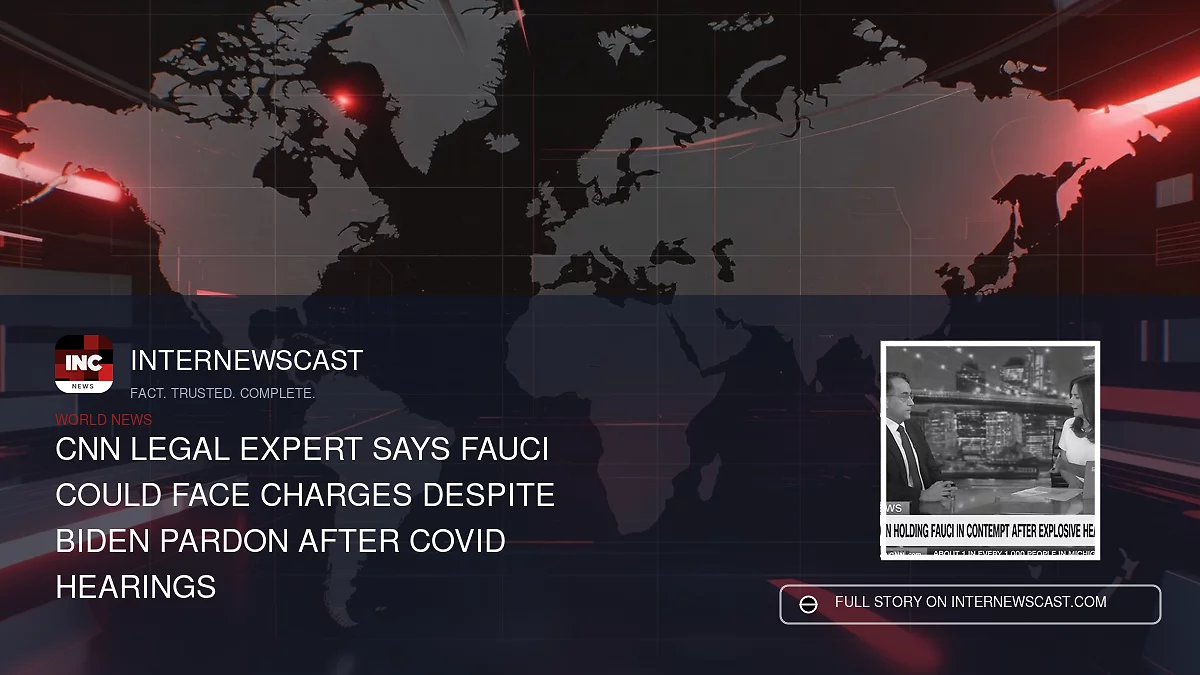

A Yale-educated legal expert said Wednesday that Anthony Fauci may have damaged his own position with his appearance before the Senate Homeland Security Committee, telling CNN the testimony could create new legal headaches for the former National Institutes of Health official.
Ryan Goodman, a New York University law professor, made the assessment during an interview with anchor Erin Burnett, as lawmakers prepared for a key vote on whether to hold Fauci in contempt over his refusal to testify next week.
Goodman pushed back on the notion that Fauci had safely navigated the hearing after repeatedly invoking the Fifth Amendment rather than answering questions about allegations that he misled Congress and the public on the origins of Covid-19.
‘I think it makes it worse,’ Goodman said, suggesting the approach raised fresh questions about the legal strategy behind it.
‘It’s even a curious way in which you wonder what his legal advice was, why they decided to do that.’
The former special counsel to the Defense Department noted that any potential offenses arising from the hearing itself would not fall under Joe Biden’s blanket pardon for Fauci, including a possible contempt issue.
‘There could be – theoretically, at least – a Justice Department that goes after him for not answering when he is not really facing that criminal charge,’ Goodman said.
Burnett noted that Fauci may have been trying to steer clear of potential ‘perjury traps’ set by Republicans on the committee, but added that for ordinary viewers, the response could sound more basic: ‘Why wouldn’t you just say the truth?’

New York University law professor Ryan Goodman criticized the strategy seen from Anthony Fauci during Wednesday’s Senate Homeland Security Committee hearing surrounding the disease doctor’s handling of the Covid-19 pandemic

Fauci, protected by a pardon from Joe Biden, pleaded the Fifth 111 times to avoid answering any questions
‘So… it doesn’t sound good,’ she admitted.
Biden’s pardon covers any potential federal offenses that may have occurred between January 1, 2014, and January 19, 2025. It was awarded to Fauci in early 2025 on the then-president’s final day of office.
Senator Rand Paul, the committee’s chairman, has alleged Fauci misled Congress and signed off on funding for experiments overseas that may have helped spread the virus.
Fauci has repeatedly insisted otherwise, saying his NIH did not fund such research in China.
Fauci, 85, said of Paul during the hearing: ‘The sole reason he is calling me before this committee is to prompt me to say something, anything, that could vindicate his repeated public pledges that I end up, in his words, “behind bars.”‘
The emergence of COVID-19 in late 2019 is the subject of two main theories – one being a laboratory-related incident, and the other natural zoonotic transmission, meaning it was transferred from animal to human.
Personal diary entries penned by Fauci from early 2020 to his retirement in 2022 released ahead of the hearing show uncertainty from Fauci on whether the virus was engineered or leaked from a lab.
Paul has argued the NIH funded research involving coronaviruses at the Wuhan Institute of Virology under Fauci, and has accused the retired official of misleading Congress about whether that work constituted gain-of-function research.

Goodman dismissed the idea the 85-year-old disease doctor was in the clear by repeatedly invoking the Fifth Amendment

Burnett acknowledged that while Fauci was likely trying to avoid ‘perjury traps’ from Republican overseeing on the committee, ‘to the layperson, it’s saying, well, “Why wouldn’t you just say the truth?”‘
More than six years later, there is still no definitive answer about how COVID-19 began.
Paul addressed the approved vote to hold Fauci in contempt of Congress next week to reporters on Wednesday with comments similar to Goodman’s.
‘We believe with his liability, his immunity from criminal liability, that he didn’t need to hide behind the Fifth Amendment and that maybe the Fifth Amendment doesn’t attach when you have a pardon in place,’ he explained.
Goodman framed the doctor’s ability to plead the Fifth again as ‘a legal question.’
‘But the question on contempt will be voted on, and then there’s a question of whether or not the Department of Justice will take it up,’ he said.


