
Opinions were loud and plentiful after President Donald Trump last week barred some of his favorite “lamestream media” adversaries from the White House.
By Thursday, the uproar—and the sound of champagne corks popping in left-leaning newsrooms—had made it difficult to determine what had actually happened. A federal judge had ordered the White House to temporarily restore press access for journalists from CNN, MS NOW and Politico who had been banned from the premises.
Now that the initial excitement has faded, however, America—and the media—should acknowledge the obvious: Once again, we fell into Trump’s trap.
Since the rise of MAGA, Trump has turned political distraction into an art form. He provokes reporters into pursuing short-lived scandals while the larger story slips from view.
Trump did not invent the tactic, but he has refined it to an extraordinary degree.
The expression “wag the dog” became part of America’s political vocabulary after the 1997 film of the same name. The movie depicted a Washington spin doctor inventing a war in Albania to divert attention from a presidential sex scandal. Later, when President Bill Clinton faced accusations that he had ordered US military strikes to distract from the growing Monica Lewinsky scandal, the phrase gained even greater currency.
I previously worked as an anchor at Fox News and still have friends and sources at the network’s Manhattan headquarters. They told me there were knowing chuckles when Trump announced on Friday, apparently without warning, that he was banning outlets for publishing “fiction and lies.”

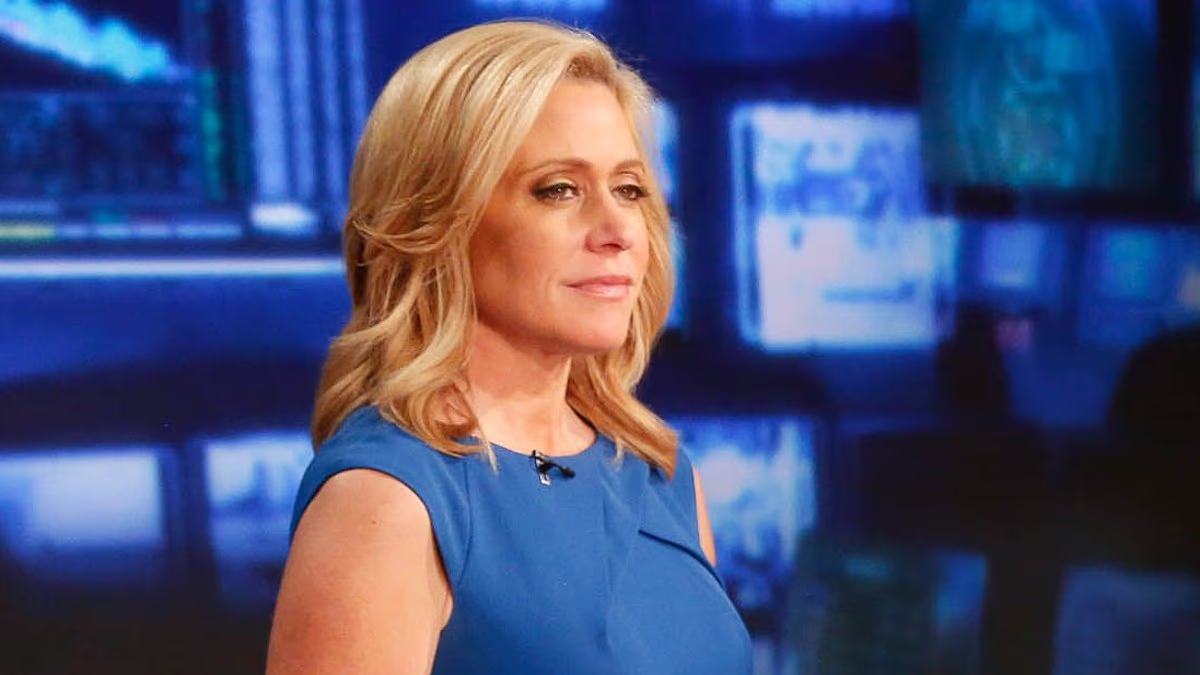
Melissa Francis, left, is a former Fox News anchor who still has friends and sources at the network’s Manhattan headquarters.

The president’s escalating battle with the news media prompted strong reactions across the political spectrum.

Why Fox News joined rivals against Trump’s media ban
At least one Fox News veteran I spoke with immediately understood the difficult position the network had been placed in.
No news organization—not even Fox News—could stand by while a president targeted fellow journalists.
He understood how quickly the network itself could become the next target.
In October 2009, President Barack Obama’s Treasury Department attempted to exclude Fox News from a series of interviews with Kenneth Feinberg, whom the administration had appointed to oversee the distribution of relief funds after the 2008 financial crisis.
The other television networks covering the White House—ABC, CBS, NBC and CNN—refused to participate in the Feinberg interviews unless Fox was included. Treasury officials reversed course within hours, and Fox ultimately took part.
That history left Fox News little choice when CNN, MS NOW and Politico were targeted. The network linked arms with its competitors and declined to cover Trump’s event.
Fox News contributor Ari Fleischer responded quickly on social media: “I agree with POTUS that several media outlets covering the WH are biased and unfair… Banning them from the WH is not the solution… Challenge liberal reporters. Argue and defeat them. Don’t ban them. Or one day they’ll ban us.”

Bill Clinton faced accusations that he ordered US military strikes to divert attention from the intensifying Monica Lewinsky scandal during his presidency.

Fox News viewers rage over solidarity with rival networks
Fox News anchor Jacqui Heinrich, who serves as president of the White House Correspondents’ Association, also weighed in: “The Constitution protects the freedom of the press from government interference.”
Fox News viewers, unsurprisingly, were far less receptive to the brief display of media solidarity. Still angry over the cancellation of Trump ally Maria Bartiromo’s show, many saw hypocrisy in the network’s position. “Fox News pulled out of the White House Press Pool in solidarity with CNN, MSNOW and Politico which were banned from the White House. This is the same Fox News who just fired Maria Bartiromo for trying to report the news,” one viewer wrote on X.
Yet few appeared to recognize the effectiveness of Trump’s “briar patch moment”: He persuaded the media that it had gained the advantage, when in reality it was responding exactly as he wanted.
United, the media denied Trump all coverage – refusing to cover his arrivals and departures – at the exact moment he didn’t want their questions anyway.
What was the biggest news story this week?
A United Nations General Assembly meeting in New York City during which Trump defended waging of an unpopular war against Iran, even as his party faces down devastation in the midterms, less than 40 days away.
Instead of reporters pummeling Trump on the things Americans actually care about – namely soaring prices at the pump – the media willingly kept their distance, voluntarily giving him the space he desperately needs.

Fox News viewers, of course, couldn’t care less and almost choked on this temporary solidarity. Still chafing from the cancelation of Trump ally Maria Bartiromo’s show, they saw a pattern (Pictured: Bartiromo interviewing Trump on April 14).
White House pushes its own news platform amid media row
And if you need receipts, just look at how the administration used the opportunity to push its own news platform (crossing their fingers that at least some Americans will turn off cable news forever).
‘Get real-time updates and live events streamed DIRECTLY to your phone. No noise. Just the news that matters most – straight from the Trump Administration,’ the White House posted on X.
Of course, if you are really cynical, you might be tempted to believe that it’s not just Trump playing this game. He wasn’t the only winner.
CNN, MS NOW and Politico all got the opportunity to shout their righteous indignation about an assault on freedom of the press.
The only loser seems to be Fox News, which was forced into the awkward position of defending the very networks it often criticizes as bogus, making the channel look a bit weak.
Somewhere, Maria Bartiromo is laughing.


