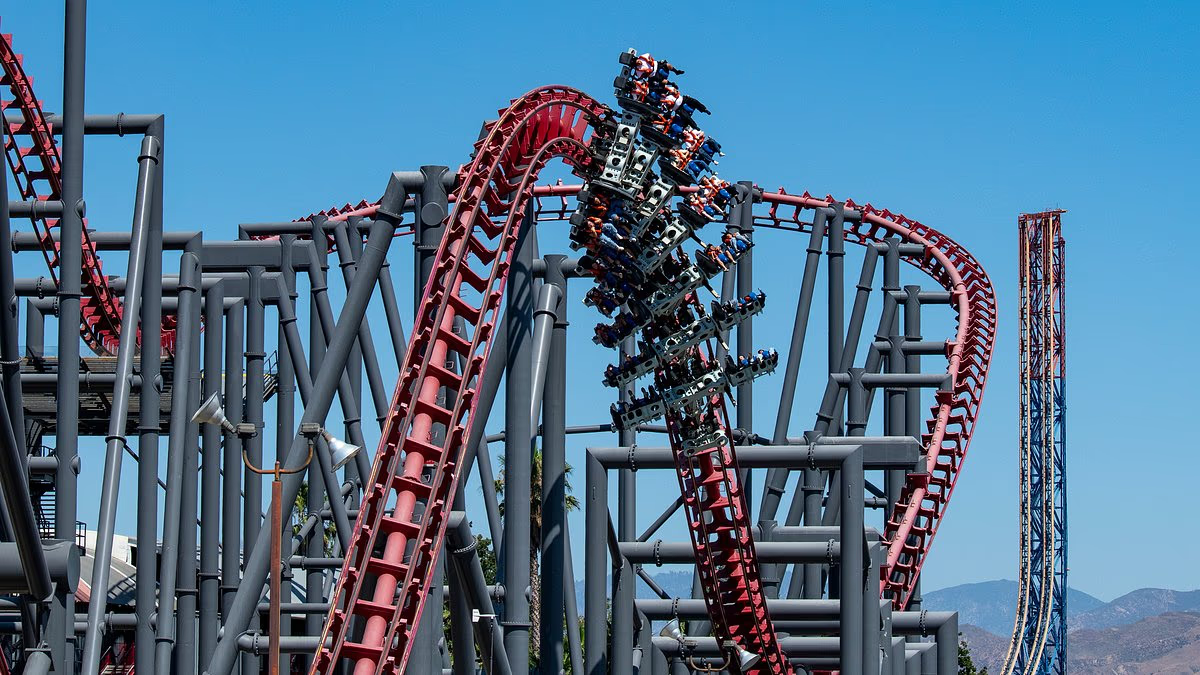

A California theme park has closed one of its most advanced rollercoasters after the ride was connected to deaths and severe injuries.
X2 at Six Flags Magic Mountain in Valencia had been billed as a “[rite] of passage for the ultimate daredevil,” but a new report suggests the high-intensity rollercoaster’s violent spins, drops and inversions may push riders beyond what the human body can safely withstand.
The attraction was shut down on July 12, one day after the second of two devastating brain-injury incidents reported within less than a week.
Those cases, however, may be part of a much broader pattern. A CNN investigation found they were the latest in a decades-long series of incidents allegedly involving life-changing disabilities, comas and deaths linked to the ride.
According to CNN’s reporting, Pamela Guillen, a 40-year-old from Hawaii, lost consciousness shortly after riding X2 while visiting the park on a family vacation.
She was rushed to hospital, where doctors discovered brain injuries more commonly associated with high-speed crashes. Guillen remained in a coma for two weeks.
Only days later, 25-year-old Los Angeles resident Naomi Greer-Wilkinson was also hospitalized after going on the same Six Flags Magic Mountain rollercoaster. As of CNN’s report, she remained in a coma.
A park spokesman told Our News Outlet: “The ride remains closed at this time.”


Six Flags Magic Mountain has been forced to close its popular X2 rollercoaster after a report linked the ride to more than a dozen severe injuries.
What injuries has the ride caused?
According to medical records, depositions, and legal filings, X2 has been linked to more than a dozen serious injuries and hospitalisations since it opened in 2002.
For example, in 2014, 17-year-old Selena O’Neil rode X2 with her friends.
Immediately after exiting the ride, her head began to ache, her vision blurred, and Selena struggled to walk straight.
Her right leg started to shake whenever she put weight on it and it stuck out at an unusual angle.
After doctors examined the otherwise healthy teenager, they discovered a subdural hematoma, an injury that occurs when blood collects on the surface of the brain.
In 2019, hospital doctors detailed her case in a medical journal without naming X2, directly blaming her injuries on acceleration caused by a rollercoaster.
The doctors warned: ‘Advances of rollercoaster technology and industry competition for thrill–seeking patrons may ultimately improve acceleration and performance beyond the passenger’s physical ability to tolerate them.’

Medical experts have found that the extreme forces created by the ride are capable of causing brain injuries (pictured) usually associated with high–speed collisions.
However, court filings made by Selena’s family and seen by CNN revealed that prior to her injuries, at least five riders had visited the hospital after riding X2.
Those included a 62-year-old man who had sued the park in 2009 after suffering a traumatic brain injury he alleged was caused by the ride.
Has anyone died after riding X2?
In 2022, college graduate Christopher Hawley, 22, rode X2 with his cousin and brother.
According to court records filed afterwards, the three relatives were flipped like ‘rag dolls’, and Christopher hit his head on his seat several times.
Shortly before exiting the ride, Christopher complained of being light-headed, and he was taken to nearby Henry Mayo Newhall Hospital.
Doctors discovered that his brain was bleeding so badly that it was crushing his brain into one side of his skull, causing it to bulge out when surgeons opened his skull to release the pressure.
Despite being in excellent health when boarding the ride, Christopher was dead less than ten hours later.

Christopher Hawley (centre) died in June 2022, the day after visiting the park and riding the X2 rollercoaster.

The LA County Medical Examiner later ruled that Christopher died as a result of blunt head trauma less than ten hours after riding X2.
Previously, in 2010, a 28-year-old single mother named Hilda Farias also died after riding X2.
Experts suspected that her death was caused by a brain abnormality that ruptured due to the intense forces of the ride.
Why is X2 so dangerous?
Typically, the forces that people experience on a rollercoaster are well within safe bounds.
However, X2’s ‘four–dimensional’ design makes it significantly tougher on riders’ bodies.
In addition to reaching a top speed of 76mph (120km/h) and featuring a 215ft (65m) drop, the seats also rotate independently.
During two so-called ‘raven turns’, the carriages spin upside down while looping, sending the riders backwards into sheer drops.
There are only two other rollercoasters in the world with a similar design, one in China and one in Japan.

Scientists have found that the forces created by most rollercoasters are lower than those exerted by football headers, but X2’s unique design created a much greater impact.
Those additional twists and turns add extra forces to each turn that can cause extremely rapid acceleration in the brain.
As the brain accelerates within the skull, this creates ‘very rapid deformations in the brain, which can lead to diffuse axonal injury, tissue tears, and vascular disruptions’.
Are rollercoasters safe to ride?
Despite around 300million people riding rollercoasters each year, the number of people injured is relatively low.
However, injuries and even deaths are not unheard of.
A 2005 study found that there were 39 deaths associated with rollercoasters in the US between 1994 and 2004, 15 of which were caused by bleeding of the brain or cardiac problems.
Similarly, a 2013 study found that 4,423 children in the US went to the emergency room each year between 1990 and 2010 for treatment of injuries ‘resulting from amusement park rides’.
Common injuries were to the head and neck, usually caused when the child fell off, on to or against a ride.

Studies show that the peak velocity exerted on the brain by a rollercoaster is comparable to sprinting and less than a header, but exceptionally dangerous rides like X2 require further investigation.
But these injuries tend to be minor, and deaths usually occur as isolated cases, rather than the repeated incidents associated with X2.
Overall, hospitalisation rates for rollercoasters are low, sitting at just 1.5 per cent annually, with an average of 4.5 deaths per year.
Likewise, studies suggest that the forces exerted by a typical rollercoaster are generally not sufficient to cause brain trauma.
According to one 2017 study, rollercoasters lead to brain strains smaller than mild football headers and comparable to the forces exerted while running.
Co-author of the report, Professor Lyndia Wu, of the University of British Columbia, told CNN: ‘I personally don’t think head injury should be an expected risk from going on a rollercoaster ride, and there is no reason a ride can’t be properly designed to prevent injuries like this.’
However, the researchers note that some higher-risk rides, such as X2, need to be investigated further.