
As tensions continue to simmer in the Middle East, Israel is reportedly gearing up for renewed military action against Iran. This comes as U.S. President Donald Trump grows increasingly impatient with the ongoing attacks on American forces and their allies during a fragile ceasefire period.
According to sources familiar with the situation who spoke to CNN, the planned strikes would specifically target high-ranking Iranian officials and the country’s critical energy infrastructure. The objective of this strategic move, they claim, is to exert pressure on Iran, hoping to prompt further concessions in ongoing negotiations.
Preparations for such military action were already in place prior to the ceasefire agreement, which was reached in early April. Despite the temporary halt in aggression, frustrations have mounted, particularly for President Trump, who finds himself caught between a rock and a hard place. He is eager to resolve the impasse but remains cautious about engaging in a full-blown conflict that could escalate tensions in the already volatile Strait of Hormuz.
Meanwhile, Israeli Prime Minister Benjamin Netanyahu has maintained a skeptical stance regarding any peace overtures from Iran. His government’s readiness to strike underscores the complexities of the geopolitical landscape and the fragile nature of peace efforts in the region.
Trump has been infuriated by the stalemate but is reluctant to be drawn back into a full-scale conflict amid fears it will exacerbate the crisis in the Strait of Hormuz.
Israel’s Prime Minister Benjamin Netanyahu has been wary of any Iranian peace overtures from the outset.
Iranian missiles fired toward United Arab Emirates on Monday accelerated planned strikes, an Israeli official told CNN.
Trump last night claimed that ‘we’ve taken out’ most of America’s remaining targets and predicted the war would be over within the next three weeks.
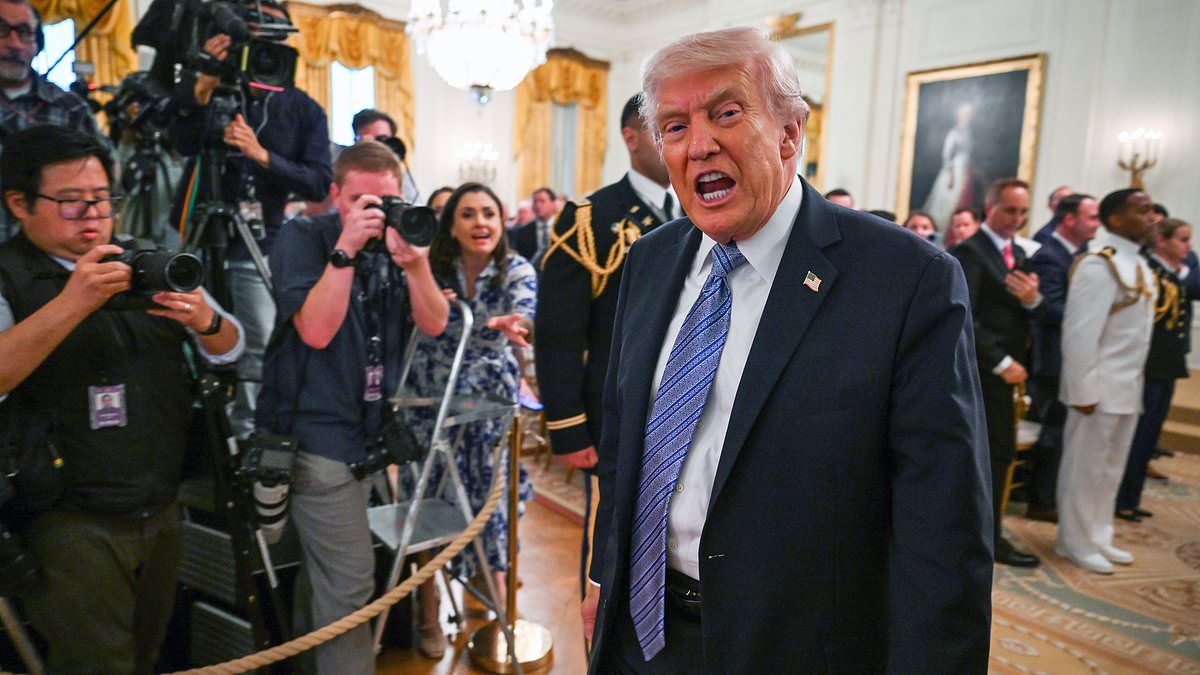
Trump departs a summit with small business owners to mark National Small Business Week in the East Room of the White House in Washington, DC
Smoke rises as the Israeli army conducts demolition operations in the southern Lebanese village of Taybeh, as seen from the Upper Galilee in northern Israel, 27 April
‘Probably another two weeks, two weeks, maybe three weeks. And time is not of the essence for us’, Trump told radio talk show host Hugh Hewitt.
Defense Secretary Pete Hegseth insisted Tuesday that the ceasefire is holding – even as he admitted Iranian forces had attacked US troops nearly a dozen times since the pause in fighting.
He told a Pentagon briefing: ‘The US aims to protect shipping from Iranian aggression. The US won’t need to enter Iranian airspace or waters as part of opening the Strait of Hormuz. We’re not looking for a fight. They said they control the Strait, they do not.’
His remarks come after Iran’s chief negotiator warned Tehran has ‘not even started’ in the battle to control the Strait hours after attacks were traded in the waterway.
Chairman of the Joint Chiefs of Staff General Dan Caine said Iran had attacked ‘attacked US forces more than 10 times’ since the ceasefire began last month.
Tehran has refused to come back to the negotiating table, even under mounting pressure from the US blockade of its ports.
Iran launched devastating new strikes in the Middle East on Monday after Trump announced the US Navy would reopen the Hormuz Strait with the launch of ‘Project Freedom.’
Hegseth told reporters the Pentagon stands ‘locked and loaded’ to respond immediately if Trump orders military strikes to resume.
Israeli Prime Minister Benjamin Netanyahu
‘That option is always there,’ Hegseth said. ‘And Iran knows that, and that’s why, you know, their choices in Project Freedom are important.’
‘Trump has directed US Central Command to restart the free flow of commerce through the Strait of Hormuz under the umbrella of Project Freedom,’ Hegseth added. ‘To be clear, this operation is separate and distinct from Operation Epic Fury.’
Trump announced the effort to guide commercial tankers through the Strait where hundreds have been stuck since the Iran war began on February 28.
Tehran’s Islamic Revolutionary Guard Corps (IRGC) responded by warning that any ship found violating the regime’s maritime rules will be stopped by force.
Iran launched four missiles at America’s Middle East ally the UAE on Monday and blew up a major oil port, following Trump’s move to reopen the strait.
The UAE issued a missile alert, the first since the fragile ceasefire between the US and Iran was announced last month.
Its defense ministry said it intercepted three missiles, while a fourth ‘fell into the sea.’ An official noted that the country’s air defenses ‘are currently dealing with missile attacks and incoming drones from Iran.’
Trump said the US had ‘shot down seven small boats’ during the latest skirmish but said only a South Korean ship had sustained damage.

U.S. Secretary of Defense Pete Hegseth holds a briefing on the Iran war, with Chairman of the Joint Chiefs of Staff General Dan Caine (not pictured), at the Pentagon in Washington, D.C., U.S., May 5
‘Perhaps it’s time for South Korea to come and join the mission!,’ the President suggested on Truth Social.
Tehran’s decision to launch these attacks officially resumes hostilities between Iran and the US in the Middle East.
Authorities also announced that a massive fire broke out at the Fujairah Oil Industry Zones on Monday following a drone attack from Iran.
A senior US official said that US warships and aircraft protected several commercial vessels from Iranian attacks earlier on Monday.
Sources said an Iranian drone successfully struck a Marshall Islands-linked oil vessel named the JV Innovation while it was attempting to move through the strait.
US warships responded to the cruise missile fire by sinking six small Iranian boats