
Four Australians aboard a cruise ship hit by a hantavirus outbreak are set to be the final passengers allowed to disembark, with their return to Australia anticipated within 48 hours.
The MV Hondius has arrived at Tenerife, a Spanish island, where authorities, including representatives from the World Health Organization, are overseeing the evacuation process, which began Sunday night Australian time.
The delay in their return is attributed to the lengthy journey required for the Australian charter flight designated to bring them back. This flight, also carrying a New Zealand citizen and a permanent resident, is expected to land in Australia on Tuesday.
The Australian government has confirmed that officials in both Tenerife and Canberra are actively coordinating the response. Medical personnel will be on the charter flight, which is scheduled to depart around 1 a.m. Tuesday, Australian time.
These passengers hail from New South Wales and Queensland, with one having already returned from the ship to Australia.
It has been reported that none of the returning individuals are currently exhibiting symptoms of the hantavirus. However, they will undergo quarantine measures managed by their respective states.
The first plane carrying passengers from the hantavirus-hit cruise ship left Spain´s Canary Islands on Sunday for Madrid, where they will be taken to a military hospital.
Spanish nationals were the first to leave the MV Hondius, which remains anchored off Tenerife, the largest island in the Spanish archipelago off the coast of West Africa. The ship arrived hours earlier.
Evacuations of a cruise ship at the centre of a rat-borne virus outbreak have begun
Passengers will be flown back to their home countries with Australia the last plane to arrive
The luxury cruise ship had 147 passengers who have remained on board since the outbreak. the Dutch flagged vessel will return to Rotterdam when passengers have left
None of the more than 140 people on the Hondius has shown symptoms of the virus, Spain´s health ministry, the World Health Organization and cruise company Oceanwide Expeditions said.
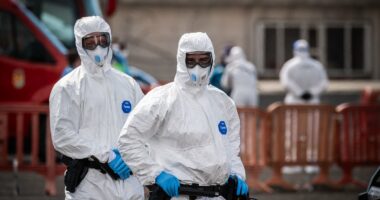
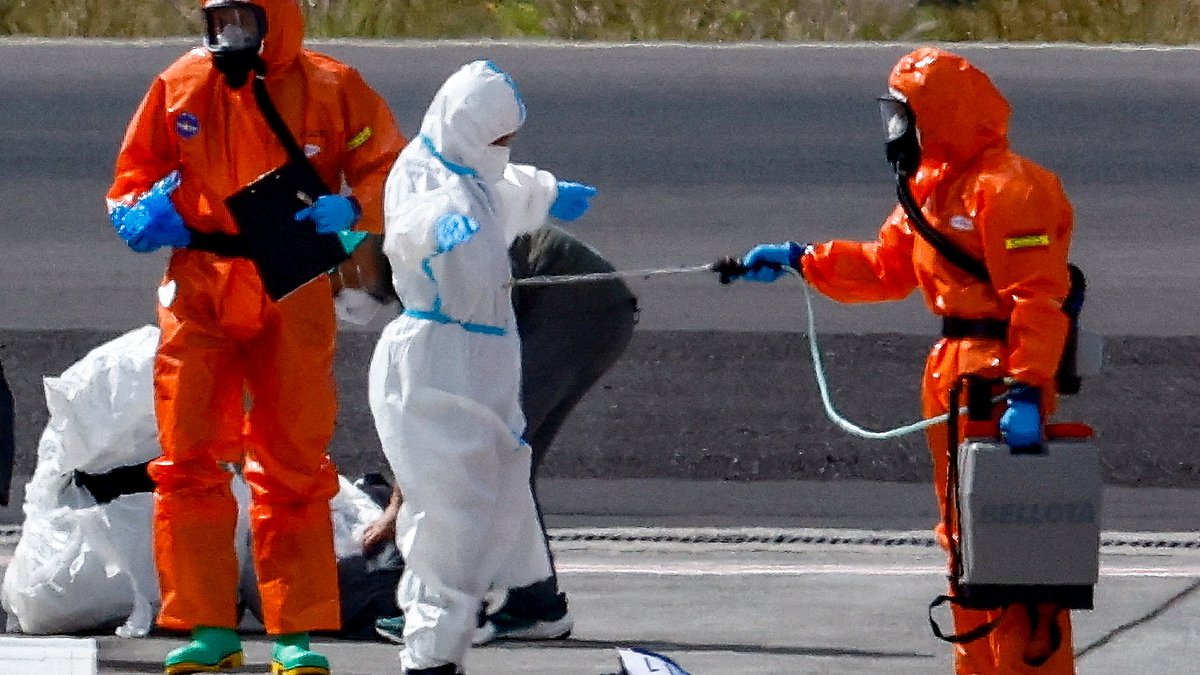
Those disembarking and personnel working at the port of Granadilla in Tenerife were wearing protective gear during the evacuation process, including face masks, hazmat suits and respirators.
‘The entire operation is proceeding normally,’ Spanish Health Minister Mónica García said.
Hantavirus usually spreads when people inhale contaminated residue of rodent droppings and isn´t easily transmitted between people.
But the Andes virus detected in the cruise ship outbreak may be able to spread between people in rare cases. Symptoms usually show between one and eight weeks after exposure.
Three people have died since the outbreak, and five passengers who left the ship are infected with hantavirus, which can cause life-threatening illness.
Passengers and crew members disembarking are leaving behind their luggage, and are allowed to take only a small bag with essential items, a cellphone, a charger, and documentation.
In a statement on Sunday, Oceanwide Expeditions, the operator of the MV Hondius ship, said: ‘Oceanwide Expeditions continues to work with relevant authorities to bring the medical situation on board to a conclusion.
Passengers watch as others are disembarked from the hantavirus-stricken cruise ship
The WHO is leading the response at the Spanish island of Tenerife

A passenger waves to the Guardia Civil officers as they are disembarked from the ship
‘The vessel arrived at the port of Granadilla, Tenerife, on Sunday… Led by local authorities, the WHO, and select international governments, the disembarkation of all guests and a limited number of crew members is underway.
‘Upon disembarkation, all individuals will be transferred immediately to waiting aircraft.
‘The sequence of disembarkation is being coordinated with the arrival of repatriation flights.
‘Oceanwide Expeditions is not involved in the planning and facilitation of guest screening and repatriation.
‘As outlined by the WHO, in partnership with several international organizations and governments, guests will be transported by air to their respective countries, where they will enter quarantine procedures.
‘Respective national authorities determine these procedures. No quarantine of non-Spanish nationals will take place in Spain.
‘After all guests and limited crew have disembarked, Hondius will bunker and take on necessary supplies at Santa Cruz, Tenerife.
‘Following this, the vessel will transit to the port of Rotterdam, the Netherlands with the remaining crew members aboard.
‘Further details regarding the vessel’s arrival in Rotterdam will be provided when available. The expected sailing time to Rotterdam is around five days.’