
Every automotive part that enters the US is slapped with a 25 percent tariff.
The tariffs enforced by President Donald Trump aim to revitalize the US automotive manufacturing industry, which has been in a state of decline for several decades.
But China responded to the auto tariff — and its separate, even higher product levies — by stopping nearly all trade on rare earth magnets.
The magnets are indispensable for modern car production. They’re used in dozens of vehicle parts, including brakes, seats, screens, and ignitions.
But more than two decades after domestic magnet-making factories migrated to China, the US now produces almost none.
Without access to Chinese supplies, factories across the Midwest and the South could soon face shutdowns, automakers and analysts are warning.
And US carmakers are running out.
‘This situation could mirror the chip shortage, where automakers are unable to produce vehicles if the rare earths ban persists,’ Seth Goldstein, an analyst specializing in Tesla at MorningStar, explained to DailyMail.com.

Carmakers have been struggling to keep down their vehicle costs, with the average consumer spending over $49,000 on a new car in May 2025
‘Tesla is planning to remove rare earths magnets from their EV motors, so the company should have a limited impact on its EV sales.’
Beijing officials stopped sending US automakers the magnets in early April.
These materials, which were last mass-produced in the US during the late 1990s, are found throughout vehicles. In fact, a modern power-adjustable seat could contain up to 12 separate magnets.
In May, the trade groups representing some of the biggest automakers in the US — including General Motors, Toyota, Volkswagen, and Hyundai — sent a letter to President Trump warning about the potential US manufacturing issues because of the dwindling magnet supply.
‘Without reliable access to these elements and magnets, automotive suppliers will be unable to produce critical automotive components,’ the letter from the Alliance for Automotive Innovation said.
‘In severe cases, this could include the need for reduced production volumes or even a shutdown of vehicle assembly lines.’
Meanwhile, the problem could get worse, even if Beijing officials re-open the magnet floodgates.
Some Chinese producers have suspended operations altogether, waiting for export approvals.

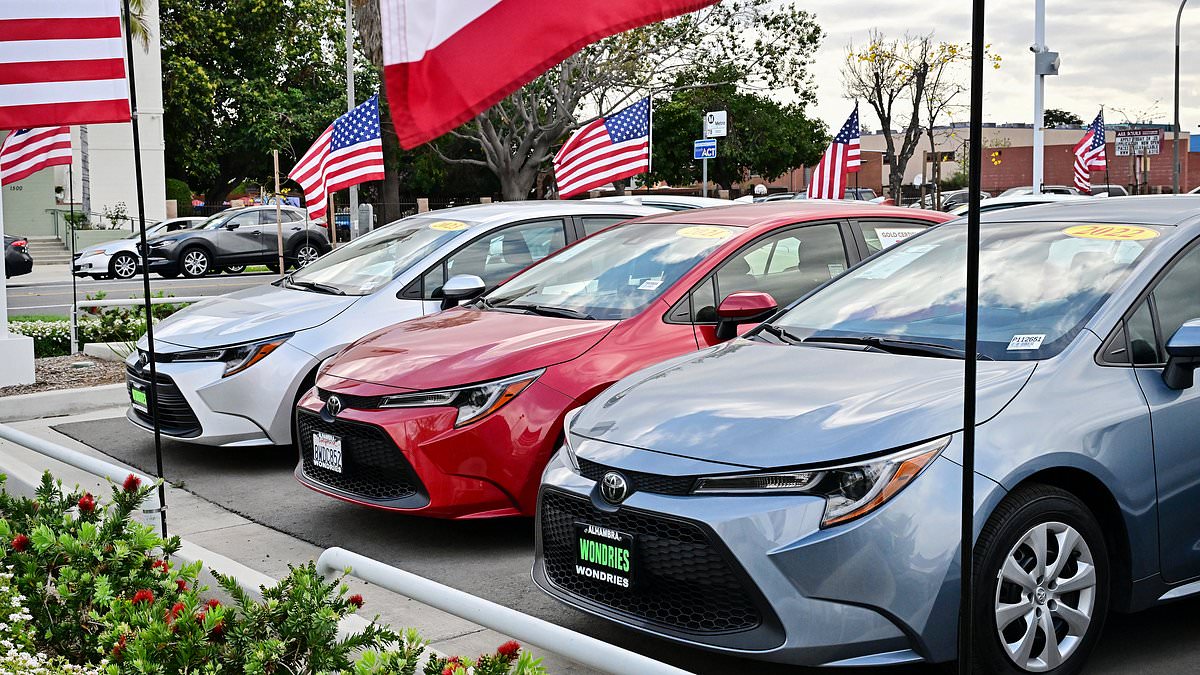
Toyota has the lowest days-on-lot metric in the entire auto industry – it’s a reading that shows how much supply each company has of its US vehicles

Car companies have been grappling with how to react to tariffs – now, they might have to deal with dwindling parts supplies
The resulting delays have jammed up supply chains, leaving automakers scrambling to secure critical inputs.
The trade blockages are also colliding with dwindling supplies on new vehicle lots.
Some car companies are facing shortages of product on their new vehicle lots: Toyota, for example, has fewer than 30 days’ worth of vehicles at many of their American dealerships.
These compounding issues could send the price for remaining vehicles further through the roof as demand outstrips supply, and American manufacturing can’t produce enough.
It currently costs the average American more than $49,000 to drive a new vehicle off a dealership lot.
Goldstein pointed out that there are signs for hope: Saudi Arabia, a country that is increasing trade relations with the US, is investing in rare earth production.
‘Any shortage could prove temporary,’ Goldstein added.
But for now, the manufacturing impact extends well beyond cars, too.
Factory automation, semiconductors, and critical military components all rely on high-performance magnets made from rare earth elements.
President Trump recently lashed out against Chinese officials for exploiting these gaps in American production.
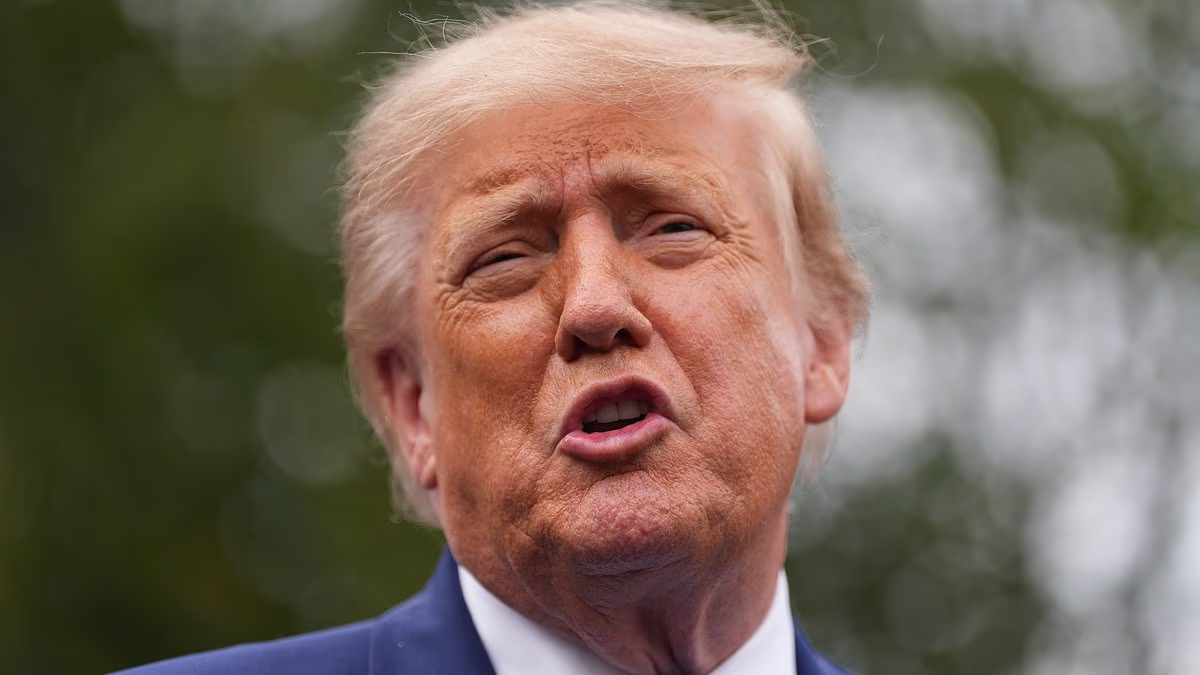
‘China, perhaps not surprisingly to some, HAS TOTALLY VIOLATED ITS AGREEMENT WITH US,’ Trump said in a post on his Truth Social platform.
Last week, US Treasury Secretary Scott Bessent said he hoped that Trump and top Chinese officials would convene to discuss a new truce in the ongoing trade war.
‘I believe we’ll see something very soon,’ he reassured CBS News.
On Monday, car stocks took a major hit as news about the tariffs and magnet controls permeated Wall Street.
Ford and GM both lost over 4 percent of their share price by mid-day trading.