

In the murder trial of Karen Read, lawyers are poised to present their closing statements on Friday following several weeks of testimony in a passionately debated case. The prosecution suggests a tragic love story that ended in murder, while the defense contends that a group of close-knit law enforcement officials in the Boston area are to blame for the death of a fellow officer.
Read, aged 45, is accused of striking her boyfriend, John O’Keefe, a 46-year-old Boston police officer, with her SUV and subsequently abandoning him to succumb to the cold outside a gathering where several local police officers and a federal agent were concluding an evening of drinking in 2022. Charged with second-degree murder, manslaughter, and failing to remain at the scene, the incident took place in Canton, near Boston.
Her defense team has argued that she was framed through an intricate conspiracy involving the fabrication of evidence and her utilization as an easy target for blame in her boyfriend’s tragic end.
The first Read trial ended July 1 in a mistrial due to a hung jury, and several jurors came out after to say that the panel had unanimously agreed that Read was not guilty of the most serious charge of second-degree murder.
Prosecution has focused on the scene of death
The state’s case was led by special prosecutor Hank Brennan, who called fewer witnesses than prosecutor Adam Lally, who ran the first trial against Read.
Brennan has referenced Read’s statement about the possibility that she backed into O’Keefe, which the defense has pointed out came not from police reports but from a voluntary interview she did for a documentary series. In the television interview, Read said, “I didn’t think I hit him,” but acknowledged she could have “clipped him.”
In the first trial, the state called Michael Proctor, the lead investigator in the case. Proctor would later be fired after a disciplinary board found he sent sexist and crude text messages about Read. Proctor was asked to read the texts aloud in court during the first trial, but in the second, the prosecution relied on others to read the offensive comments.
The defense called one of Proctor’s friends to read more texts that suggested he had focused on Read early in the investigation. During the first trial, Proctor acknowledged being friends with Kevin Albert, a Canton police officer who is the brother of the owner of the home where the party was held.
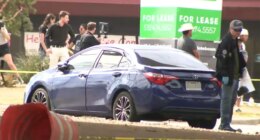
Prosecutors this time focused on evidence from the scene, and tried to make the point that broken pieces of Read’s taillight show she struck O’Keefe with her vehicle. The defense has argued that the taillight was actually damaged when Read was backing out of O’Keefe’s house and hit his car. They have suggested Proctor and others could have colluded to plant the pieces of broken plastic near O’Keefe’s body after they took the vehicle back to the police department.
Experts called by the prosecutors testified that data on O’Keefe’s phone matched with it being located near a flagpole on the lawn, near the street, where his body was found. There was also no phone activity after that and the phone’s battery temperature dropped considerably, the specialist said. Another specialist used GPS and phone data to place Read’s vehicle at the scene around the same time.
Another expert testified that Read’s vehicle reversed more than 50 feet (15 meters) at about 23 mph (37 kph).
Andre Porto, a forensic scientist who works in the DNA unit of the Massachusetts State Police Crime Lab, detailed various items he tested, including the broken rear taillight and pieces of a broken cocktail glass found in the yard. Only O’Keefe was a likely match for both. A hair found on Read’s vehicle was a match for O’Keefe. Traces of DNA from three people, O’Keefe and two unknown individuals, were on the outside of Read’s taillight and O’Keefe’s clothing, Porto said.
Prosecutors called a neurosurgeon who testified that O’Keefe suffered a “classic blunt trauma injury” associated with falling backward and hitting his head. The broken cocktail glass found at the scene is another key piece of evidence, prosecutors have said, because O’Keefe was holding it when Read dropped him off.
The prosecution pointed out that Read and O’Keefe were fighting. Voicemails recovered from Read’s phone in which she said, “I (expletive) hate you,” to O’Keefe were played in court. That voicemail would have arrived while he was lying in the snow.
The defense’s strategy in the second trial
Read’s defense team has cast doubt on the state’s case by suggesting Read was framed.
The defense has painted a picture of a deceitful web of people in O’Keefe’s social network who saw Read as a scapegoat for his death. The network includes federal agent Brian Higgins, who exchanged flirtatious text messages with Read, leading the defense to question if that led to a fatal confrontation. Higgins was present at the party on the night of O’Keefe’s death.
Defense attorneys presented a different view of how Read’s taillight was cracked. They have attempted to show, via witnesses, surveillance video and photographs, that Read may have damaged her taillight the morning after O’Keefe’s death when she backed out of his driveway and bumped his car with her own.
Nicholas Barros, a police officer at a department where Read’s car was impounded, testified that he saw only a small crack in Read’s taillight when the car first arrived. The defense has pointed out that the taillight later looked much more damaged, arguing it could have been tampered with.
A crash expert who testified for the defense said, based on every test he performed, the damage to Read’s taillight and O’Keefe’s clothing was inconsistent with her SUV striking an arm or body at the speed described by the prosecution.
The defense has also questioned why investigators never entered the home where the party took place, although witnesses from the scene and prosecutors have said O’Keefe never went inside.
Dr. Elizabeth Laposata, a former medical examiner called by the defense, said O’Keefe’s injuries were consistent with blunt force trauma to the back of the head, but that his eye wounds were not consistent with being hit by the rear of Read’s SUV. She testified she did not think O’Keefe was hit by the SUV at all.
The defense also questioned Jennifer McCabe, who was at the house party and is the sister-in-law of the host, retired Boston police officer Brian Albert. McCabe made a misspelled web search, “hos long to die in cold,” after O’Keefe’s death.
The timing of the search has been in question. The defense argued that McCabe made the search at about 2:30 a.m. and helped cover for the real killer. The prosecution claims she searched after O’Keefe’s body was found later in the morning.
The defense called into question the actions of others who were at the party the night O’Keefe died. The party happened at the home of Albert, and after O’Keefe’s death, the Alberts rehomed their dog Chloe — who the defense claims bit O’Keefe — and refurbished their basement before selling their home at a loss.
Dr. Marie Russell, a retired emergency medicine physician, testified that the wounds on O’Keefe’s arms were the result of a dog attack, injuries the prosecution attributes to being struck by Read’s vehicle.
The judge in the case did not allow medical examiner Laposata to testify specifically about potential dog bite wounds, but did allow her to testify that some of O’Keefe’s arm injuries were consistent with an animal bite, not with wounds from a broken taillight.
The defense introduced phone records that showed unanswered calls between Albert and Higgins in the early morning hours after O’Keefe’s death. They both later destroyed their phones, with Higgins testifying in the first trial that he obliterated his phone’s SIM card and disposed of it at a military base. The defense also introduced records from McCabe that showed she repeatedly called O’Keefe after midnight, calls she described as “butt dials.”
Read faces a maximum penalty of a life sentence if convicted.