
More than half of Israel’s air force participated in a significant offensive against Iran, deploying 200 aircraft in at least two waves during the early hours of Friday.
The operation targeted the elimination of Iran’s military leadership, the dismantling of ballistic missile production centers, and inflicted damage on nuclear sites, such as Natanz and Fordow.
Israeli Prime Minister Benjamin Netanyahu stated that the operations would continue “as long as it takes,” with the primary objective being the eradication of Iran’s nuclear weapon production capability.
Israel, which is itself an undeclared nuclear weapons state, has long seen a nuclear-armed Iran as an existential threat.
Netanyahu’s open-ended declaration indicates that the timeframe will depend on the evolving military objectives and Iran’s responses. Tehran has already retaliated by launching more than 100 drones towards Israel, and Supreme Leader Ayatollah Ali Khamenei has vowed severe consequences.
“The big question is whether this slows or accelerates Iran’s pursuit of a nuclear weapon,” said Jon Alterman of the Center for Strategic and International Studies.

“Israel’s argument is that they can just keep doing this if Iran persists,” he added. “However, Iran may decide it needs to develop a nuclear deterrent [and leave the international nuclear non-proliferation regime] . . . I don’t think the answer is obvious.”
Can Israel destroy Iran’s nuclear sites by itself?
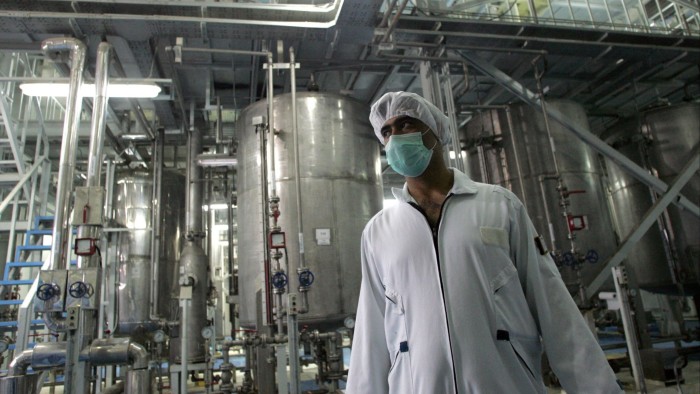
Israel said it had struck Natanz on Friday and “damaged” the underground area of the site, a multistorey enrichment area with centrifuges, electrical rooms and other infrastructure. Israel did not elaborate on whether it targeted Fordow.
Both nuclear facilities were created with such strikes in mind. The Fordow facility for fuel enrichment is buried under a mountain, and both it and Natanz are under dozens of metres of reinforced concrete. Destroying such a structure would require successive hits with bunker-buster bombs.

While the US has B-2 stealth bombers with 30,000lb massive ordinance penetrators that are designed just for this type of strike, Israel’s options are more limited — if it is operating by itself.
Israeli F-15 fighter bombers can carry 4,000-5,000lb GBU-28 bunker-buster bombs, each capable of punching through 5-6m of concrete. Israel does have such bombs but their numbers are a closely guarded secret, and few analysts believe the country has enough on its own to do the job.
Israel’s forces “don’t have enough 5,000-pounders” to take out Fordow and Natanz, retired US Air Force General Charles Wald, who now works for the Jewish Institute for the National Security of America, said in April.

They have far more BLU-109 2,000lb ordinance penetrator bombs, capable of being carried on F-35 stealth fighters. These were used in October 2024 to kill Hizbollah leader Hassan Nasrallah in an underground shelter in Beirut, but the assassination reportedly required multiple passes. Penetrating the reinforced bunkers that protect Iran’s nuclear programme would take far more.
Israel can also target the nuclear sites with stand-off weapons — ballistic missiles launched from fighter jets, possibly flying over Syrian air space — without even coming in range of what is left of Iran’s air defences. But these on their own would not be sufficient.
“They can do considerable damage to Iran’s nuclear programme,” said Matthew Savill, the head of the military sciences department at the Royal United Services Institute in London. “It’s doubtful they can destroy it all on their own, but I think they are prepared to keep hitting it over time.”
How resilient are Natanz and Fordow?
Natanz, near the city of Isfahan, and Fordow, built into a mountain near Qom, are Iran’s primary sites for enriching uranium and the main targets for Israeli air strikes aimed at neutralising Iran’s nuclear programme.
Both facilities operate thousands of centrifuges designed to produce various grades of enriched uranium. They have generated a large stockpile of 60 per cent enriched uranium, which would require little further enrichment to achieve a weapons-grade level of 90 per cent.
The International Atomic Energy Agency, the UN’s nuclear watchdog, estimated in May that Iran has accumulated a total of 408.6kg, and the advanced centrifuges at Natanz and Fordow are producing on average 33.5kg a month.
According to a report this month by the Washington DC-based Institute for Science and International Security, “break out” would take three weeks, “enough for nine nuclear weapons”.
Much of this stock of enriched uranium may have been moved to a facility in Isfahan, the Fuel Plate Fabrication Plant (FPFP), according to the ISIS report.

Darya Dolzikova, an expert on nuclear weapons at Rusi, said it would be difficult for Israel to completely destroy Iran’s nuclear enrichment capability.
“Natanz is not Iran’s only enrichment facility; its most hardened site — at Fordow — has not been affected, nor have a number of other key nuclear sites across the country,” she said.
“Should Iran make a decision to produce a nuclear weapon, it would likely do that at hardened and potentially still secret sites,” Dolzikova added.
The IAEA closely monitors Iran’s nuclear programme, but has not reported the location of the stockpile of highly enriched uranium since 2023.
“The truth is we don’t know where the 60 per cent [uranium stockpile] is located that is not known publicly,” said David Albright, ISIS president. “The IAEA obviously knows to a certain point . . . But if Iran is moving it from one safeguarded site to another, the IAEA doesn’t go along for the ride.”
What are Israel’s objectives?
In addition to the ultimate objective of neutralising what it says are Iran’s efforts to develop a nuclear weapon, Israel has killed a number of senior military leaders, politicians, and scientists, including Major General Hossein Salami, Commander-in-Chief of the Islamic Revolutionary Guard Corps. That indicates that among their objectives may be regime change, though it has not explicitly said this.
Experts remain sceptical that Israel by itself would be able to accomplish either of these ambitious goals.
Robert Pape, a US military historian and author of Bombing to Win, a landmark survey of 20th century bombing campaigns, said: “Israeli air power cannot decisively knock out Iran’s nuclear programme.
“The remnants can be assembled covertly, and fears of Iranian nuclear retaliation will surely grow — possibly precipitating a ground war, just as happened against Iraq in 2003.”

He also cautioned that any Israeli air bombing campaign would be unlikely to succeed alone in changing the government in Tehran, should that be an Israeli objective.
“Air power alone has never toppled a government. Israel’s attempt is likely just another data point.”
How are Iran’s air defences performing?
Last year, Israel attacked Iran using air-launched ballistic missiles from far beyond the reach of Iran’s most advanced air defences, the Russian supplied S-300 surface to air missiles. These Israeli strikes severely degraded Iran’s most advanced air defences, particularly the S-300, and it is not clear what remains.
On Friday morning Israel’s military announced it had “completed a large-scale strike against the aerial defence array of the Iranian regime in western Iran”, which had destroyed “dozens of radars and surface-to-air missile launchers”.

Before attacking the nuclear sites with bunker-buster bombs, Israel would have likely destroyed or jammed much of what was left of Iran’s air defences, using anti-radiation missiles designed to target radar — and deter crews from turning their SAM systems on.
Iran, however, had prepared for just such an attack and had many types of air defences, some supplied by Russia or China, with many mobile launchers capable of hiding and surviving a first wave of attacks. These may yet come into play in coming days.
Even Iran’s less advanced air defence could be dangerous to Israeli planes. For example, Syria in 2018 downed an Israeli F-16 with a S-200 surface-to-air missile, a Russian system that came into service in the late 1960s. The plane crashed in northern Israel and both pilots survived.

What about Iran’s response?
Israel has said that Iran has so far launched more than 100 drones, which appear to be mainly 136-Shaheds of the type frequently used by Russia against Ukraine. These can take hours to reach their targets, making them easy for Israel’s air defences to pick off. Even so, the Iranian strategy may be to deplete Israeli stocks of interceptor missiles, and then send its more advanced and harder-to-shoot-down ballistic missiles.
Israel’s triple layered anti-missile defence system, which includes the Iron Dome and was augmented late last year by a US Thaad antimissile battery, is legendary.
It performed almost flawlessly during previous Iranian strikes against Israel, twice in 2024. Crucially, however, US and UK military assets, including two US navy destroyers and two RAF jets, augmented Israel’s air defences during those attacks by tracking incoming missiles and in the case of the US, shooting some down.
On Friday, the UK indicated it would not participate in Israel’s defence.
Israel’s supply of interceptors has become an issue and the country has struggled to resupply its air defence systems after a busy year of attacks by Iran, Hizbollah and Houthi militiamen in Yemen.
Last October, Israel Aerospace Industries, the state-owned company which makes the Arrow interceptors used to shoot down ballistic missiles, said it was having to run triple shifts to keep it production lines running at full tilt, and that it was “no secret that we [Israel] need to replenish stocks”.
Iran in recent months has also reportedly increased its production of ballistic missiles to roughly 50 a month, with the specific aim of being able to fire more missiles than Israel can defend itself against.
Iran’s current stock of ballistic missiles and drones is a closely guarded secret, but according to US intelligence estimates the country has around 2,000 ballistic missiles with warheads that can carry 2,000 pounds of explosives or more, according to Axios.
Graphic illustrations by Bob Haslett and Ian Bott


