
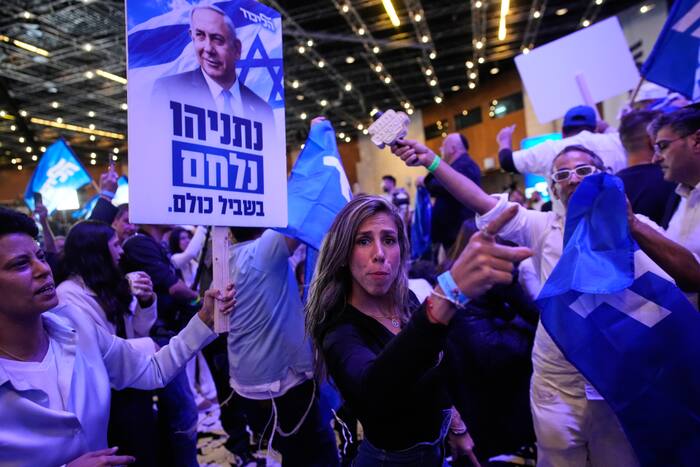
JERUSALEM – Israelis watched nervously on Wednesday as election results emerged after voters delivered a sharp rebuke to Prime Minister Benjamin Netanyahu’s far-right government. Turnout reached its highest level in more than 25 years, but exit polls showed no clear victor, raising the prospect of weeks of coalition negotiations.
Arab-led factions appeared to be heading toward a historic result, although it remained uncertain whether the government’s opponents — who exit polls indicated could hold a firm majority in the next parliament — would agree to form a coalition with them. Questions involving Palestinians and their descendants remain deeply sensitive in Israel.
Netanyahu struck a defiant tone early Wednesday as he sought to preserve his position as Israel’s longest-serving prime minister, highlighting the country’s military achievements over the past three years. He rejected the possibility of cooperating with Arab parties, whose constituents represent about 20% of Israel’s population, calling such an alliance treasonous.
“We must establish a strong, right-wing, nationalist government,” said Netanyahu, who faced a formidable challenge from former military chief and centrist Gadi Eisenkot. “We must not endanger Israel and establish a government that relies on anti-Zionist Arab parties.”
Eisenkot has indicated that he could work with Arab parties if they meet certain conditions, including recognizing Israel as a Jewish state and Hamas as an extremist organization. Some potential partners have already rejected that possibility, leaving open the question of whether they might reconsider in order to remove Netanyahu from office.
After half the votes were counted, Netanyahu’s Likud party held 20.6%, compared with 16.8% for Eisenkot’s Yashar party. Figures from Israel’s Central Elections Committee do not show how those shares will translate into seats in the 120-member Knesset.
The tight contest indicated that Netanyahu’s rivals had not been able to turn the anger and grief following the Hamas-led Oct. 7, 2023, attack — which set off three years of war — into a decisive defeat for the prime minister.
Far-right National Security Minister Itamar Ben-Gvir was a clear casualty of the vote. To many Israelis, he embodied the most extreme elements of Netanyahu’s government, having openly mocked Palestinian detainees and said that many people in Gaza are “not even people.”
Turnout reached 77.7% among eligible voters, the highest rate since 1999. Final results are due in the coming days, once hundreds of thousands of absentee ballots have been counted.
Netanyahu suffers a setback but avoids outright defeat
The vote reflected widespread unease over Netanyahu’s partnership with far-right politicians, as well as anger about exemptions from military service granted to Israel’s large ultra-Orthodox Jewish population.
Exit polls from Israel’s major television stations indicated that Netanyahu’s coalition had lost ground, although Likud was still expected to remain the largest party and the leading candidate to receive a mandate from President Isaac Herzog to form a government. Herzog is not obligated to choose the party with the most seats.
The polls put Netanyahu’s bloc and Eisenkot’s alliance at roughly 51 seats each, while Arab parties were projected to win about 18. The figures point to a prolonged period of political bargaining before a prime minister is chosen — if one can secure a coalition at all — or another election is called.
Eisenkot’s clearest route to a parliamentary majority would be an agreement with Arab-led parties, but such a partnership could carry a heavy political cost. In an early Wednesday address centered on national unity, he said he would form a government and promised “a new era — an era of hope.”
Arab-led parties may hold the balance of power
Israel’s Arab citizens are descendants of Palestinians who remained within the country after its creation in 1948. They frequently report discrimination and are viewed suspiciously because of their support for the Palestinian cause. Those tensions grew after Oct. 7, despite Palestinian citizens of Israel also being among those killed and abducted.
Netanyahu had warned that Arab parties could determine the election’s outcome, claiming they were turning out in “unprecedented numbers.” He has ruled out cooperating with them, while the Arab-led parties have likewise rejected an alliance with him.
Celebrations broke out at the headquarters of the United Arab List, the only Arab party ever to join an Israeli governing coalition, doing so briefly in 2021.
“We are here, we are not on the sidelines,” party leader Mansour Abbas told supporters.
Should no faction succeed in assembling a majority coalition, Israelis could return to the polls early next year. The country held five elections between April 2019 and November 2022 after a comparable political deadlock.
No single party has ever won an outright majority in parliament. Minority governments are possible, but they must rely on cooperation from parties outside the government to pass legislation.
Attitudes over a polarizing Netanyahu will shape days ahead
The race was widely seen as a referendum on Netanyahu’s nearly unbroken 17-year rule. Israelis were divided even before the deadliest attack in the country’s history. The resulting wars in Gaza, Lebanon and Iran, along with settler violence in the occupied West Bank, have stoked worldwide outrage, straining ties with Israel’s closest allies and fueling a rise in antisemitism.
Netanyahu’s supporters see him as someone who led Israel through a war of redemption. They think he is protecting Israel’s security and Jewish identity in the face of international pressure and liberal elites at home.
His detractors say that Netanyahu, beset by an ongoing corruption trial, dragged out the war in Gaza and its hostage crisis for political reasons. They say he is undermining Israel’s independent judiciary and weakening its democratic underpinnings. And they accuse his government of allowing ultra-Orthodox religious Jews to avoid military conscription.
Eisenkot is viewed by supporters as a capable leader with sterling security credentials who could act against creeping illiberalism. His son and two nephews were killed in Gaza, and his backers believe that he feels deeply the pain that still courses through Israel.
Parties that likely would support Eisenkot have vowed to improve Israel’s international standing and work to conscript ultra-Orthodox men while bolstering the independence of the judiciary.
Israel has found itself increasingly isolated over its conduct in Gaza and the West Bank. Public support among Americans has plummeted, and partners in Europe and elsewhere have slapped sanctions on Israel. Netanyahu faces an international arrest warrant over alleged crimes against humanity in Gaza, allegations he denies.
___
Lidman reported from Tel Aviv, Israel. Associated Press writers across Israel contributed to this report.