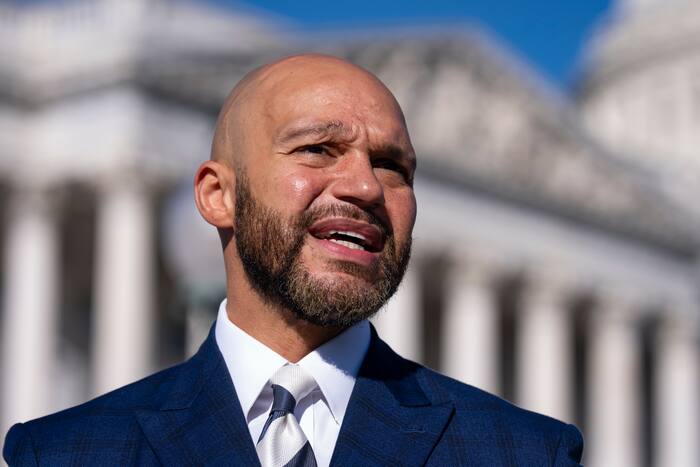

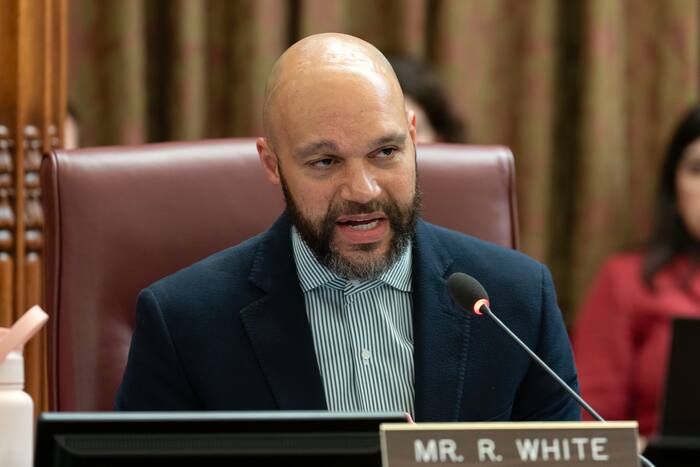
WASHINGTON – The last time Washington, D.C., sent a new delegate to Capitol Hill, the Soviet Union was still intact, George H.W. Bush was in the White House and the first Gulf War had yet to begin.
Now Robert White Jr. is taking over the seat held for 36 years by Eleanor Holmes Norton, the city’s iconic congressional advocate. White was just 8 when Norton began her tenure and later worked for her before launching his own political career.
In an interview with The Associated Press between orientation sessions, White said his agenda remains focused on two longstanding goals: achieving statehood for the District and strengthening its economy. He enters Congress, however, at a moment when Democrats hold unexpectedly large majorities in both chambers, potentially giving D.C. its strongest opening in years.
“Serious support for D.C. statehood should be a baseline requirement for any Democratic presidential nominee in 2028,” he said. “I think it would be malpractice for Democrats to not get statehood the next time we have the House, the Senate and the White House.”
The District has operated with limited home rule since 1973, when Congress granted the city a measure of self-government while retaining broad oversight. The relationship has long been uneasy, and tensions have intensified since President Donald Trump returned to office two years ago.
With a Republican-controlled Congress behind him, Trump deployed National Guard troops to the city, dismissed thousands of federal workers and began reshaping local institutions, including the John F. Kennedy Center for the Performing Arts.
“I actually ran for this seat because I was so concerned about the need to defend D.C.,” said White, 44, who previously served as an at-large member of the D.C. Council.
White makes statehood his top priority
D.C.’s delegate has powers that differ from those of other members of Congress. White can introduce legislation, but he cannot cast a vote on final passage.
White said statehood, a goal that has eluded the city for decades, will come first. In 2021, Democrats controlled Congress and Joe Biden was president when the House approved legislation to make Washington a state. The bill stalled in the Senate after Republicans used the threat of a filibuster to block it.
“I’m looking to make sure Democratic leadership nationally understand why D.C. is such a pivotal piece in their strategy,” he said.
He said he has already begun speaking with new colleagues about the impact of adding two senators who would almost certainly be Democrats, given the city’s deeply blue political makeup. Their presence, White argued, would be “a game changer.”
Recent national developments, he said, could help explain to voters elsewhere why the issue matters.
“This is a time in history because of the redistricting battles, because of what the Supreme Court has done to the Voting Rights Act that people can understand D.C. statehood,” White said.
The District is also confronting serious economic pressure.
The D.C. Office of Revenue Analysis estimates that the city suffered a net loss of 22,000 jobs in 2025, reducing residents’ annual income by $3 billion. Local officials have blamed at least some of the losses on the Department of Government Efficiency, or DOGE, which Trump empowered to cut the federal bureaucracy.
“We’ve lost some 30,000 federal jobs. Because of those, families are struggling to stay in D.C. Many have left already,” White said. “It’s the cost of utilities, the cost of gas, the cost at the grocery stores. These are the things that have to be top priorities of Congress, but some specific to D.C.”
The layoffs have rippled through businesses across the city, White said. The workers affected are people “who are no longer going to lunch or going for drinks after work.”
White plans to challenge Trump’s projects
White said he is reaching out to incoming committee chairs whose panels will oversee funding and decisions affecting the District, particularly several projects proposed by Trump.
The issue is personal for White. He began golfing in college and frequently played at East Potomac Golf Links, an affordable course that became a favorite. His children have performed at the Kennedy Center, and his grandparents are buried at Arlington National Cemetery.
Trump’s plans touch all three places and have become the subject of litigation. He wants to transform East Potomac into a world-class course, potentially ending its role as an affordable golfing destination. He shut down the Kennedy Center after unsuccessfully seeking to add his name to the building. He also wants to construct a 250-foot triumphal arch in a traffic circle near Arlington National Cemetery.
“These are local and national treasures,” White said. They should not be changed, he argued.
White said he has not spoken directly with Trump but is working to establish a channel to the administration.
“I have been talking to D.C. folks who have ties into the White House, working to set up a meeting, particularly with Stephen Miller, who is now going to be chief of staff,” he said.
White also objects to the continuing National Guard deployment. Trump says the troops are needed to protect the city, while White considers the mission an unnecessary expense. He is concerned, too, about how the forces might be used in the future, especially in light of the Jan. 6, 2021, attack on the U.S. Capitol.
“We cannot have a little army under the control of the president two years from now, when there’s supposed to be another peaceful transfer of power,” he said.
White plans to work closely with the new mayor
The District also has a new mayor, Janeese Lewis George, who succeeded Muriel Bowser after Bowser completed three terms in office.
White said he speaks with Lewis George regularly and that they are “aligned” on the city’s next steps.
“We’re seizing every opportunity for D.C.,” he said. “What’s not lost on either of us is, as the Democrats will now control both the House and the Senate, that’s going to make it harder for the president to have impact nationally and internationally. That may mean that he turns his attention to D.C., and we have to be ready for that.”
White is also focused on building relationships that could prove valuable. He invited incoming lawmakers to join him at a Wizards basketball game Monday night and has been making a point of meeting colleagues across Capitol Hill.
“I’m asking, who were former staffers like me? Who smoke cigars like me? You know, who goes to church on Sundays with their family like me? That’s the way we build a relationship,” he said.
White is only the third person to serve as the District’s delegate since Congress approved the District of Columbia Delegate Act in 1970. Walter Fauntroy took the oath on April 19, 1971, followed by Norton on Jan. 3, 1991.
“It is all I can do for my eyes not to well up,” he said. “What I’ve said to other incoming members of Congress, both Democrats and Republicans, if we keep that sense of awe and privilege, we will do the right thing here.”


