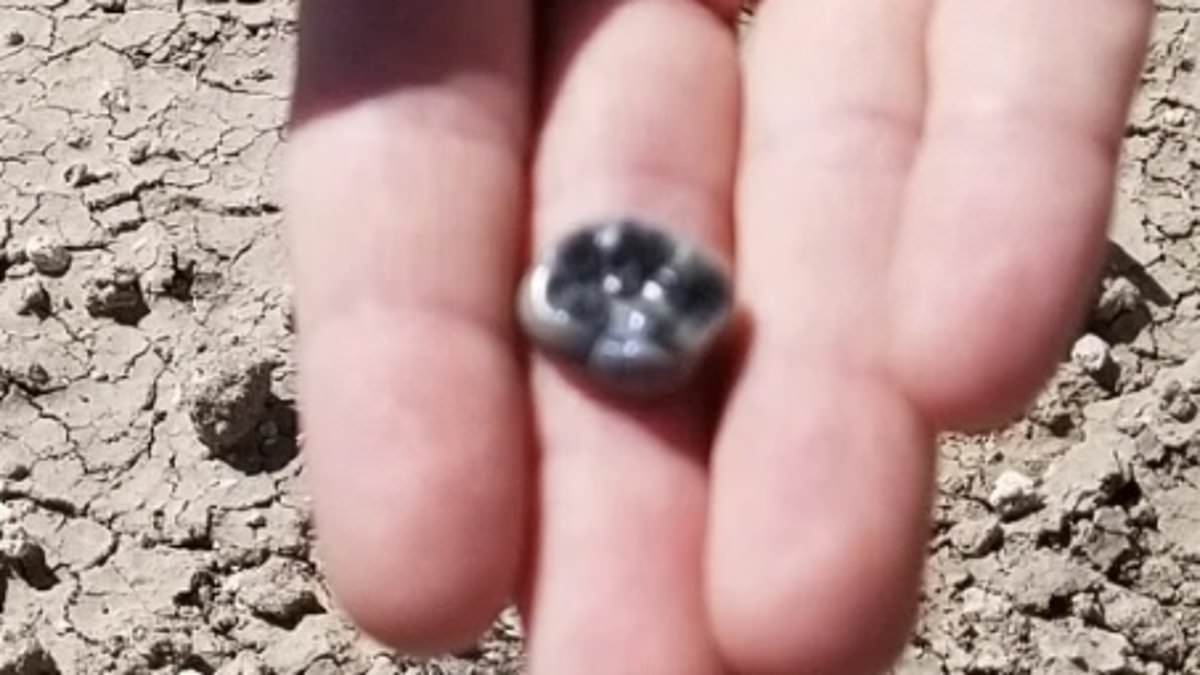

A lost chapter in human evolution has been discovered among a collection of teeth that dates back 2.8 million years.
Scientists at Arizona State University have identified a previously undiscovered species of ancient humans that lived alongside the genus Homo, our direct ancestors, in Africa.
The researchers highlighted that the period between 2.6 and 2.8 million years ago was pivotal in human evolution, marking the earliest emergence of the Homo species documented.
Researchers also discovered the oldest known stone tools at the Ledi-Geraru site in the Afar region of Ethiopia.
In 2013, another team found a 2.8-million-year-old Homo jawbone at the same site. However, the 13 teeth discovered recently don’t belong to our direct ancestors.
Instead, the team determined that these teeth are from a new member of the Australopithecus species, a group closely related to modern humans that inhabited Africa between two and four million years ago.
These teeth differ significantly from previous fossils of the species Australopithecus afarensis, indicating the development of a new evolution of early humans in this region, which coincided with the existence of our ancestral family line.
The researchers believe that the discovery of this unrecognized Australopithecus species implies that human evolution was a complex process, involving multiple coexisting species, rather than a straightforward transition from ape to human.

Arizona State University researchers found 13 teeth in Africa which appear to belong to a previously unknown species of early humans

The teeth were discovered at the Ledi-Geraru site in the Afar region of Ethiopia
The most famous member of the Australopithecus afarensis species has been a fossil named ‘Lucy,’ whose fossil skeleton was discovered in 1974 in Hadar, Ethiopia.
Australopithecus walked upright, a key human trait, but examinations of skull fragments have found they had smaller brains and ape-like features, such as larger teeth and robust jaws for chewing tough plants.
However, researchers have not been able to find any fossils at the Ledi-Geraru site that match Lucy’s species.
The differences in the 13 Australopithecus teeth unearthed there, along with the presence of the Homo species, suggest that Lucy’s species did live beyond 2.95 million years ago, according to the study in Nature.
ASU paleoecologist Kaye Reed said: ‘This new research shows that the image many of us have in our minds of an ape to a Neanderthal to a modern human is not correct — evolution doesn’t work like that.’
‘Here we have two hominin species that are together. And human evolution is not linear; it’s a bushy tree, there are life forms that go extinct,’ Reed added in a statement.
The ‘bushy tree’ theory Reed mentioned refers to the concept of multiple early human species living simultaneously in ancient times.
Some would go extinct while others would lead to the development of modern humans, like the species Homo. Researchers added that the new fossils don’t represent a single ‘missing link’ but rather show evidence of diverse overlap during this evolutionary period.

Researchers previously discovered the oldest known fossil of our direct ancestors at the Ledi-Geraru site in 2013
‘We know what the teeth and mandible of the earliest Homo look like, but that’s it,’ Reed explained.
‘This emphasizes the critical importance of finding additional fossils to understand the differences between Australopithecus and Homo, and potentially how they were able to overlap in the fossil record at the same location,’ the study author continued.
The genus Homo includes modern humans and our closest extinct relatives.
The Ledi-Geraru Homo fossils, including the new teeth and the previously found jawbone, revealed that early Homo individuals likely had slightly larger brains and smaller teeth than Australopithecus.
This suggests that the human diet was already shifting millions of years ago towards more meat or softer plants than Lucy’s species ate.
These humans also learned to use primitive tools, which the ASU researchers also found at the site.
The fossils’ age was determined by dating volcanic ash layers containing feldspar crystals, a method that pinpoints the time of eruptions sandwiching the fossils.
The Ledi-Geraru landscape, once a vegetated area with rivers and lakes, was much different than today’s arid badlands.
The ASU team noted that future research will focus on tooth enamel to explore diet and potential interactions between the Homo and Australopithecus, such as whether these species competed for food or peacefully lived in different ecological regions of Africa.