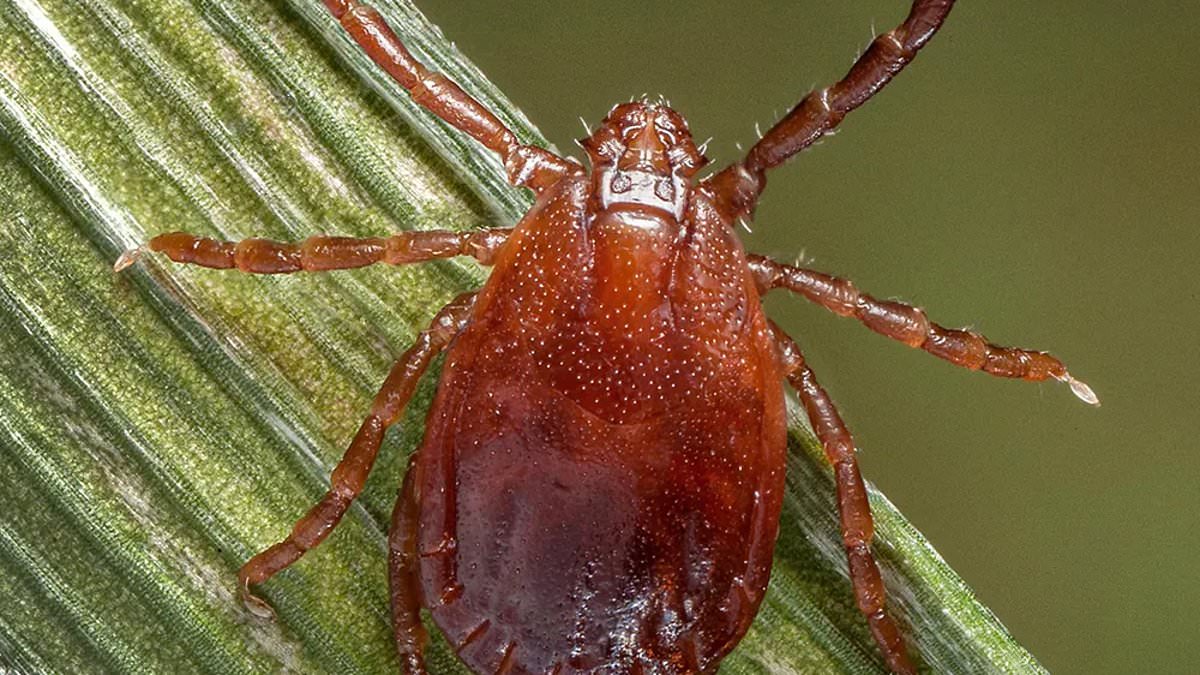

Researchers have confirmed the presence of an invasive species of tick in Maine for the first time, marking the 25th state in the country and farthest northeast in the United States the pest has ever been discovered.
The University of Maine and state conservation officials say they confirmed the presence of the Asian longhorned tick in the state in July.
The tick is native to eastern China, Japan, the Russian Far East and Korea, where it is capable of spreading tickborne infections such as spotted fever.
The tick was first confirmed in the United States in New Jersey in 2017 clustering mostly around the eastern third of the country.
Exactly how the tick arrived in the country isn’t certain, but public health officials have cited possible routes of entry including on pets and livestock.
‘This discovery underscores the critical importance of continued tick surveillance in Maine,’ said Griffin Dill, director of the UMaine Extension Tick Lab.
‘While this appears to be an isolated case, we are closely monitoring the situation and coordinating with state and federal partners.’
The tick specimen was not yet an adult and it was collected in the southern part of the state, the lab explained.

The tick was first confirmed in the United States in New Jersey in 2017 clustering mostly around the eastern third of the country

The Asian longhorned tick is about the size of asesame seed but it can also harm livestock and spread disease

Researchers have confirmed the presence of an invasive species of tick in Maine for the first time, marking the 25th state in the country and farthest northeast in the United States the pest has ever been discovered
Follow-up surveillance didn’t turn up any additional specimens in the surrounding area, the lab said.
Asian longhorned ticks feed on numerous animals, including cattle and humans. They can carry diseases that pose a serious threat to humans and animals.
The species carries a virus that kills 15 percent of its victims in Asia, but only cow deaths have been reported in the US since the tick arrived in 2017.
In humans, the ticks can carry diseases such as severe fever with thrombocytopenia syndrome, which can have a fatality rate of up to 30 per cent.
The species has two forms: one with males and females, and one with self-cloning females that lay eggs without needing to mate, a process called ‘parthenogenesis.’
The self-cloning form, free from the need to look for mates, are especially likely to thrive and spread posing a challenge for pest control authorities because a single individual can create an infestation, the lab said.
Single animals with high Longhorned tick densities can experience stunted growth and anemia, and in rare cases, can be drained of so much blood they die.
The specimen found in Maine could not reproduce yet because it was a juvenile, the lab said.

This summer, a team from the Evolution and Ecology of Disease Systems Laboratory collected thousands of black-legged ticks, dog ticks, and Asian longhorned ticks at eight sites across Philadelphia

The tiny ticks are seen collected on some sticky tape

Three Longhorned ticks are seen here – from left, a fully engorged female, a partial engorged female, and an engorged nymph

Asian longhorned ticks have been spotted in Maine, the 25th state in the nation. They are known to carry dangerous diseases that infect livestock

What thie species threatening is that it is asexual and does not need a mate in order to reproduce, allowing females to create a fast-growing population
Research is still going on to determine the tick species’ ability to spread pathogens in Maine and elsewhere in the US, the lab said.
Ticks are a major public health concern in the Northeastern US, where another species, the blacklegged or deer tick, spreads Lyme disease.
The arachnids invaded Australia and New Zealand in the early 1900s and have since established a population that causes significant losses in the cattle industry – with experts warning similar events could occur in the US.
In the meantime, the public can prevent tick bites by taking steps such as conducting rigorous checks for them, avoiding overgrown vegetation and wearing protective clothing, public health officials said.
Tick populations are expanding into new areas for a number of reasons.
As climate change increases average temperatures all over the world, colder regions of the US are becoming warmer.
This increases the amount of time that ticks can remain active throughout the year, and allows them to thrive in places they couldn’t before.

Scientists at Penn Arts and Sciences can be seen studying the ticks under a microscope

The scientists ventured out into the countryside where the ticks thrive
If you find an Asian longhorned tick attached to yourself or your pet, remove it immediately.
You can do so by grasping the tick as close to the skin as possible with fine-tipped tweezers or your fingers. If you’re using your fingers, use a tissue, a foil-covered gum wrapper or a plastic sandwich bag as a protective barrier.
Once you grasp the tick, pull upwards with steady even pressure. Do not twist the tick as you pull.
After you remove it, wash the affected area with soap and water and disinfect the bite with a topical antiseptic.
Whatever you do, don’t throw away the tick! Put it in a plastic Ziplock back and seal it closed. That way you can take it to you doctor or veterinarian for identification.