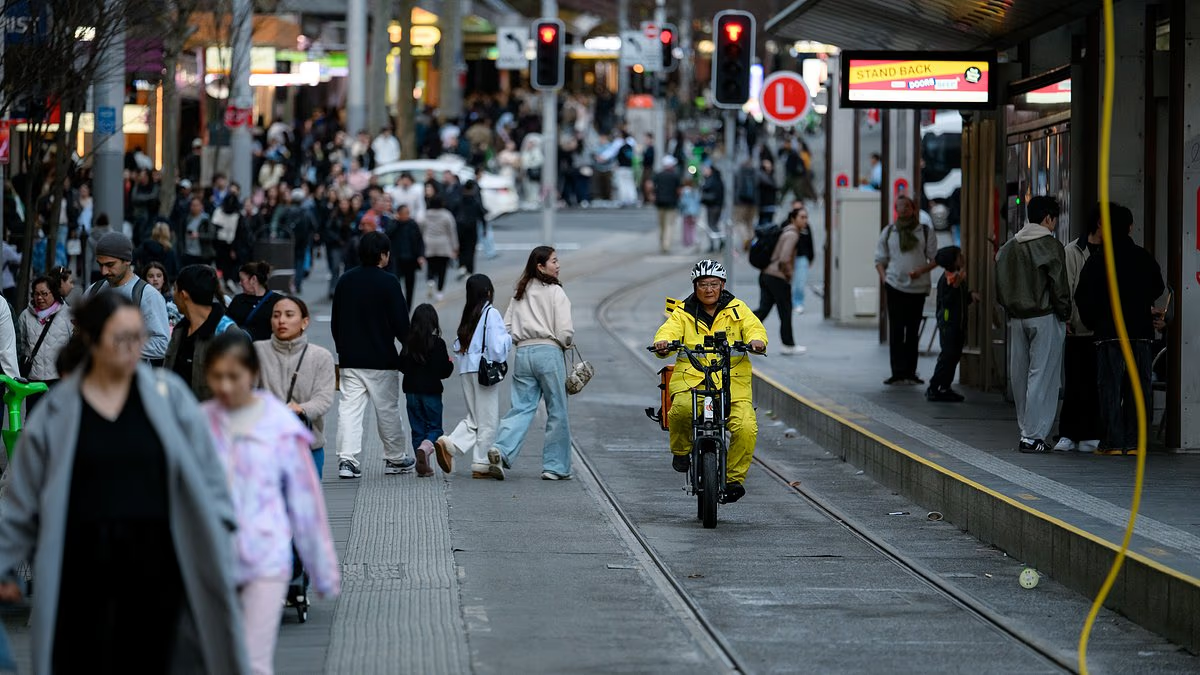

Britain will introduce a mandatory digital ID scheme for British citizens and residents in an attempt to curb illegal immigration.
But the ‘dystopian’ plan has been met with furious backlash, with critics arguing that the move could infringe on civil liberties.
Some individuals have expressed concerns that such a system could escalate into an Orwellian-like surveillance state, similar to China’s application of facial recognition technology for monitoring its extensive population of 1.4 billion people.
The communist nation has been expanding its Big Brother-like mass surveillance system across the country.
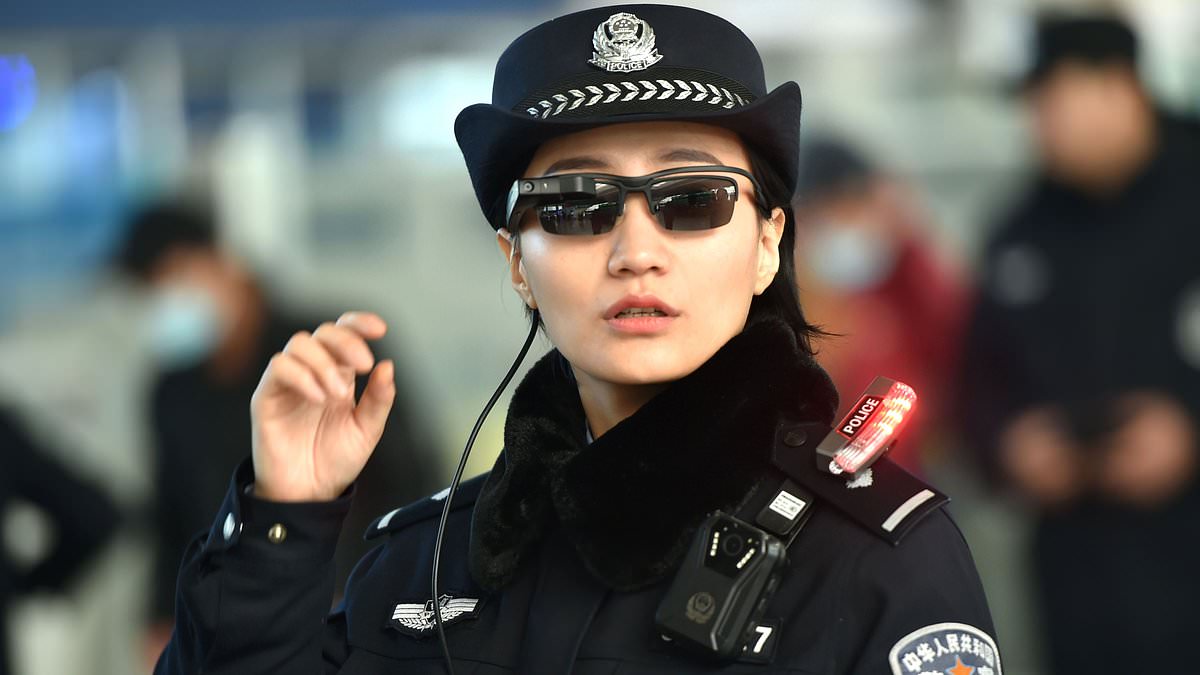
Chinese cops have been wearing sunglasses equipped with facial-recognition technology to catch criminal suspects over the last seven years.
In 2018, transport police in Zhengzhou, a city in central China, were equipped with state-of-the-art devices designed to scan passengers and identify potential suspects amidst the crowds in train stations.
These devices, which resemble smartphones, are integrated with cameras that enable officers to capture an individual’s image. This image is then compared against a database located at the headquarters.
Once processed, the system retrieves the suspect’s personal details, including their name, ethnicity, gender, and address, and transmits all this information back to the officer’s glasses.

This image, taken on February 5, 2018, depicts a police officer utilizing smart glasses equipped with a facial recognition system at Zhengzhou East Railway Station in Zhengzhou, China’s central Henan province.

In this screen capture, visitors are filmed by security cameras that employ AI (artificial intelligence) and facial recognition technology at the 14th China International Exhibition on Public Safety and Security at the China International Exhibition Center in Beijing on October 24, 2018.

China has millions of surveillance cameras across the country
The glasses can also tell officers whether or not the targets are on the run from the law, the address of any hotel they are staying at and information related to their internet usage.
This is part of China’s efforts to build a digital surveillance system that uses a variety of biometric data – from photos and iris scans to fingerprints – to keep close tabs on the movements of its people.
The smart glasses can pick up facial features and car registration plates, and match them in real-time with a ‘blacklist’ of suspects, according to Reuters.
Meanwhile, millions of AI-powered surveillance cameras have been placed around the country to monitor citizens’ emotions and track their ‘social credit’ scores.
China also uses City Brain Surveillance – a software system which oversees a combination of satellites, drones and fixed cameras to record millions of images.
Through the ‘social score’ system, spy cameras are used to keep tabs on Chinese citizens.
Residents with a high score get to enjoy benefits like discounts and shorter waiting times and are more likely to get jobs.
But those who have lower scores are banned from taking flights.

Millions of AI-powered surveillance cameras have been placed around China to monitor citizens’ emotions and track their ‘social credit’ scores

Biometric cameras are used in schools to monitor the concentration levels of students

People look at four-legged robot dogs at the 2025 Jiangsu Industry-University-Research Cooperation Conference in Nanjing, in China’s eastern Jiangsu province on September 12, 2025. Robot dogs are being used to police China’s streets

China has also turned to the use of robotic dogs to keep a close eye on its population

Drones equipped with speakers are also widely used in China to patrol its streets
Biometric cameras, meanwhile, are used to read people’s emotions to identify whether they are a threat to the state.
In schools, they are used to monitor the concentration levels of students.
China has also turned to the use of robotic dogs to keep a close eye on its population.
Footage shared on social media shows how the bots with inbuilt scanners wander the streets and approach citizens to check they have their Covid-19 vaccine certificates on them.
In one amusing video, a citizen is seen showing the robot dog their phone before being allowed to pass through a gate.
Drones equipped with speakers are also widely used in China to patrol its streets, and were heavily deployed during the pandemic to enforce residents to wear masks.
One social media clip shows how a drone approaches an elderly woman and tells her: ‘This is the drone speaking to you. You shouldn’t walk about without wearing a mask’.
Another clips shows a drone flying over a built-up area in an unknown Chinese city, as it tells residents on the street: ‘We’re watching you the whole time. Behave yourself! Or you’ll bear the legal liability’.

Another way of monitoring residents is through the use of mandatory digital IDs in schools

China also plays a shame game with people who break the law by displaying them alongside their names and government ID numbers on large billboards
Another way of monitoring residents is through the use of mandatory digital IDs in schools.
Students are able to get into their classrooms through the facial recognition system and are even able to pay for their lunches with just one glance.
This year, China also launched digital IDs to require users to authenticate their identity for internet services – a move that further adds to Beijing’s era of digital control. The country also requires identification for most daily activities.
China also plays a shame game with people who break the law by displaying them alongside their names and government ID numbers on large billboards.
The idea is that a person who has committed a small offence, like jaywalking or debt avoidance, is outed in front of their neighbours and colleagues in an attempt to humiliate them and teach them a lesson.
Videos are often shared on social media showing how unlawful residents are publicly shamed on massive billboards.
The shaming tactic has led to some people featured on the big screens to change their phone numbers, addresses and even disappear.
Public shaming is not novel in China and was used as a way to punish criminal behavior in ancient times,
Offenders would have different weights of wooden clamps placed around their necks to publicize the crime and warn off other.
When Mao Zedong declared a class war, known as the Cultural Revolution, in 1966-76, guards held ‘struggle sessions’ in which people accused of capitalist thoughts were verbally and physically abused in public.