Share this @internewscast.com
It was meant to make healthy choices simple, but nutrition experts say the Health Star Rating system is falling short.
According to its critics, the front-of-pack labelling system for food and drink lacks consistency across products, uses an algorithm that overlooks ultra-processed foods and artificial sweeteners, and — because displaying a rating is not mandatory — is more likely to be applied to products that score higher as a promotional tactic.
After a five-year process in the wake of a 2019 review, Friday marks the final deadline for food and beverage manufacturers to voluntarily apply the rating to 70 per cent of relevant products.

The government has pledged to potentially enforce the system if the desired goals aren’t achieved, which seems to be the current situation.

Research by the Sydney-based The George Institute for Global Health found that uptake across the industry in 2025 was just 37 per cent.
Uptake has stagnated in recent years. Last November, only 35 per cent of intended products in Australia displayed a star rating, according to government data, up just a fraction from 32 per cent the year before.
Alexandra Jones, head of food governance at The George Institute, said the government targets were “extremely generous, yet the multibillion-dollar packaged food industry has not even come anywhere close to meeting them”.
“This is an abject failure by the industry that suggests a blatant disregard for Australian consumers who buy their products.”
Julian Rait, vice president of the Australian Medical Association, told SBS News mandating the system is “the only way to ensure that there will be a benefit to consumers and not just industry from the Health Star Ratings”.

“It appears that food manufacturers are quite selective in applying Health Star Ratings,” he remarked. “They often display these ratings on their healthier products, using them as a marketing gimmick, while conveniently leaving them off less healthy items.”

The Health Star Rating system evaluates the nutritional quality of packaged food and beverages on a scale ranging from 0.5 to 5 stars.

The government initiative was introduced in Australia and New Zealand in 2014 in consultation with industry and public health stakeholders.

Source: SBS News

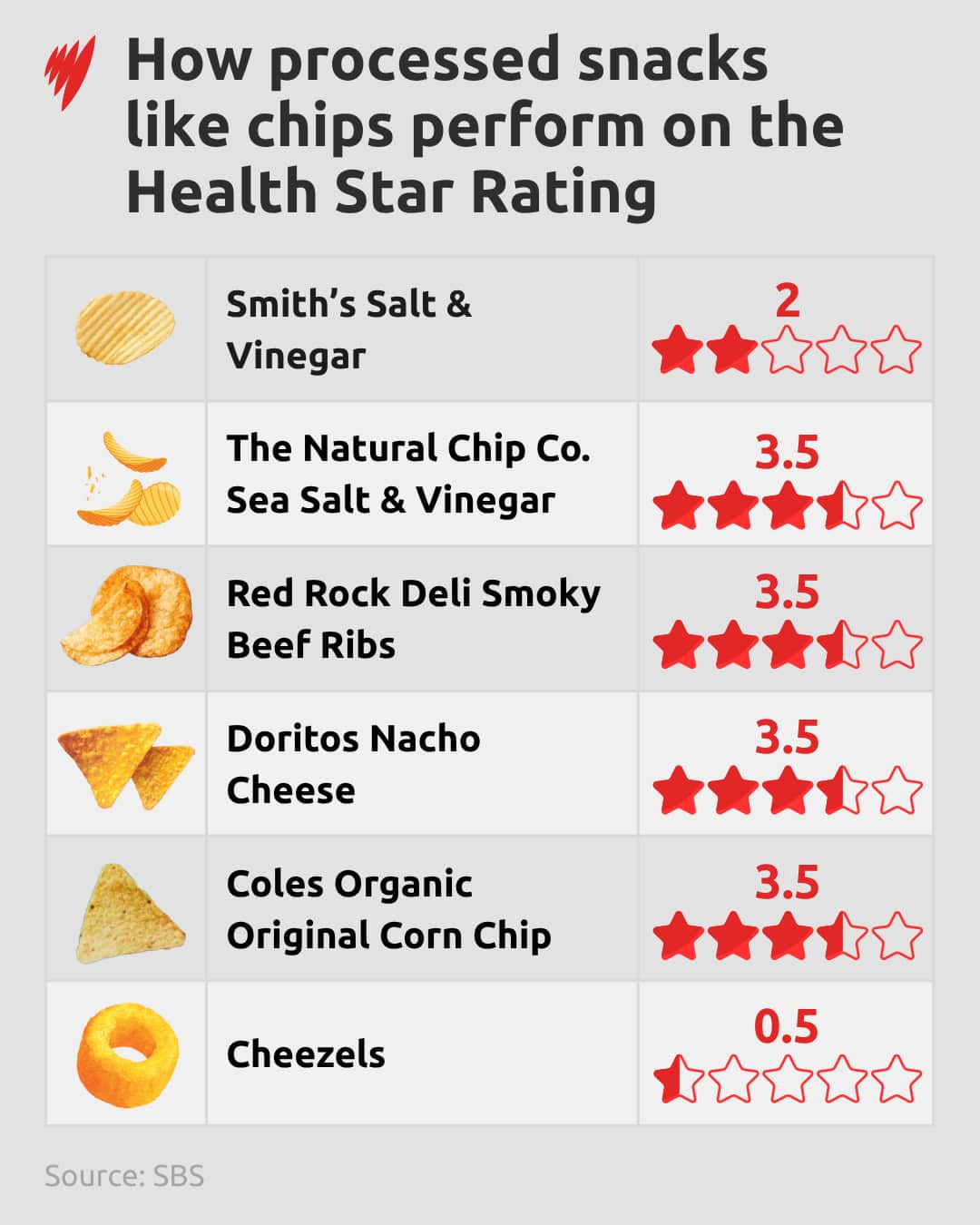
Graphic showing the star ratings of various types of corn and potato chips and cheese puffs

Manufacturers utilize an online calculator to input four primary “negative” nutrients that can decrease an item’s score: kilojoules, saturated fat, sugars, and sodium.

Using an online calculator, manufacturers plug in four key “negative” nutrients which lower the score of an item: kilojoules, saturated fat, sugars and sodium.

They can then add four “positive” inputs that increase the rating. These are:

Fibre

Protein

Fruit, vegetable, nuts and legume content (FVNL)

Concentrated fruit or vegetable ingredients such as tomato paste
It’s intended to compare similar products — so cheese against other cheese products, but not cheese against muesli bars.
Sarah Dickie, a research fellow in the Department of Nutrition, Dietetics and Food at Monash University, told SBS News that allowing positive components to negate negative ones is not an ideal system.

“This idea of being able to add enough good ingredients in to balance that out, it doesn’t really work. It’s still a junk food.”

Low-rated products less likely to display a rating

Research from The George Institute across more than 21,000 products last year found that 61 per cent of five-star items displayed their rating.

Just 16 per cent of products that would receive half a star were labelled, and only 24 per cent of products that scored three stars or lower showed a rating.
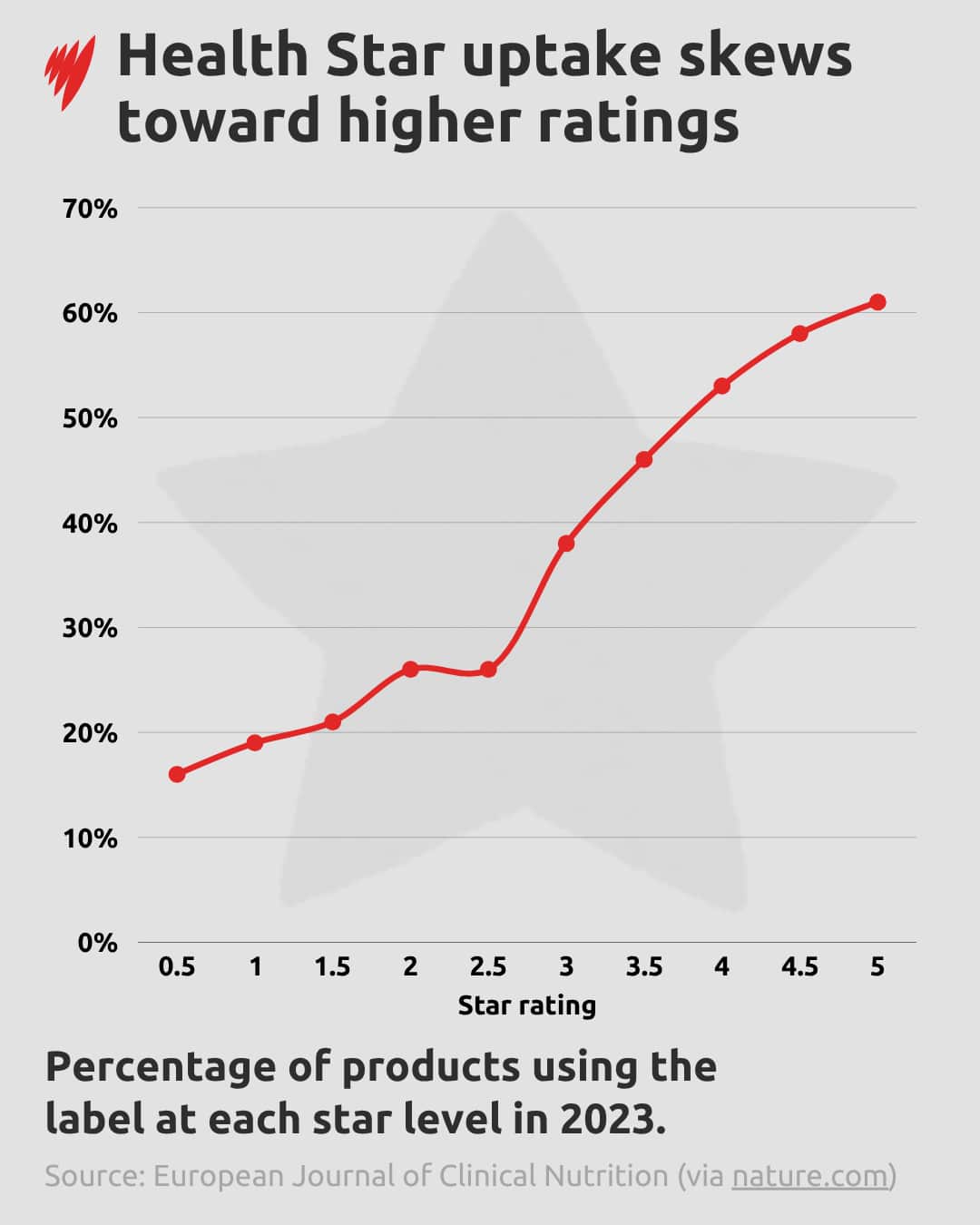
Health Star Rating uptake

Source: SBS News

Jones, of The George Institute, said in August the lack of consistency makes it difficult for consumers to compare items.

She called for a “clear and expedient timeline” to mandate ratings in addition to regular, independent reviews of the algorithm underlying the system.

Processing not factored in

Ultra-processed foods (UPFs) are made with few whole foods, created using industrial techniques, modified substances and various additives. They include products such as chips, carbonated or artificially-sweetened drinks, lollies, certain cereals and energy bars.
Processing is not captured by the Health Star Rating algorithm, despite growing evidence linking UPFs to numerous harmful health outcomes including heart disease and diabetes.

“You’re getting these ultra-processed foods that can go through the algorithm and say they’re really healthy,” said Dickie, whose research has looked specifically at the Health Star Rating system.
Health Star

Source: SBS News

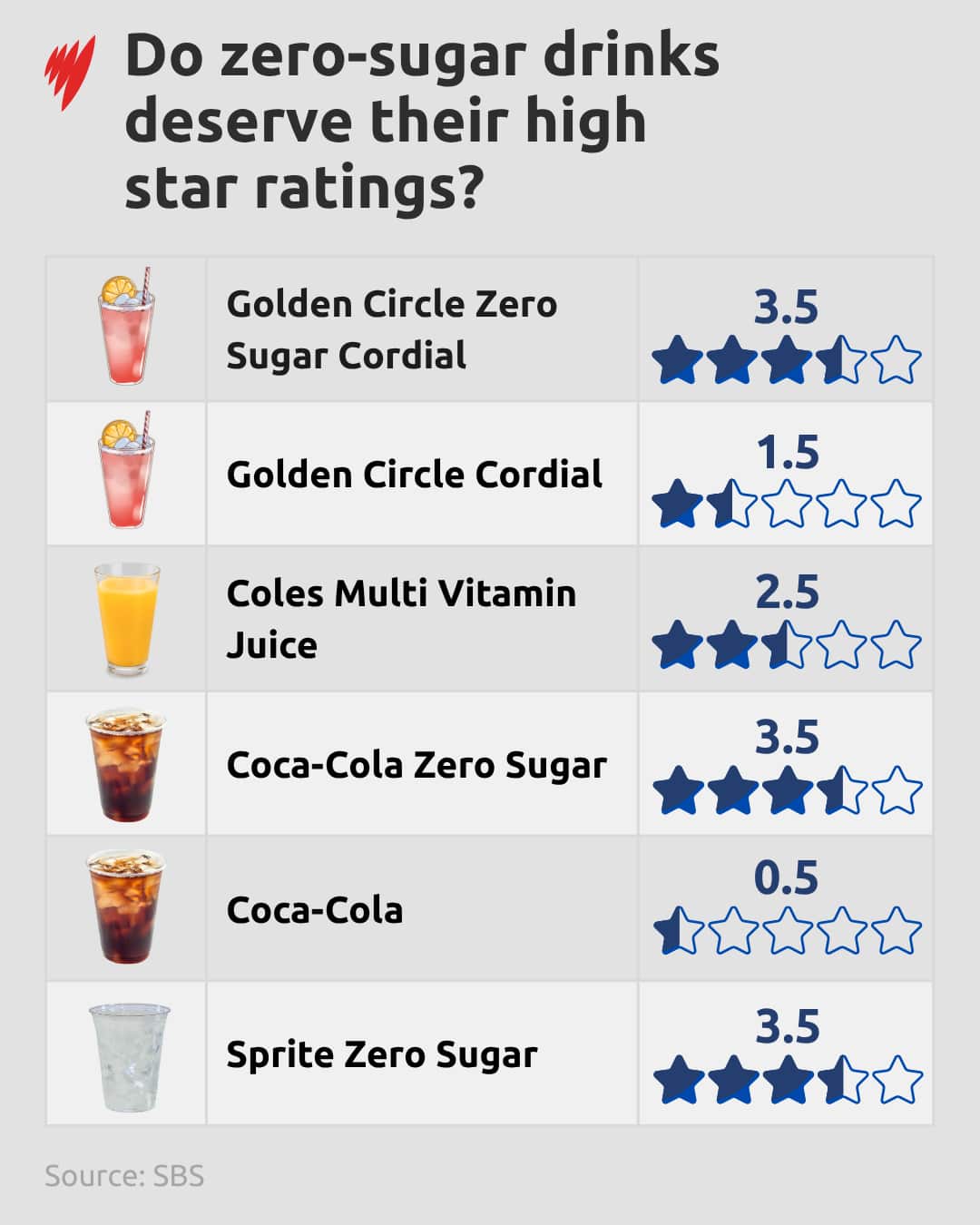
Artificial sweeteners are also not accounted for by the system, meaning zero-sugar soft drinks and cordials can rate up to 3.5 stars.

While some positive adjustments were made to the rating system after a previous review, Dickie said there are still some “fundamental flaws” in the algorithm.
“You can go around the supermarket and find things that are heavily processed, you know, like Up & Go, or even artificially-sweetened soft drink — 3.5,” she said.
“That does not make any sense, right?” she added. “There’s no nutritional value [in artificially-sweetened soft drink].”

Artificial sweeteners have been linked to gut issues, she said, and can promote taste preferences for sweetened food and drinks.

“If you’re having those from a young age, you’re developing a taste for sweetness, which is not good for your dietary habits.”

Up & Go liquid breakfast products, which contain fibre and protein, rate between 4.5 to 5 stars. Various brands of packaged chips have ratings of up to 3.5 stars. Milo snack bars have ratings of 4 stars while other snack products like LCMs choc-chip display a 1-star label.

Consumers want more transparency, surveys suggest

A 2024 VicHealth survey of 1,100 Australians found that nutrition information was the second most important factor influencing food purchases after price, yet many respondents said they didn’t trust food labels to be transparent.
Similarly, a 2023 Cancer Council survey found 82 per cent of Australian adults believe Health Star Ratings should be included on all packaged foods.

About two-thirds said making the system mandatory would make it more useful, and 65 per cent said it would help simplify their purchasing decisions.

Should a flawed system be mandated?

Experts agree that a compulsory system is crucial, but differ on where to go from here.
Magriet Raxworthy, CEO of Dieticians Australia, said the peak body supports making the current system mandatory, but said “there’s still opportunity for improvements” in future.
“I do believe it is going to set us on a motion in the right direction, and certainly enabling the Australian public to make more informed choices,” she told SBS News.

She suggested that outlier products with inaccurate ratings make up only a small fraction of the picture, but said the large majority “do provide the right information”. She called, however, for better messaging to the public on how to appropriately read the ratings.

“We know that people are comparing Health Star Ratings of products outside of groupings, and that means you’re also not utilising the system correctly,” she said.
Dickie, who is also an executive member of the advocacy group Healthy Food Systems Australia, said she doesn’t believe the current model is fit for purpose.
That group would not want the system mandated in its current form.

“Our preference would be to change it to a warning-based system,” she said.

Food ministers meeting early next year

A Department of Health spokesperson told SBS News that food ministers will meet early next year to review reporting on uptake and receive updates from Food Standards Australia New Zealand — the agency that develops food standards and policies for both countries — on preparatory work it has undertaken on potentially mandating the system.
“Based on this update, food ministers will further consider whether to mandate the HSR system,” the spokesperson said.

If ministers decide to mandate the system, it could still take several years before consumers see the effects on the shelves.

The spokesperson noted the existing system was designed to align with the Australian Dietary Guidelines, which don’t reference processing level.
Those guidelines are under review, and once an updated version is released, “consideration will be given to whether the HSR system remains aligned”.
“The HSR does not replace nutrition know-how. Unlike dietary guidelines, it doesn’t tell you what types of food to eat or in what quantities. Just because a product has a 5 star rating does not mean you should eat it every day or in large amounts,” the spokesperson said.

“Health Stars help consumers to quickly and easily compare similar products. It won’t help you to choose between bacon and breakfast cereal. But if you’ve decided to buy breakfast cereal then it will help you to choose a healthier option.”

The Australian Food and Grocery Council, the peak industry association for the food, beverage and grocery supply industry, told SBS News it “supports the Health Star Rating system as a tool to help Australians make informed food choices”.
“For many companies, particularly small manufacturers, introducing or revising packaging involves considerable time, cost and logistical complexity,” a spokesperson said.

“Any shift of the HSR to a mandatory measure would require adequate timeframes and support to ensure long-term planning and avoid unnecessary waste or disruption to production.”

What could a different approach look like?

Dickie pointed out that the existing system is positively skewed — by design, every product technically has a positive star rating above 0.5, even those that rank most poorly.
Research on front-of-pack labelling suggests that a warning system or negatively-skewed system is more effective.
“Something that actually puts a warning label on junk foods and points out the products that we shouldn’t be eating is going to be more effective than this kind of ranking-based system that is positive,” she said.

Share this @internewscast.com
You May Also Like
Ahead of the Budget delivery on Tuesday evening, Greens housing spokesman Max Chandler-Mather slammed the $9.3billion surplus as evidence of 'how little Labor cares about the housing crisis'

Budget 2024: Albo’s Challenger Unveils Key Oversight by Jim Chalmers

For the second consecutive year, Treasurer Jim Chalmers has announced a budget…

Australian Women Confront Tough Decisions Amid National Crisis

in brief Experts are warning that the cost of living crisis is…
Treasurer Jim Chalmers handed down the Budget on Tuesday night, boasting of a $9.3 billion surplus driven by a strong labour market and increased commodity prices

Budget 2024 Unveiled: $300 Cash Boost for Australians, Student Debt Forgiveness, Tax Cuts, and New Travel Policies by Albanese Government

In a strategic move to garner voter support ahead of elections, the…
Emma Sleep mattress

Mattress Industry Leader Faces $15 Million Penalty for Deceptive Online Advertising

Mattress company Emma Sleep has been ordered to pay a $15 million…
Michelle Stalimeros (pictured) grew up in a 'chaotic' home where alcohol was woven into family life

Weekend Wine Habit Triggered Blackouts and Anxiety, Straining Marriage; Reflecting on Three Years of Sobriety

At first glance, Michelle Stalimeros appeared far from someone struggling with alcohol.…

Unpacking the Key Issues in the NDIS Overhaul

In Brief Roughly 160,000 Australians are set to lose access to the…

Australia Boosts Fuel Reserves to Pre-Middle East Conflict Levels

In brief: Australia’s fuel reserves are now greater than before the US-Israeli…
Jade Elston

Adelaide Family Turns to Crowdfunding for Son’s Urgent Cancer Treatment: A Community’s Call to Action

An Adelaide family has found themselves seeking help from the kindness of…
The Australian soldiers who fought epic battle in the 'forgotten war'

Heroic Australian Soldiers Recall Epic Battle in the Overlooked Korean War

Anzac Day falls 75 years after Australian soldiers fought a bloody battle…

UK Plans New Legislation to Prohibit Cigarette Sales for Those Born After 2008

In brief A rolling age ban means children and anyone born in…
Anzac soldiers

Partial Remains of Australian Soldiers from WWI Finally Laid to Rest Over a Century Later

The partial remains of eight Australian soldiers have been laid to rest…
The owner of a service station in Sydney has been left fuming after a truck driver stole close to $3000 worth of petrol in one hit.

Brazen Petrol Theft Sparks Outrage: Service Station Owner Fumes Over Fuel Heist

A Sydney gas station proprietor is up in arms after a truck…