Share this @internewscast.com
Sun, beach, and time off work sum up the holiday season for many Australians, yet it is one of the deadliest times of the year — especially for overseas-born beachgoers.
Around one in three of the at least 139 people who drowned in Australia last summer were born overseas, according to Australia’s Royal Life Saving Society, the nation’s leading water safety educator.
Between Christmas Day and New Year’s Day in 2024, nearly three people drowned each day on average, making the period particularly dangerous — especially for those less aware of beach safety.
“Individuals born overseas are five times more likely to drown while swimming. Over the past decade, people born overseas have represented over a third of all drownings,” a Life Saving Victoria spokesperson told SBS News.
“The core issue for Victoria’s multicultural communities is a lack of swimming and water safety skills and knowledge.”

A spokesperson highlighted several reasons why the risk level is elevated, citing factors such as limited access to safe swimming areas, language and cultural challenges, origins from landlocked regions, and a general fear of water.

Masaki Shibata, who specializes in intercultural studies at Monash University and spearheaded these investigations, pointed out that the issue partly lies in how beach safety messages are conveyed on signage.

Beach safety signage is one tool used to improve knowledge and warn beachgoers of potential hazards, but studies show the signs often fail to effectively communicate the risks to non-English speakers.
A recent study from Monash University, in collaboration with Life Saving Victoria, found that only 14 per cent of Korean students in Australia understood what the red and yellow flags meant.

These safety signs are designed to alert beach visitors about both ongoing and sporadic dangers present at the beach.
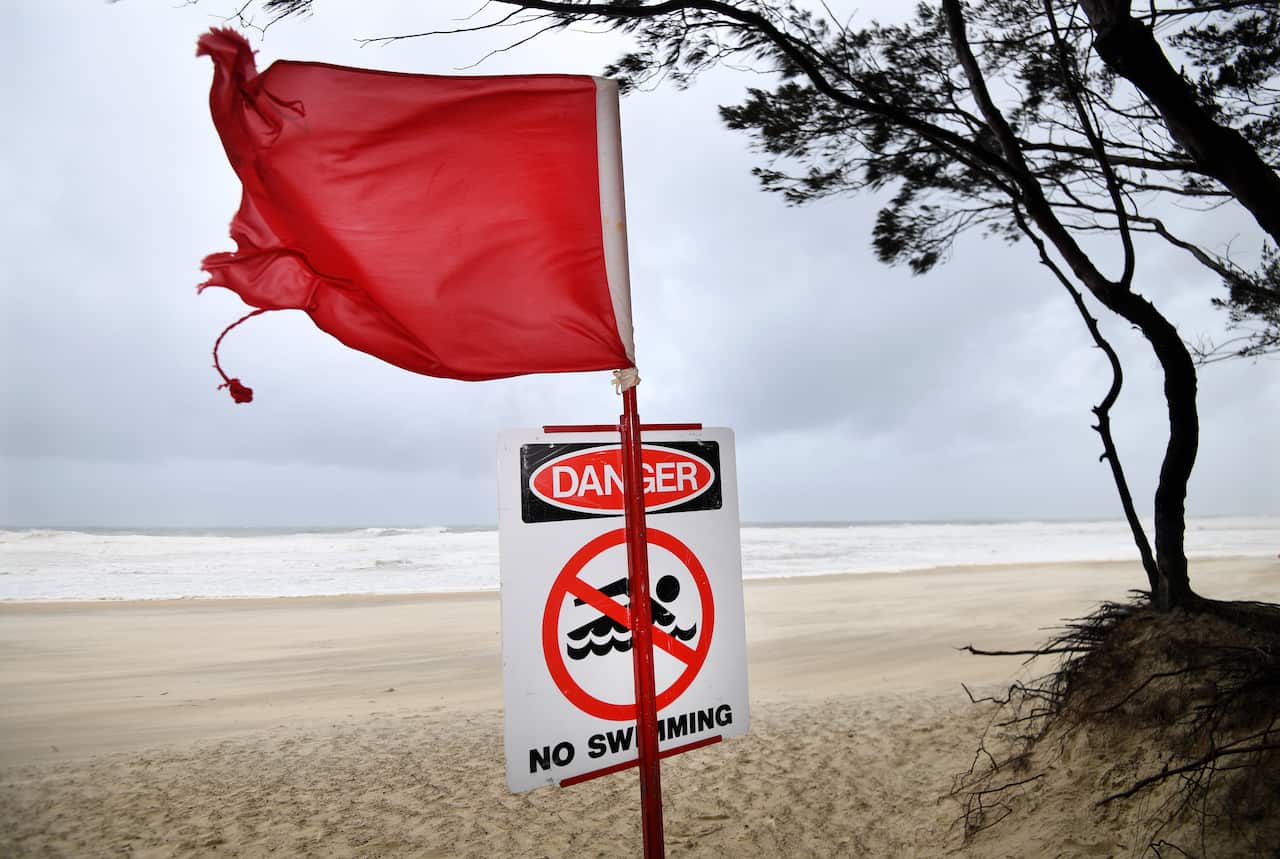
Red flag and “No swimming” danger sign on a windy beach with rough surf.

“The language used can be somewhat complex,” Shibata explained to SBS News. “Due to the color coding, some misunderstandings can arise.”

A related study conducted in 2024 focused on Japanese students and revealed that three out of five had limited comprehension of safety flags, with approximately 60% struggling to grasp warning terms.

“In translations to Chinese and Korean, ‘shore’ sometimes mistakenly refers to a designated area for disposing of waste,” Shibata noted.

Shibata said some commonly used terms, such as “rip current” or “shore dump”, were even unfamiliar to students in their own language.
“In other words, they don’t know the [word’s] existence,” he said.
“When you put the shore dump or shore break into Google Translate, at the moment, it actually comes out wrong.

“In Chinese and Korean, it comes out as a place to put rubbish on the shore.”

Experts warn that understanding phrases such as “rip current” — among the most common hazards on Australian beaches — is crucial for improving beach safety.
According to the Royal Life Saving Society, 45 people on average die from rip currents in Australia every year.
A Life Saving Victoria spokesperson said they “emphasise the importance of effective coastal safety signage in preventing aquatic incidents”.
“It’s important to note that signage is just one part of a broader, multidisciplinary drowning prevention approach that reduces drowning risk by addressing hazards, exposures, and vulnerabilities to protect individuals and communities.

“Life Saving Victoria has a dedicated multicultural department that delivers water safety activities daily throughout the year.”

Improving translatability

In recent years, there have been growing calls to improve beach warning signs for non-English speakers — and some changes have already been made.
For instance, Victoria’s Bass Coast Shire Council recently announced a trial of new coastal safety signage at high-risk locations, including Kilcunda Beach, Woolamai Beach and Forrest Caves.
The council has said the signage, developed by Life Saving Victoria, incorporates evidence-based design, multilingual messaging, and clear hazard warnings.

Shibata said that some of the terms should be “revised in English first” to make them more comprehensible to culturally and linguistically diverse communities (CALD).

“Let’s say, for example, ‘shore dump’ can be changed to ‘crushing waves’. Because shore is a location and dump is an action, but it doesn’t really capture waves … that’s why it’s a lot of different interpretations,” he said.
“So let’s put the wave there [in the phrase] … and then we know the dump can be misunderstood, so we can change it to crushing waves.
“It is important that the signs have to be very clear and very simple, very translatable,

But Shibata warns that no matter what the signs say, some people do not read them.

Beach education while studying English

Some initiatives to improve beach safety awareness for CALD communities begin before they even arrive in Australia.
Monash University, Surf Life Saving Australia, and the University of NSW Beach Safety Research Group created a reading exercise about beach safety for students preparing for the International English Language Testing System (IELTS) exam.

Shibata said the exercise was created to “educate those who are not interested in water safety or who just ignore our message”.

“We developed the exercise for IELTS, but then incorporated beach safety information and rip currents, beach science and risky behaviour in Australian beaches,” he said.
“So even though they are not really interested, they can just study English with our material, but unconsciously learn about beach safety.”
Survey results found an improvement in participants’ knowledge after finishing the IELTS exercise, particularly in identifying rip currents, red and yellow flags, and beach signage terms.

Share this @internewscast.com
You May Also Like
The bulk of Cath Armstrong's grocery shopping for the entire year is done in just three days.

Cath Plans 2026 Meals in Advance with Annual Pantry Restock

Cath Armstrong is not a fan of grocery shopping, so the Victorian…

UAE to Withdraw Remaining Troops from Yemen Amid Intensifying Crisis Post-Saudi Airstrike

The United Arab Emirates said it was pulling its remaining forces out…
snake

Unbelievable Journey: Python Secretly Travels Across Queensland-NSW Border in Driver’s Car

A coastal carpet python embarked on an unexpected journey, sneaking into a…
Good news in new poll for Hanson - but who is our most-liked politician?

New Poll Unveils Australia’s Most-Liked Politician: Surprising Results for Hanson

One Nation leader Pauline Hanson will end 2025 on a relative high,…
Sam Kerr and Kristie Mewis marry in private ceremony in Perth

Inside the Secret Perth Wedding: Sam Kerr and Kristie Mewis Tie the Knot

Australian soccer icon Sam Kerr has tied the knot with fellow athlete…

Australia’s 2026 Migration Overhaul: What It Means for Skilled Visas and International Students

Australia is heading into 2026 with a migration policy undergoing a major…

Ring in 2025: Ultimate Guide to New Year’s Eve Celebrations Across Australia

With only a few hours left, Australians across the country are preparing…

Key Insights into China’s Significant Military Exercises Near Taiwan

China’s large-scale military drills around Taiwan went on for a second day…

Iranian Government Proposes Dialogue Amid Rising Student Participation in Shopkeeper Protests

Protests over Iran’s soaring cost of living have spread to several universities,…
Revellers defy terror fears to flock to Sydney NYE celebrations

Thousands Gather in Sydney for New Year’s Eve Celebrations Amid Heightened Security Concerns

Fears of a desolate New Year’s Eve turnout deserted by people fearing…

Australian Cricket Legend Damien Martyn Reportedly in Induced Coma

Former Australian Test cricketer Damien Martyn has been rushed to hospital in…
The Tarago lost control and rolled around 5.30 this morning.

Tragic Minivan Rollover: Fatal Crash Claims Two Lives, Injures Six on Isolated Highway

Two people have died and six others have been rushed to hospital…