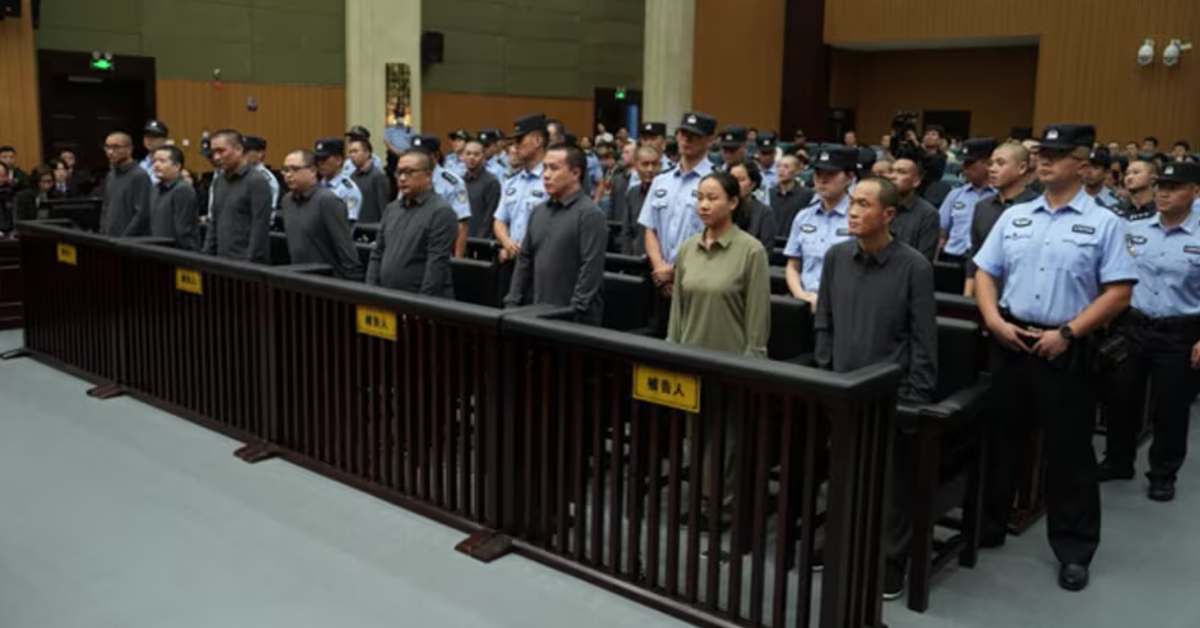

The Ming family, notoriously known as one of the “four families” of northern Myanmar, has been linked to extensive criminal activities. These syndicates have been accused of operating numerous compounds involved in internet fraud, prostitution, and drug manufacturing. Members of these families have held significant roles in both local government and militias that support Myanmar’s ruling junta.
Recently, 11 individuals were executed after being sentenced to death in September. They were found guilty of various offenses, including homicide, illegal detention, and fraud, as reported by the Xinhua news agency.
Among the accused, two sought to appeal their sentences. The case was brought before the Supreme People’s Court, China’s highest judicial authority, which ultimately upheld the initial verdict, according to Xinhua.
The crime syndicate, led by Ming Xuechang, was particularly infamous for its connection to the Crouching Tiger Villa, a notorious compound located in Kokang, an autonomous region along Myanmar’s border with China.
At its zenith, the syndicate employed around 10,000 individuals, facilitating scams and other criminal activities, as noted by Chinese state broadcaster CCTV.
Laukkaing, the capital of Kokang, became the epicenter of a lucrative scam industry worth billions. It thrived in the lawless regions of Myanmar, where trafficked individuals were exploited to deceive unsuspecting victims with intricate online schemes.
After years of complaints by relatives of trafficked scam centre workers and growing international media attention, Beijing cracked down on the compounds in 2023.
That November, China issued arrest warrants for members of the family, accusing them of fraud, murder and trafficking, and posted rewards of between $14,000 ($AUD19,859) and $70,000 ($AUD99,297) for their capture.
Family head Ming Xuechang, who had also served as member of a Myanmar state parliament, later killed himself while in custody, Chinese state media reported at the time.
His son Ming Guoping, who was a leader in the junta-aligned Kokang Border Guard Force, and his granddaughter Ming Zhenzhen were among those executed, Xinhua reported yesterday.
Before they were executed, they met with close relatives, the report said.
The Ming family syndicate also conspired with the leader of another syndicate, Wu Hongming, who was also executed, to intentionally kill, injure and illegally detain scam workers, resulting in the deaths of 14 Chinese citizens, according to Xinhua.
In one incident in October 2023, four people were killed when members of the group allegedly opened fire on people at a scam compound. In a report into the shooting, Chinese state media CCTV reported the group were transferring workers from the cyberfraud park under armed guard after being tipped off that police were planning a raid of the compound.
Scamming gangs in Southeast Asia steal more than $60 billion a year, according to the US Congress-founded United States Institute of Peace.
In Myanmar, scam compounds have been shielded by corruption and lawlessness that has long saturated the country’s border regions.
The criminal syndicates and the armed groups hosting them have also exploited almost five years of devastating civil war to expand their business.
When asked about the executions yesterday, a spokesperson for China’s foreign ministry said Beijing would continue to intensify efforts to “eradicate the scourge of gambling and fraud.”
NEVER MISS A STORY: Get your breaking news and exclusive stories first by following us across all platforms.