
BLOOMINGTON, Ind. – Former Congressman Lee Hamilton, a distinguished Indiana Democrat recognized for his significant contributions to foreign policy over a 30-year tenure in the U.S. House, passed away on Tuesday at the age of 94. Known for his characteristic crewcut, Hamilton played a crucial role in scrutinizing the September 11 terrorist attacks.
During his time in office, Hamilton also spearheaded an inquiry into the Reagan administration’s Iran-Contra scandal while serving the rural district of southern Indiana. According to his son, Doug Hamilton, he died peacefully at his residence in Bloomington, Indiana, although no specific cause was provided.
Hamilton emerged as a prominent critic of President George H.W. Bush’s 1991 Gulf War, advocating for sustained economic sanctions against Iraq instead of immediate military intervention following Iraq’s invasion of Kuwait.
Opting not to pursue reelection in 1998, Hamilton later expressed his belief that the United States should be perceived globally as more than just a military leader. He emphasized the need for America to embody optimism and benevolence.
In a 2003 statement, Hamilton articulated, “The United States must be — and must be seen as — an optimistic and benign power. We must speak and act as a source of optimism, a beacon of freedom, a benign power forging a consensus approach toward a world of peace and growth and freedom. And American power must be accompanied by American generosity.”
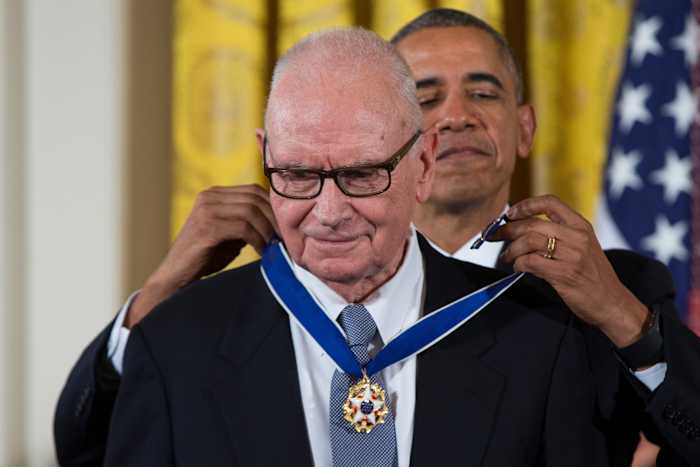
In recognition of his service, President Barack Obama honored Hamilton with the Presidential Medal of Freedom in 2015, praising him as a person respected across the political spectrum for his integrity, insight, and unwavering dedication to bipartisanship.
9/11 investigations
Hamilton was a small-town lawyer known for his exploits as a high school basketball star when he first won election to his southern Indiana congressional seat in 1964 at the age of 33.
With his thick glasses and calm, deliberate manner, Hamilton rose to become chairman of the House Foreign Affairs and Intelligence committees and a Democratic leader on international relations before retiring from Congress in 1999.
His reputation as an evenhanded moderate had Capitol Hill leaders turn to him for some of the most tumultuous matters facing Washington. But he also faced criticism that he was not aggressive enough in pursuing allegations of wrongdoing by Republican administrations.
Hamilton was tapped in 2002 as vice chairman of the Sept. 11 terrorist attacks commission. That group spent 20 months investigating the 2001 attacks, which killed nearly 3,000 people when 19 hijackers flew airliners into New York’s World Trade Center towers, the Pentagon and the Pennsylvania countryside.
He presented a united front with the panel’s Republican chairman, former New Jersey Gov. Thomas Kean, through its clashes with the George W. Bush White House and its lobbying efforts for changes to the U.S. intelligence system.
The commission found that both the Clinton and Bush administrations had failed to grasp the gravity of terrorist threats and took actions so feeble, they never even slowed the al-Qaida plotters.
“The fact of the matter is, we just didn’t get it in this country,” Hamilton said when the commission released its report in 2004. “We could not comprehend that people wanted to kill us, they wanted to hijack airplanes and fly them into big buildings.”
Iran-Contra committee
Hamilton gained national prominence in the mid-1980s with his selection as a co-chairman of the congressional Iran-Contra committee, which investigated the Reagan administration’s diversion of profits from Iran arm sales to help Nicaragua’s Contra rebels. The panel’s report found that President Ronald Reagan created an atmosphere at the White House in which subordinates felt free to skirt the law and Constitution.
“There was too much secrecy and deception,” Hamilton said at the time. “Information was withheld from the Congress, other officials, friends and allies and the American people.”
Hamilton, however, was able to gain little Republican support for the committee’s work. then-Rep. Dick Cheney, a top Republican on the Iran-Contra committee, called the report a political document that selected only the most damaging evidence against the Reagan administration.
Hamilton was considered as a possible vice presidential running mate both for Michael Dukakis in 1988 and Bill Clinton in 1992, but they decided against picking the nontelegenic congressman from a Republican-leaning state.
Born April 20, 1931, in Daytona Beach, Florida, the son of a Methodist minister moved with his family to Evansville, Indiana, as a child.
Hamilton went on to college at DePauw University and attended Goethe University in Frankfurt, Germany, before graduating from Indiana University’s law school in 1956.
After Congress
After serving in Congress, Hamilton continued with his interests in foreign affairs and congressional reform as director of the Washington-based Woodrow Wilson Center. He also spent time as a faculty member at Indiana University, which in 2018 named its School of Global and International Studies after Hamilton and longtime Republican Sen. Richard Lugar, who died in 2019.
Hamilton and his wife were married for 58 years after meeting while students at DePauw. Nancy Hamilton died in 2012. He is survived by three children, five grandchildren and one great-grandchild.
__
Volmert contributed from Lansing, Mich. Davies is a former Associated Press Writer.
Copyright 2026 The Associated Press. All rights reserved. This material may not be published, broadcast, rewritten or redistributed without permission.