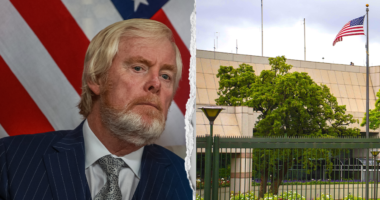


Mayor Zohran Mamdani’s proposal to increase New York’s corporate tax could potentially trigger a migration of businesses and residents to New Jersey, cautioned the leader of the city’s foremost business organization.
Steve Fulop, recently appointed CEO of the Partnership for The City of New York, expressed concerns on WABC’s “Cats Roundtable” program. He explained, “Engaging in this tax debate is counterproductive, as it could double our rates compared to New Jersey. Currently, New Jersey’s corporate tax rate stands at 11%. Should we implement the Mayor’s plan, our rate would leap to 22%, twice that of New Jersey.”
“Relocation doesn’t mean moving to distant states like Texas or Florida. A mere mile’s move can have significant economic repercussions for New York. While people are drawn to our city, we must ensure our economic environment remains competitive. We’re nearing a point where that may no longer be the case,” Fulop remarked to host John Catsimatidis.
With a strong grasp of the competitive interplay between New York and New Jersey, Fulop is familiar with the landscape, having served as the mayor of Jersey City. The proximity of Jersey City allows residents to enjoy lower living costs while conveniently commuting to Manhattan via the PATH train.
Mamdani’s proposal suggests raising the corporate tax from 7.25% to 11.5%, which would align it with New Jersey’s rate.
However, Fulop points out that the total combined marginal corporate income tax rate in New York City, factoring in additional charges like an MTA surcharge, would escalate from 17.44% to 22.48%. This increase is part of a strategy to address a substantial budget deficit and support Mamdani’s expansive policy initiatives, pending approval from Governor Kathy Hochul and the state legislature.
During the campaign, Mamdani said New York’s corporate tax rate has also fallen over time, from 12 percent in the mid-1970s to 10 percent in the mid-1990s, to just 6.5 percent in 2014 as a result of former Gov. Andrew Cuomo’s corporate tax cut and lower than neighboring states.
“A majority of all corporate tax revenue is paid by fewer than 1000 super-profitable corporations. The Mamdani administration will champion an increase of the top corporate tax rate to 11.5 percent—the same rate as New Jersey—which will raise $5 billion per year,” his campaign website said.
Mamdani said he would push the City Council to raise property taxes by 9.5% if Albany refused to raise corporate taxes and the income tax on millionaires in an election year. The state must approve all major city taxes, with the exception of the property tax.
Fulop said he met with 25 of the city’s top corporate CEOs who want the Partnership to take a more aggressive approach in opposing higher taxes and government spending under Mamdani, a democratic socialist.
They are also alarmed about growing antisemitism in the city. Fulop and some of the city’s corporate honchos are Jewish.
‘The CEOs would say, `We’re in uncharted territory … a lot of things he says we don’t believe in period,” Fulop said.
“They’re definitely concerned about the business climate, about some of the rhetoric, growing antisemitism on the extreme left and … the quality of life throughout the city.”
He said there’s much bloat in the city government that should be addressed instead of raising taxes.
Exhibit A, Fulop said, is the city’s Department of Education.
Madmani’ pending plan for fiscal year 2027 beginning July 1 would boost the DOE budget overall by $3 billion, to a total $38 billion — event as the public school system’s enrollment has cratered following the COVID-19 pandemic.
But political opposition from the unions and council members have thwarted prior mayors from curbing spending at schools with dwindling enrollment, via a “hold harmless” provision.
“School funding in New York … is flawed.… You’ve seen enrollment drop from 1.1 million to a little bit more than 800,000 while the budget has increased,” Fulop said.
The city also spends massively on rental assistance programs, he noted.