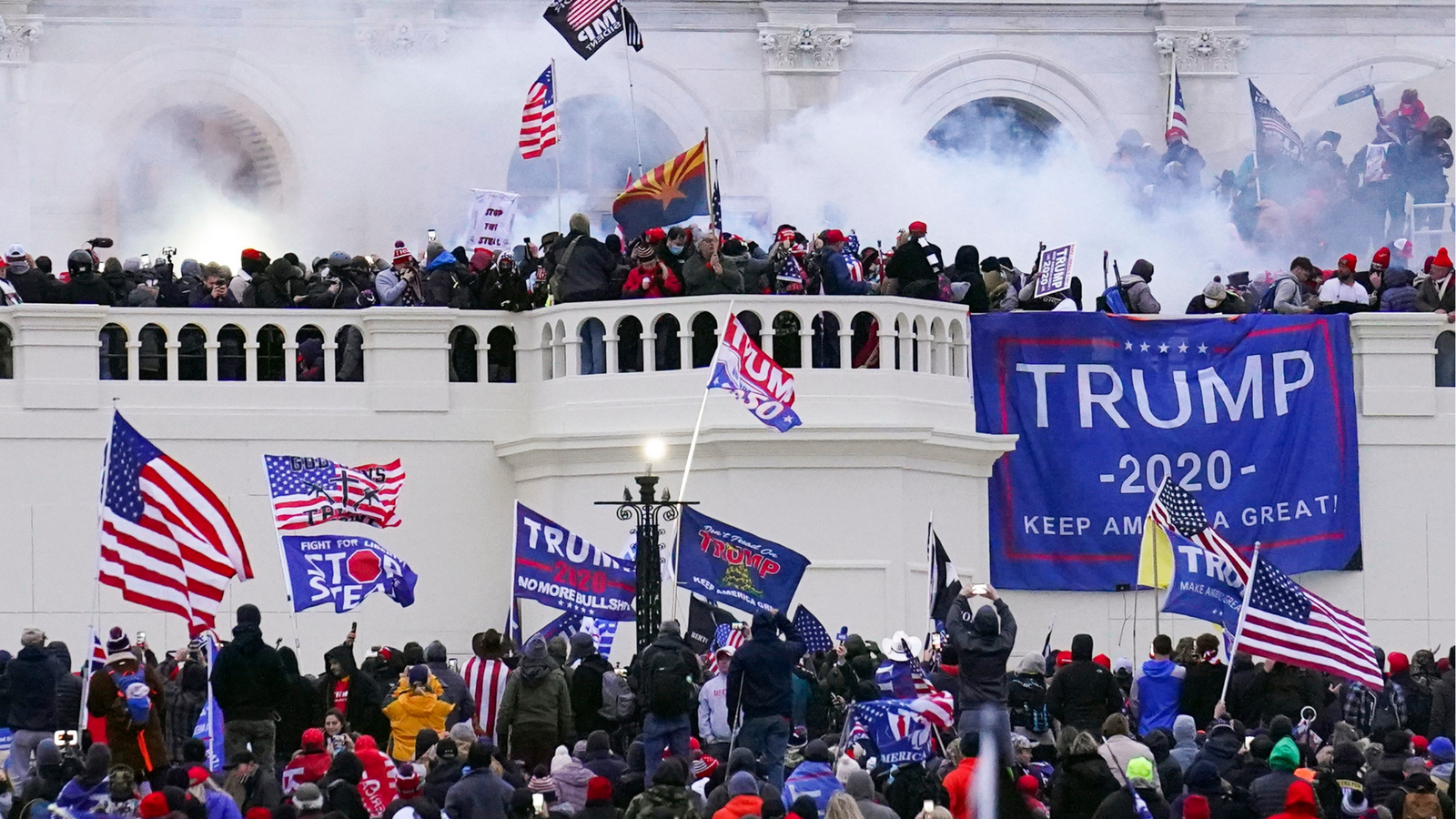

David Johnston, a former lawyer, took part in the Capitol riot with a crowd of President Donald Trump’s supporters on January 6, 2021. Now, more than five years later, he is extending a helping hand to fellow participants, known as “J6ers,” by assisting them in applying for compensation from a substantial $1.8 billion fund established by the Trump administration for those alleging victimization by a biased government.
Johnston proposes to offer his services for a 10% commission on any awarded amount, with a maximum fee of $5,000 per person.
In a social media video, Johnston expressed optimism about the evolving narrative surrounding the events of that day, stating, “I believe the story is shifting in our favor. Positive developments are occurring for us.”
Many Trump supporters who admitted guilt for their involvement in the Capitol breach have since received pardons from Trump. Now, they are eager to benefit financially from their actions by accessing the $1.776 billion fund, designed to aid allies of the former president who feel they were unfairly targeted politically.
Despite facing bipartisan criticism and a judicial block, the fund has sparked enthusiasm among January 6 participants eager to claim a portion of the taxpayer-funded pool. Some are already making moves to secure their share, even though the application process remains undefined and a judge has temporarily halted the fund’s establishment.
Rioters seek compensation payouts.
The fund’s critics see it as another vehicle for Trump and his allies to whitewash the events of Jan. 6, retroactively justify the mob’s assault on a pillar of American democracy and reward some of Trump’s most loyal followers.
Jason Riddle, a military veteran from New Hampshire who was sentenced to 90 days behind bars after pleading guilty to riot charges, publicly rejected a pardon from Trump. Likewise, he said it would be “ridiculous” for him or any other Jan. 6 rioter to get government compensation.
“I’d love money, but I can’t accept that. That would bother me for the rest of my life,” he said. “We weren’t innocently persecuted just because of who we are or who we vote for. We were persecuted for committing criminal behavior in the Capitol of the United States.”
Plenty of other “J6ers” do not share Riddle’s reluctance.
A Florida man who posed for photos with then-House Speaker Nancy Pelosi’s podium argued on social media that he deserves to be compensated for the cost of his infamy. A rioter from New Jersey described by prosecutors as a Nazi sympathizer hailed the fund as “good news not just for J6ers but all victims of weaponization.” A Texas man who received a seven-year prison sentence for storming the Capitol with a metal tomahawk celebrated the fund as “payback” for “victims of Biden’s tyranny,” referring to Democratic President Joe Biden.
Oregon resident Pamela Hemphill, sentenced to 60 days in jail for her conviction, rejected a pardon from Trump but has drafted a written claim for compensation from the fund. Unlike scores of rioters who claim to be victims of a government weaponized by Democrats, Hemphill blames Trump for her legal troubles. Her claims letter says she is seeking $5 million in compensation.
“I wouldn’t have been through all of this if Trump hadn’t lied about the election being stolen,” she said during a telephone interview. “It’s a direct result of his lies that I was even there that day.”
Fund faces legal and political challenges
It is an open question whether anyone convicted of a Capitol riot-related crime could be eligible for payments from a fund created to resolve Trump’s lawsuit against the IRS over the leak of his tax returns.
Acting Attorney General Todd Blanche has not ruled out that possibility. Blanche said there are no limits on who can apply, but he noted that the fund’s five commissioners – all yet to be named – will decide who deserves to be compensated and why, based on factors such as “what the person did, his sentence, how much time he was in jail.”
“That’s up to the commissioners,” Blanche told The Associated Press on Thursday when asked about his position on whether violent Jan. 6 defendants should be eligible for payments.
“You have to define something and then stick to it. That’s something I’ve been hesitant to try to do, because it’s very fact-intensive,” Blanche said. “Me sitting here and talking in hypotheticals is something that I don’t think is fair to the process.”
It is unclear whether Congress would block payments to Jan. 6 defendants. Senate Republicans who are angry about the settlement have said they want to place parameters on the fund as part of a Department of Homeland Security spending bill. They abruptly left town earlier this month after a tense meeting with Blanche and will return on Monday with the situation unresolved.
A federal judge in Virginia has frozen the fund’s establishment and temporarily blocked any processing or paying of claims. The judge issued that ruling Friday in one of at least three lawsuits challenging the fund.
Brendan Ballou, a former prosecutor who tried several Jan. 6 cases before leaving the Department of Justice last year, sued on behalf of two police officers who helped defend the Capitol from the mob. Ballou views the fund’s creation as part of a broader Trump campaign to undermine democratic institutions and rewrite the history of Jan. 6.
“And if the president is successful in that effort, if he’s able to get people to either forget or condone that day, he knows that he can get people to accept any attack on democracy,” Ballou said.
Rioters emboldened by Trump’s Jan. 6 recasting
Nearly 1,600 people were charged with Capitol riot-related federal crimes. More than 1,200 were convicted and sentenced before Trump issued mass pardons and ordered the dismissal of all pending Jan. 6 cases. Trump also freed far-right extremist group members who were imprisoned for plotting to attack the Capitol to keep Trump in office after he lost the 2020 presidential election to Biden.
The self-described “J6 community” isn’t the only pro-Trump constituency angling for cuts of the money.
Meshawn Maddock, who was charged as being a fake elector for Trump in Michigan before a judge dismissed the case last year, said she and her husband, state Rep. Matt Maddock, “absolutely” plan on making a claim. She believes the fund’s use of taxpayer money is justified because it “paid for the prosecution and investigation of the years that I was being hunted down.”
“I want vengeance and I want retribution,” Maddock said.
Trump’s campaign to recast Jan. 6 as a peaceful protest seems to have emboldened many convicted rioters.
Johnston’s eagerness to help other Capitol rioters with claims contrasts with his remorse at sentencing in 2022. He apologized for his “terrible lapse in judgment” before a judge sentenced him to three weeks in jail and three months of home detention. He pleaded guilty to a misdemeanor trespassing charge.
“It was a dumb, dumb thing to do,” Johnston told the judge. “I am 100% responsible for what I did that day.”
___
Associated Press writers Jamie Stengle in Dallas and Mary Claire Jalonick and Joey Cappelletti contributed to this report.
Copyright © 2026 by The Associated Press. All Rights Reserved.