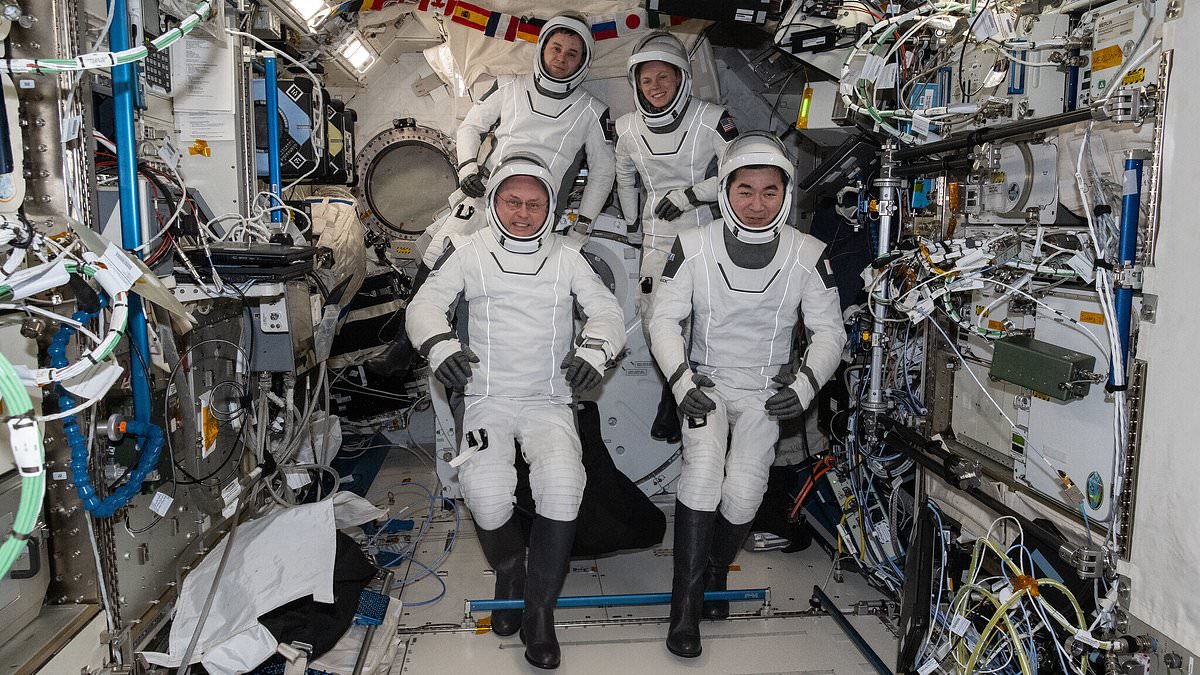

NASA has shared further insights into the unusual medical evacuation from the International Space Station (ISS) that occurred last month.
The agency announced on Tuesday that astronaut Mike Fincke, aged 58, was the individual who experienced the health issue, leading to Crew-11’s mission concluding a month ahead of schedule.
While Fincke has chosen not to disclose the specifics of his medical condition or his current health status, he expressed gratitude towards his team and medical staff, commending their “professionalism and dedication” and acknowledging their role in achieving a “positive outcome.”
Fincke explained that after additional assessment, NASA decided that an early but well-organized return was the most prudent choice. This decision, not deemed an emergency, aimed to provide the crew with access to advanced medical imaging unavailable on the ISS.
Last month, NASA Administrator Jared Isaacman mentioned that the choice was driven by caution, emphasizing that the medical situation was deemed “serious” and warranted further treatment on Earth.
The Crew-11 team, which also comprised Roscosmos cosmonaut Oleg Platonov, NASA astronaut Zena Cardman, and Japan Aerospace Exploration Agency (JAXA) astronaut Kimiya Yui, safely landed off the coast of San Diego, California, on January 15.
‘I’m doing very well and continuing standard post-flight reconditioning at NASA’s Johnson Space Center in Houston,’ Fincke said.
‘Spaceflight is an incredible privilege and a reminder of how human we are. Thank you all for your support.

The agency revealed on Tuesday that astronaut Mike Fincke (second from left) experienced the issue, which cut Crew 11’s mission short
This was the first time a crew on board the ISS had their mission ended early due to medical reasons.
Crew-11 arrived at the ISS on August 1, 2025, meaning their return date had been scheduled for late February.
The four astronauts were set to leave after Crew-12 arrived on a new SpaceX Dragon capsule no earlier than February 15. However, the Crew-12 mission launched to the ISS on February 13.
While NASA has not provided details about the medical emergency, Fincke dropped a hint during Crew-11’s first public appearance after returning to Earth.
He said a portable ultrasound machine was ‘super handy’ during the crisis.
‘Having a portable ultrasound machine helped us in this situation; we were able to take a look at things that we didn’t have,’ he explained.
While the astronaut did not elaborate on the medical emergency, the fact that an ultrasound was used suggests two likely reasons.
Firstly, ultrasound scans are often used to examine how astronauts’ cardiac systems are functioning in low gravity.

Mike Fincke declined to share specifics about his condition or current health but praised his colleagues and medical team for their ‘professionalism and dedication.’ Pictured is Fincke after returning from the ISS last month
The other main use for ultrasound in space is to monitor astronauts’ eye health.
However, ultrasound can also be used as a general diagnostic tool in a vast number of medical cases. It remains unclear what the medical emergency was or how ultrasound proved useful.
During the press conference, Fincke explained that the crew had lots of experience using the ultrasound machine to track changes in the human body, so ‘when we had this emergency, the ultrasound machine came in super handy’.
The Crew–11 pilot even went so far as to claim that all future spaceflights should be equipped with portable ultrasound machines.
‘Of course, we didn’t have other big machines that we have here on planet Earth,’ he said.
‘We do try to make sure that everybody, before we fly are really, really not prone to surprises. But sometimes things happen, and surprises happen, and the team was ready … preparation was super important.’
The ISS has carried a modified off–the–shelf ultrasound machine called Ultrasound 2 since 2011, which is used in both biomedical research and routine health checkups.
Ultrasound 2 is typically employed to address two primary medical concerns: heart and eye conditions.
In a constant state of free–fall induced microgravity, blood tends to drift up from the astronauts’ feet and collect around their head and chest.

This was the first time a crew on board the ISS had their mission ended early due to medical reasons
This creates a significantly increased risk of developing blood clots that can be life–threatening if they migrate into the heart or lungs.
In 2020, a NASA astronaut developed a large clot in their internal jugular vein during spaceflight and was forced to stretch the station’s dwindling supply of blood thinners to last more than 40 days until supplies could be sent.
The other main use for ultrasound in space is to monitor astronauts’ eye health.
As fluids build up in the head, they can cause swelling that triggers a collection of changes in the eye and brain called ‘spaceflight–associated neuro–ocular syndrome’.
Increased pressure around the optic nerve causes swelling in the connection between the eye and the brain, and flattening of the back of the eye.
This can lead to blurred vision and long–term damage to an astronaut’s vision.