
For many Australians, consumed by managing mortgages, sports, and grocery runs, the ongoing tensions in the Middle East might appear as a distant conflict between unfamiliar nations.
However, the situation could hit home if oil prices skyrocket, making fuel even costlier. There’s also a possibility that Australia might find itself pulled into another ‘mateship moment’ with the United States.
The Australian government has been quick to express political support for Washington’s justification in its military action against Iran, advocating for measures to prevent Iran from acquiring nuclear weapons, while simultaneously clarifying that Australia is not involved militarily.
This dual approach—aligning rhetorically with the US while asserting non-involvement—poses its own risks.
In such conflicts, US requests often begin with less visible but significant support, like intelligence sharing and logistical aid, rather than immediate troop deployment.
Given the increasing threats to shipping in the Strait of Hormuz, a crucial channel for global oil supply, participating in safeguarding energy resources can be framed as a defensive and restrained action.
Until it isn’t. We are lucky to be so geographically removed.
But then there is the sovereignty problem. Even when ministers say Australia isn’t involved, they decline to speak about what Australia-based joint facilities may be doing in support of US operations.

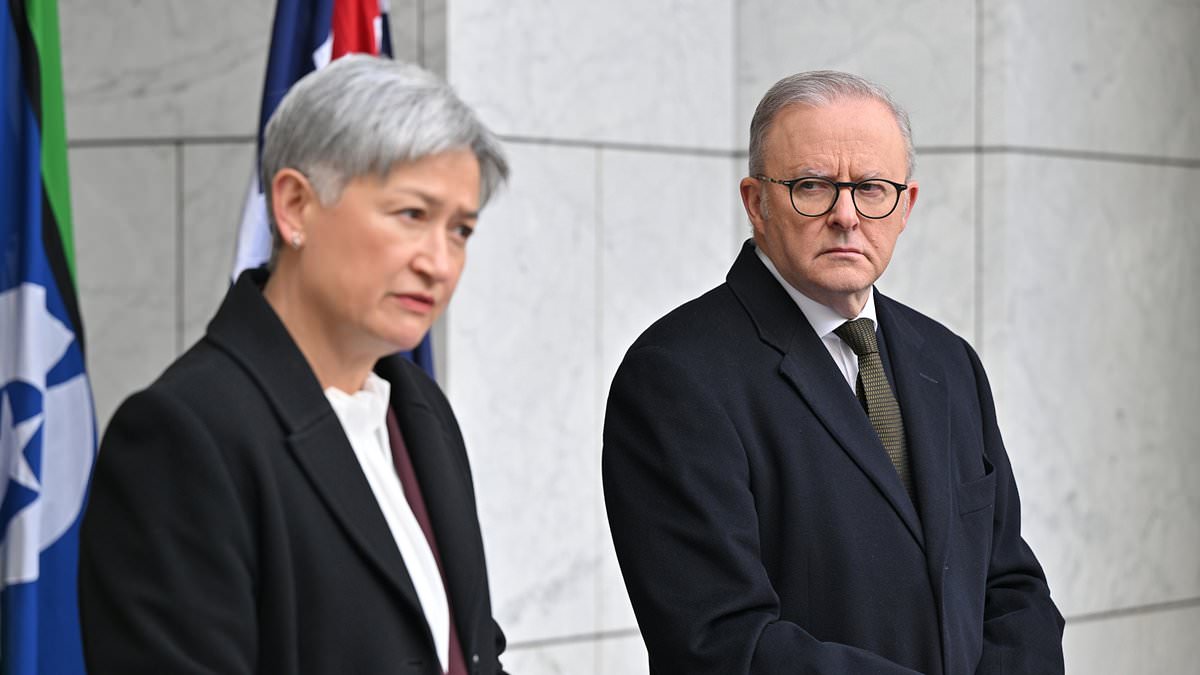
Prime Minister Anthony Albanese and Foreign Minister Penny Wong are trying to thread the needle between backing the US action against Iran without getting Australia involved

But who could say whether the Australia-US spy base Pine Gap was involved in the Iran operation
That ambiguity is politically convenient in the short term, but strategically combustible if Iran decides that support and participation are the same thing. After all, not visibly helping didn’t save Iran’s neighbouring Gulf countries from being bombed.
In such circumstances we should be grateful that the US and Israel have knocked out most of Iran’s military capabilities, although the threat of terror by proxies remains real.
Meanwhile, the debate about whether the US and Israeli strikes on Iran breached international law isn’t just a nerdy United Nations parlour game.
The whole situation gives rise to key questions that affect Australia: Do the rules that supposedly keep bigger wars in check still mean anything? Did they ever?
The US strikes have been criticised by legal scholars and commentators as sitting outside the UN Charter system.
But Iran has spent years building a way of fighting that sits precisely in the seams of that very system, terrorising its enemies through proxies, such as Hezbollah.
Such warfare isn’t war in the conventional sense. It’s pressure and violence designed to stay below the threshold that triggers retaliation.

Donald Trump’s action against Iran makes clear that the US will consider ‘grey zone’ operations – where a nation terrorises others under the cloak of deniability – as a trigger for war
Which means staying within international law means the West did little or nothing to combat what Iran gets up to – until this week.
Iran’s Revolutionary Guard and its network of aligned armed groups have played this tricky game for decades.
Creating just enough uncertainty to split coalitions, and turn any counterstrike into a legal and moral argument rather than a strategic one.
This is where the legal critique of the current campaign, even if technically correct, collides with a much harder question.
What is the law worth when one side has treated deniable violence as a long term substitute for open warfare?
When the international outrage isn’t directed at the violence itself, but at states like the US and Israel when they finally decide to assign responsibility to the state that has been terrorising its region and the global community for decades.
Donald Trump has publicly described the operation against Iran in contradictory terms, but the strategic signal he’s sending is consistent: proxy action will now be treated as state action.
It is fashionable to say this is reckless, and maybe it will prove to be. But it also addresses something Western governments have too often been unwilling to admit: that deterrence collapses when the costs of retaliation are seen as too high to green light.

Gulf states such as the United Arab Emirates were not involved in the US-Israeli strikes – but that did not stop Iran from bombing them (Dubai attack above) to raise the cost of the conflict
That thinking emboldens the way the likes of Iran continue to terrorise. Iran’s model has exploited such Western concerns for decades, confident that alliance politics and legal anxiety would blunt any meaningful response to what they get up to.
The early shape of this conflict, however, appears to be jettisoning the limits of past actions by the West. Targets have included leadership figures and missile infrastructure, with Israel arguing Iran was building deeper protected facilities and US officials pointing to intelligence about looming reprisals against American forces.
Perhaps some of that intelligence will stand up, perhaps it won’t. The fog of war is thick, and the incentives to exaggerate are obvious for someone like Trump, especially when public support is shaky at best.
But this is exactly why the international law question, while serious, is a limited consideration.
The danger is that normalising preventive war corrodes what remains of a system designed to restrain it. That matters. It matters especially for middle powers that rely on rules more than force. It’s why the Albanese government is in a somewhat awkward position as it tries to back America without joining it.
But there is another danger here, too: that the rules are hollowed out from the other direction, by actors like Iran who wage violence through intermediaries and then demand courtroom standards of proof before the victims of their actions can respond.
If that model is rewarded, it will spread fast. Russia and China already understand threshold manipulation and deniable pressure. So do smaller rogue states that have watched Iran do it for years. The lesson of the past week may be that the US under Trump is prepared to collapse the distinction between proxy and patron.
Trump’s outside the box approach is complicating the way Iran is forced to respond to the attacks against it.

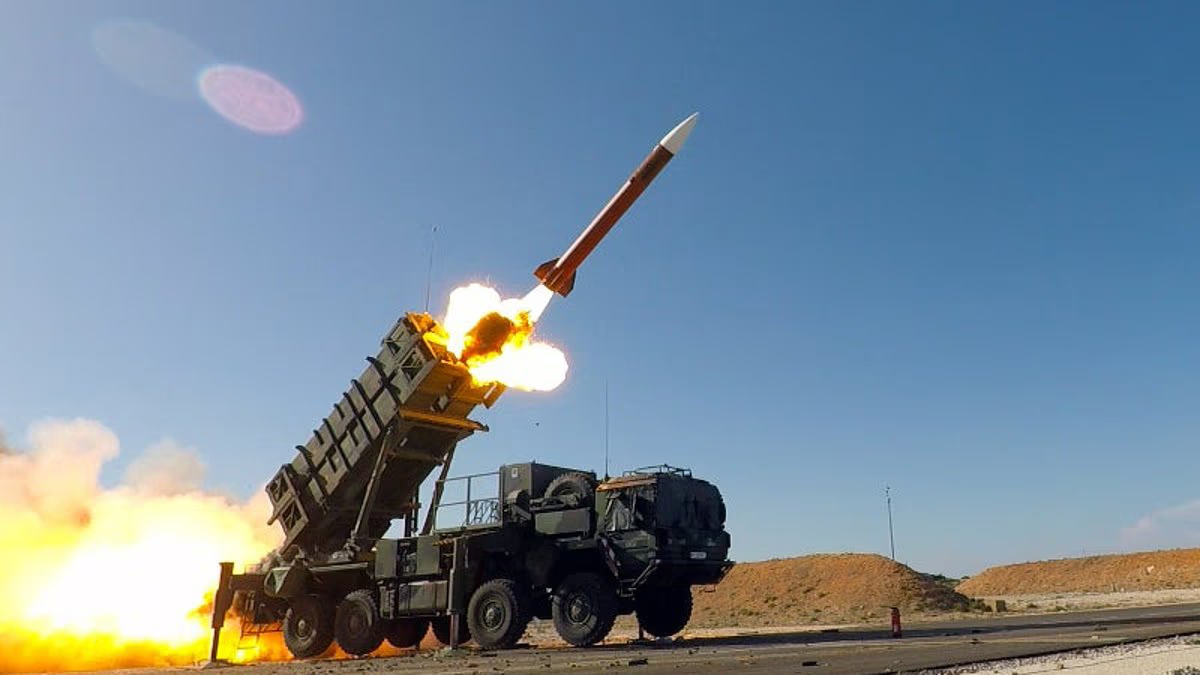
A missile launched by Iran is intercepted, above, in this Reuters photo
Striking Gulf infrastructure and rattling energy routes is counterproductive in the short term because it forces Sunni Arab states to cling tighter to American protection and it encourages, at the very least temporarily, more alignment with Israel.
But Iran can cause all manner of problems for a region desperate to become more attractive to foreign investment. The idea that Iran’s drone and missile ecosystem can be bombed out of existence quickly should be treated with scepticism.
Without a ground invasion – which for good reason is being ruled out – who is to say that what we are watching play out right now can’t continue indefinitely, certainly from Iran’s perspective.
If regime change doesn’t follow that’s a terrible outcome for the Middle East, other than whatever value can be placed in crushing Iran’s nuclear ambitions.