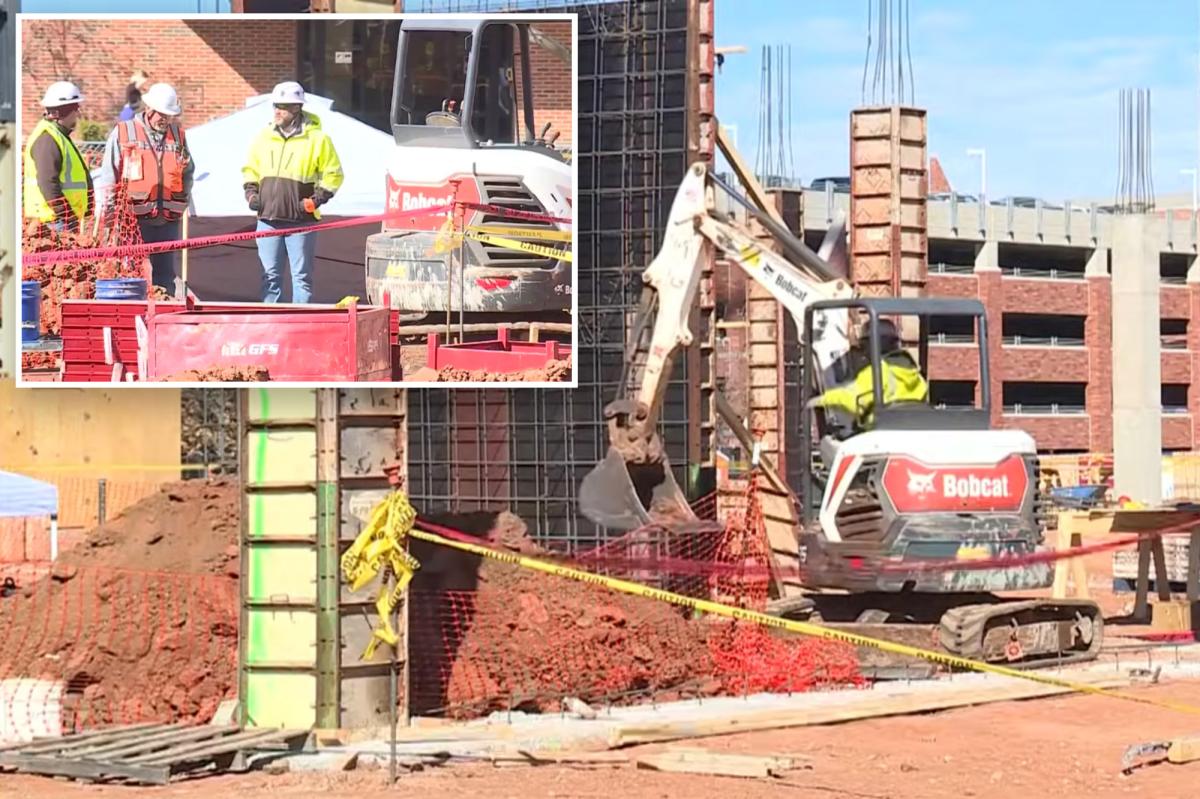


While working on a project at the University of Oklahoma, construction workers stumbled upon human remains believed to be over a century old. This unexpected and somber find caused the project to come to an immediate standstill.
The University of Oklahoma communicated the news through a statement shared with Fox News Digital.
According to the announcement dated February 20, the remains were uncovered at the location designated for the university’s upcoming Life Sciences Laboratories Building.
Photographs obtained by Fox News Digital reveal that the construction zone was swiftly evacuated following the discovery.
The university confirmed that construction activities “halted immediately” upon the realization of the find.
“The university promptly informed law enforcement and the State Medical Examiner’s Office,” the statement disclosed.
“All required procedures and state burial protection laws are being followed.”
“The university is committed to ensuring the remains are handled with care, dignity and respect,” the release added.
Though research is still ongoing, the university said that no foul play is suspected.
“Based on preliminary evaluation, there are no findings to suggest criminal activity,” the statement added.
“Early indications suggest the remains date to the early 1900s.”
In a Feb. 26 statement to Fox News Digital, university officials said the remains may have been cadavers.
The Oklahoma Archaeological Survey (OAS), which operates out of OU’s campus, said the remains appear to be “cadavers used for educational purposes in the early 1900s.”
“The remains were found in the area of the former School of Biological Sciences, and their handling at the time followed standard practices,” OU said.
The construction project has since resumed.
The discovery comes nearly a year after a similar discovery was made in England.
Last April, University of Gloucestershire reported that construction workers found 317 skeletons and 83 brick burial vaults during their work on the school’s City Campus.