
Once again, oil prices are teetering on the edge of the $100 per barrel mark, spurred by President Trump’s prioritization of halting Iranian actions over mitigating rising oil costs.
Earlier today, Brent crude briefly surged past the $100 threshold following Iran’s aggressive moves against three vessels. Although prices retreated to approximately $95, the President’s remarks have reignited the possibility of crossing that critical line once more.
In a social media statement, President Trump asserted, “The United States is the largest oil producer in the world, by far, so when oil prices go up, we make a lot of money. BUT, of far greater interest and importance to me, as President, is stopping an evil Empire, Iran.”
Shortly after his comments, Iran’s Supreme Leader delivered a public address, promising to maintain the closure of the strategic Strait of Hormuz, a key maritime passageway for global oil shipments.
Compounding the situation, the International Energy Agency announced earlier this morning that the world is facing its most significant oil supply disruption to date. After releasing 400 million barrels from emergency reserves on Wednesday, the agency predicts a substantial decline in supply, expecting it to drop by 8 million barrels per day in March.
It expects it to drop by 8 million barrels per day in March.
Middle East Gulf countries, including Iraq, Qatar, Kuwait, the UAE and Saudi Arabia, have cut total oil production by at least 10 million bpd – almost 10 per cent of global demand – as a result of the conflict, the IEA said.
The FTSE 100 sank 0.5 per cent, or 50 points, at the opening bell while other European markets also opened lower.

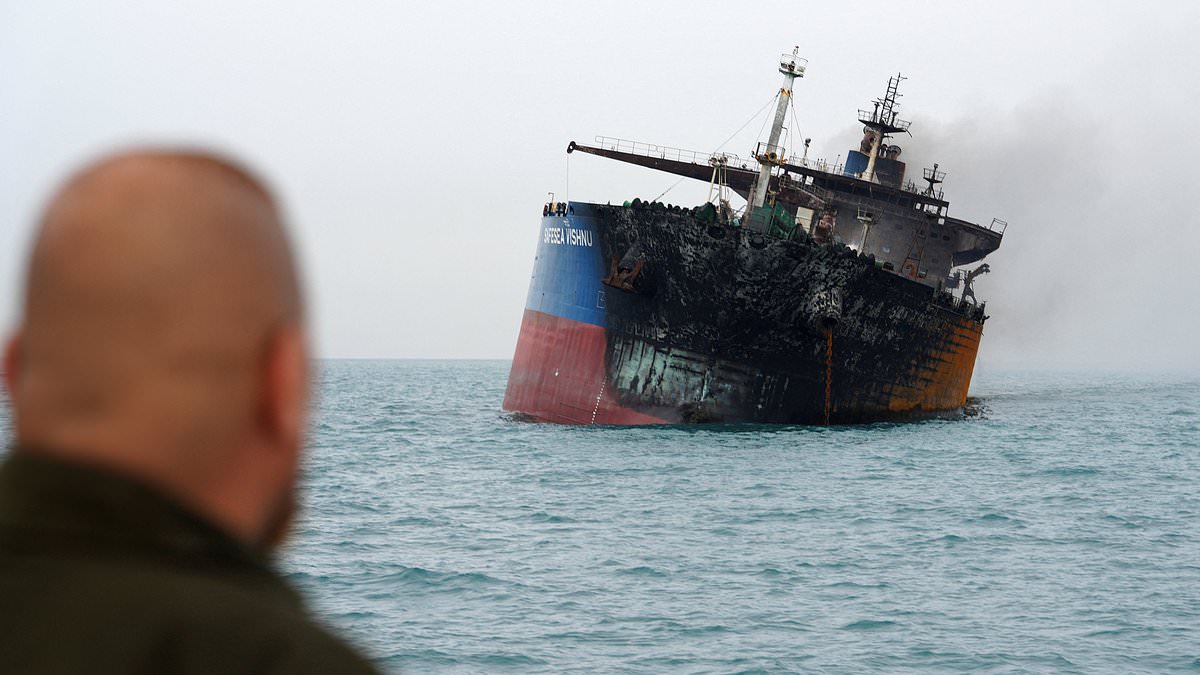
Oil shock: Tankers are unable to make their way through Strait of Hormuz pushing prices up
The Stoxx Europe 600 dipped 0.4 per cent while Germany’s Dax is down 0.37 per cent, as markets contend with the escalating conflict and the knock-on effect on oil prices.
It comes just days after markets staged a minor relief rally after Donald Trump indicated the Iran conflict would end ‘very soon’.
The IEA’s announcement on Thursday had little impact on crude markets after the release had been trailed earlier in the week.
Panmure Liberum analysts said it was ‘deemed inadequate to offset the impact of supplies already lost,’ said Panmure Liberum analysts. ‘The release of oil from strategic reserves is a temporary measure and is a sticking plaster on the lost supply.’
Neil Wilson, Saxo UK Investor Strategist, said that it was a ‘huge release but half of it is already accounted for.’
‘We’ve already lost about 200million barrels, with about 14million barrels per day (bpd) since the conflict started,’ Wilson said in a note.
‘So unlike in 2022 with Russia there has been an actual loss of barrels from the market, rather than just flows being reset and redirected (e.g in 2022 from Europe to India and China).’
He added: ‘Reserves are stockpiles sitting as existing inventory – the market is more concerned about flows. The reserves can maybe replace about 2million bpd but the market is short about 6.2 million bpd at least.
‘The timing and the pace of the release will be important to the market’s reaction, but it seems unlikely that the flow of reserves can make up for the lost flow of production. This is a temporary and limited solution – the key is to reopen the Strait of Hormuz.’
The IEA now projects world output will fall by 8million barrels a day this month, its lowest level since the first quarter of 2022.
Oil prices are around 40 per cent higher than at the start of the conflict, and around 60 per cent higher than at the start of the year when brent crude traded at around $61 a barrel.
Gas prices have also been hit by concerns over disrupted liquefied natural gas (LNG) supply.
European gas futures surpassed €52/MWh – up over 60 per cent since the start of the conflict – while UK gas prices are up to 132p per therm, from 78p at the end of February.
Defence stocks Babcock and BAE Systems led the FTSE 100’s biggest risers this morning, both up around 2.75 per cent. Meanwhile, financial companies came under pressure again with HSBC tumbling over 4 per cent, while Schroders dipped 2.5 per cent.
EasyJet and British Airways owner IAG remain under pressure in the face of rising fuel prices.
DIY INVESTING PLATFORMS
AJ Bell

AJ Bell
Easy investing and ready-made portfolios
Hargreaves Lansdown

Hargreaves Lansdown
Free fund dealing and investment ideas
interactive investor

interactive investor
Flat-fee investing from £4.99 per month
Freetrade

Freetrade
Investing Isa now free on basic plan
Trading 212

Trading 212
Free share dealing and no account fee
Affiliate links: If you take out a product This is Money may earn a commission. These deals are chosen by our editorial team, as we think they are worth highlighting. This does not affect our editorial independence.
Compare the best investing account for you