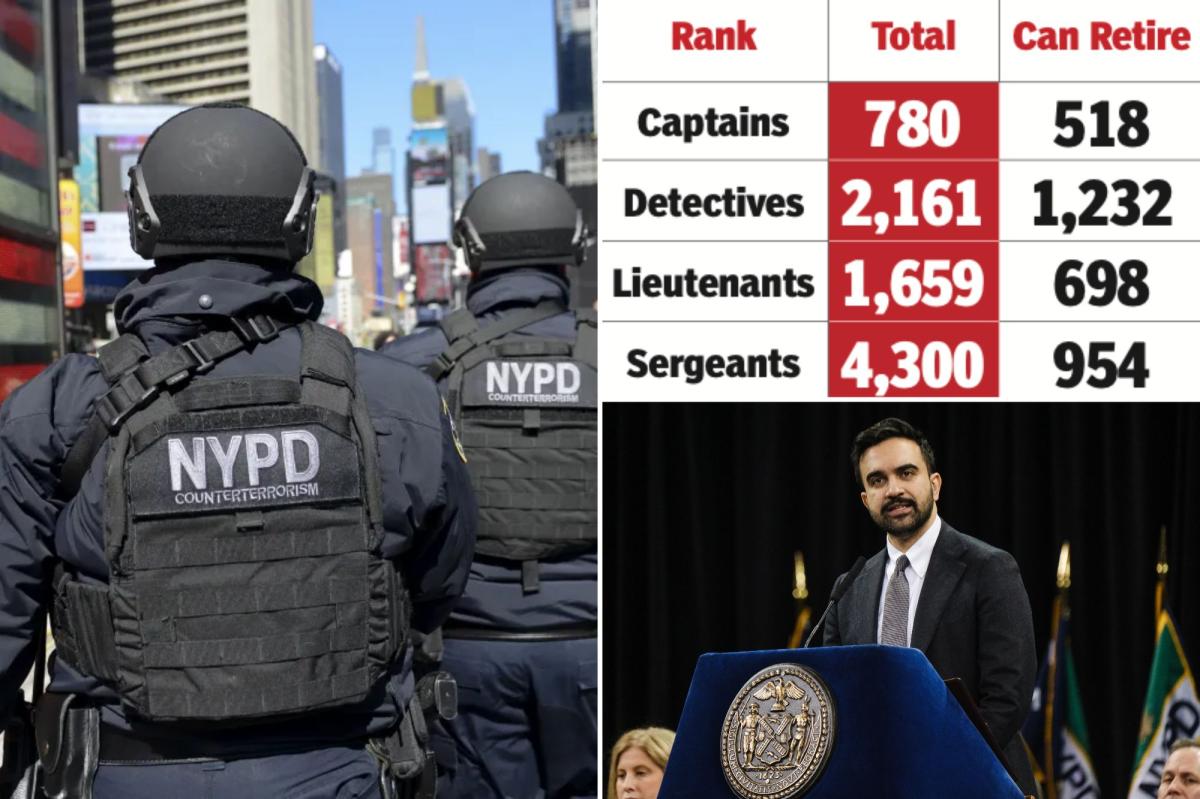


Over half of the officers in the NYPD’s Joint Terrorism Task Force are currently eligible for retirement, raising concerns about the future of counterterrorism and crime prevention in New York City, according to information obtained by The Post.
Out of 82 detectives in the JTTF, 45—equivalent to 55%—have served 20 years, qualifying them for retirement with full pension benefits, based on union statistics.
Across the NYPD, there are 2,161 active detectives, and 1,232 of them—about 57%—are in a similar position, eligible for full pensions after two decades of service.
Additionally, 698 lieutenants, which is approximately 42% of the 1,669 total, are eligible for retirement today. Furthermore, 518 captains, or 66% of the 780 total, and 954 sergeants, representing around 22% of the total 4,300, could also choose to retire, according to the union data.
There is growing concern among police officials that if Mayor Mamdani decides to cut overtime, it could prompt a mass exodus of experienced NYPD leaders and detectives, as this would substantially impact their pension benefits, union representatives have warned.
For officers who joined the force after 2000, their pension is calculated at half of their earnings from their final full year of service.
So if they think anti-cop Mamdani will cut their future OT pay, it would make sense for them to retire now, and use their 2025 pay under cop-friendly Mayor Adams as the basis for their pension.
“If they have a big overtime year, they have to go,” said Detectives Endowment Association President Scott Munro, who has been lobbying Albany for the three-year average.
He said a perceived lack of mayoral support, and public anti-cop sentiment that it creates, is also pushing cops to leave.
“What’s happening is people are getting in our police officers’ faces,” Munro said. “They’re harassing them out there in the street.”
Unions are “losing control of people leaving,” Lieutenants Benevolent Association President Lou Turco said.
“Once you hit 20 [years], the department loses control,” he said. “If I have a really good year of overtime and the department decides it wants to cut overtime, I have to leave.”
At the beginning of the year, officers were told they needed to reduce their overtime by nine to 11 hours in February as part of a cost-cutting initiative, The Post reported.
The cuts came during the shortest and coldest month of the year when there were few major events, a spokeswoman said at the time, calling the move “management 101.”
But cops “see the writing on the wall,” said retired NYPD Detective Michael Alcazar, an adjunct professor at John Jay College of Criminal Justice who served in the NYPD for three decades before retiring in 2019.
“I did 30 years because it was a good job, I was getting good overtime, and I was enjoying it,” he said.
“But now these guys are not because they’re backfilling patrol,” he said of veteran supervisors forced back to the street to make up for a loss of manpower.
“Detectives and lieutenants are back on patrol,” he said. “You know when you’ve got 20, 25 years you don’t want to put the bag back on and get on foot post, which is what they’re doing.”
Police Commissioner Jessica Tisch testified at a City Council budget hearing this week that 2025 retirements lined up with projections based on the number of cops hired two decades ago.
She added that the NYPD had the “largest hiring year on record – more than 4,000 officers” last year.
“We are not in a hiring crisis anymore,” she told the City Council. “We ended 2025 at a headcount of 34,769 — just 250 shy of our authorized headcount.”
“It’s the senior people we do not want to lose,” Sergeants Benevolent Association President Vincent Vallelong said.
There are 220 sergeants who are bosses in the detective bureau who don’t get special assignment money, which is basically lieutenant pay, he said.
“If they gave them special assignment money, I promise right off the bat these guys wouldn’t leave,” the union boss said.
Part of the problem with watching veteran officers walk away is that there’s nobody left in the wings to replace them, said Munro.
“I have senior detectives telling their kids, ‘Do not come on this job,’” said Munro, who has two police officer sons. “And that’s not the way this job used to be.”