

In a recent post on Truth Social, former President Donald Trump announced that he directed the U.S. military to delay planned strikes on Iran’s power plants and energy infrastructure for a period of five days. This decision, he indicated, followed discussions with Iranian officials.
During a subsequent phone interview with CNBC’s Joe Kernen, Trump expressed a strong desire to reach an agreement with Iran, stating, “We are very intent on making a deal with Iran.”
However, Iranian state media presented a different narrative. Citing an anonymous “senior security official,” a message on Telegram contradicted Trump’s account, asserting that no direct or indirect negotiations have taken place between the U.S. and Iran. The official reportedly claimed, “There is no negotiation, and with this kind of psychological warfare, neither the Strait of Hormuz will return to its pre-war conditions nor will there be peace in the energy markets.”
In response later that morning, Trump reaffirmed that negotiations between the U.S. and Iran had indeed occurred. He claimed these discussions were “very, very strong” and resulted in “major points of agreement,” notably that Iran would commit to never developing a nuclear weapon.
Addressing the media in Palm Beach, Florida, Trump mentioned that his son-in-law, Jared Kushner, alongside U.S. special envoy Steve Witkoff, took part in these discussions with a high-ranking Iranian official on Sunday evening. This statement underscores the former president’s continued involvement in international diplomacy.
Trump, speaking to reporters in Palm Beach, Florida, said his son-in-law Jared Kushner and U.S. special envoy Steve Witkoff participated in those talks Sunday evening with “a top person” in Iran.
“They want, very much to make a deal. We’d like to make a deal too,” he said. “We’re going to get together today by, probably, phone, because it’s … very hard for them to get out, I guess. But we’ll, at some point, very, very soon, meet.”
Trump said that if the five-day halt in strikes goes well, the parties could end up “settling this.”
“Otherwise, we’ll just keep bombing our little hearts out,” he said.
The president also said that he believes Israel will be “very happy” with the progress made with Iran so far.
He added that the Strait of Hormuz “will be opened very soon, if this works.”
Asked who would control the strait, Trump said it might be “jointly controlled” by himself and “whoever the ayatollah is,” suggesting that such a move would come as part of a “very serious form of regime change.”

In his Truth Social post earlier Monday, Trump said that the U.S. and Iran had “VERY GOOD AND PRODUCTIVE CONVERSATIONS REGARDING A COMPLETE AND TOTAL RESOLUTION OF OUR HOSTILITIES IN THE MIDDLE EAST.”
The U.S. president said these talks would continue through the week. It was not immediately clear who participated in the talks or when and where they were held.
U.S. stock futures rallied, the dollar fell against other major currencies, and oil prices tumbled on the news.
Speaking with Kernen, Trump said discussions with Iranian authorities had been very intense and that he remains hopeful something very substantive can be achieved.
The U.S. president also insisted on the same call that what is unfolding in Iran can be described as regime change, Kernen reported.
The White House did not immediately respond to CNBC’s request for additional information about the purported talks, and did not immediately respond to Iran’s claim that no such negotiations are underway.
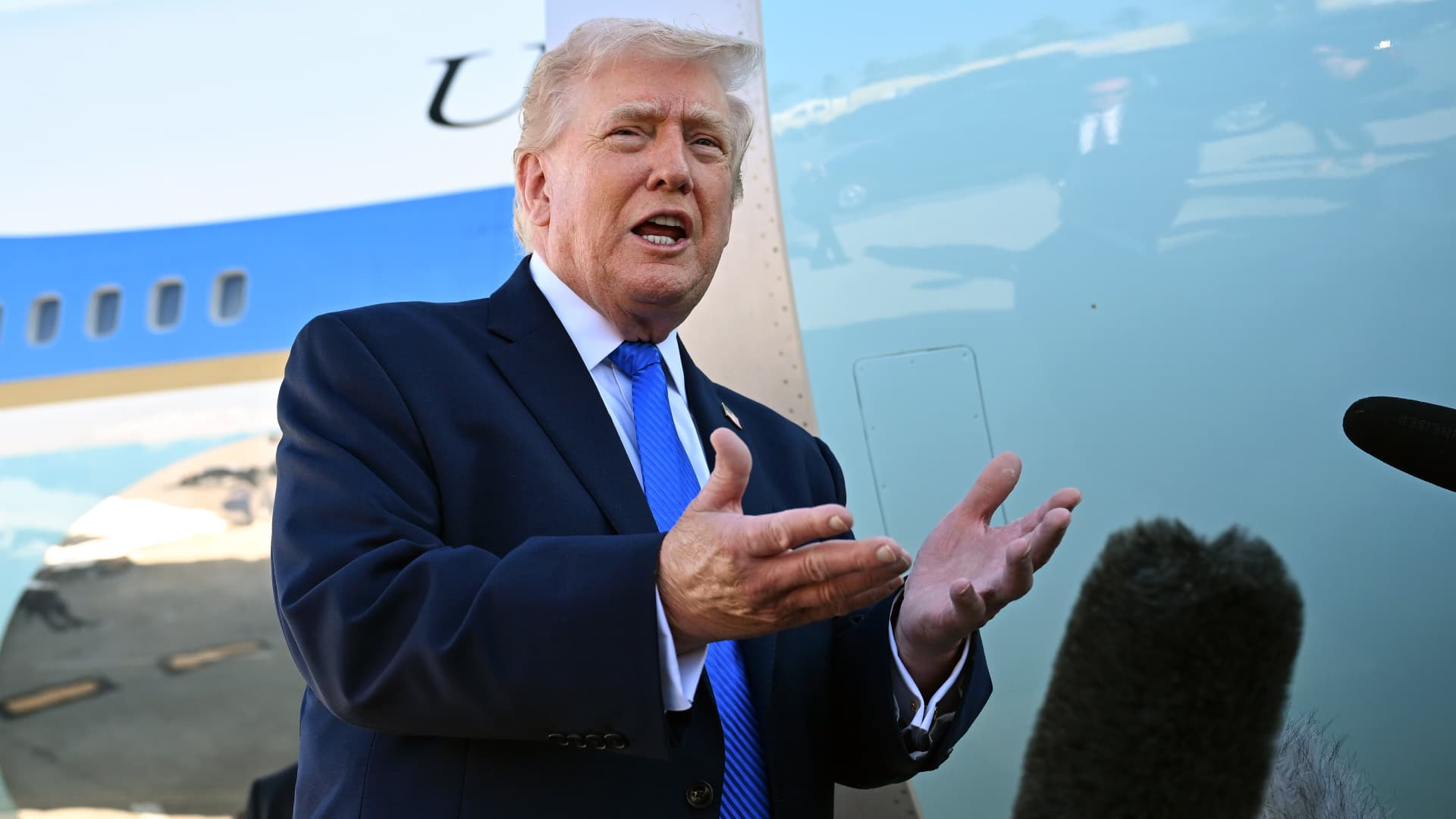
U.S. President Donald Trump speaks to reporters before boarding Air Force One at Palm Beach International Airport on March 23, 2026 in West Palm Beach, Florida.
Roberto Schmidt | Getty Images
The U.S. president on Saturday issued a 48-hour ultimatum to Tehran to reopen the Strait of Hormuz or face strikes on Iran’s power plants.
The narrow waterway is a key maritime corridor that connects the Persian Gulf and the Gulf of Oman. Roughly 20% of global oil and gas typically passes through it.
The deadline had been due to expire on Monday evening in Washington.
Iranian Parliament spokesperson Mohammad Baqer Qalibaf had said critical infrastructure and energy facilities in the Persian Gulf region could be “irreversibly destroyed” should Iranian power plants be attacked.
Shipping traffic through the Strait of Hormuz has virtually ground to a halt since the U.S. and Israel launched airstrikes on Iran on Feb. 28. Iran has retaliated by targeting ships trying to pass through the strait, with several incidents reported in recent weeks.
The Iran war has stoked global inflation fears and created what the International Energy Agency calls the largest supply disruption in the history of the oil market.
— CNBC’s Anniek Bao contributed to this report.