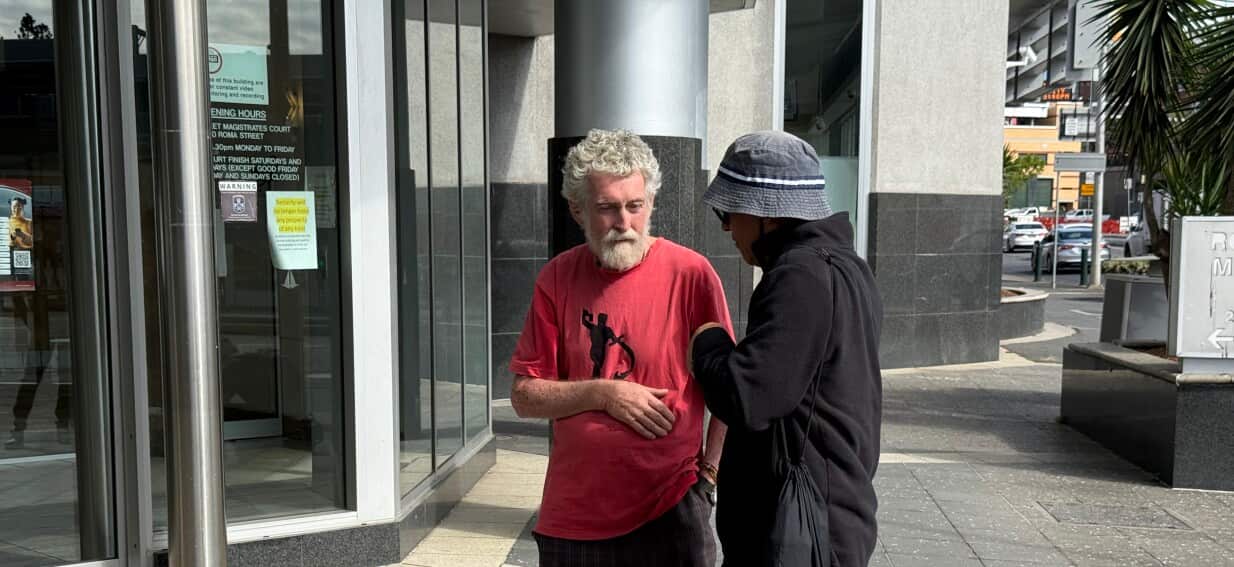
In a recent court appearance, a 70-year-old man, Jim Dowling, is set to contend with charges related to his use of a controversial phrase during a protest against the Gaza conflict. Dowling, who identifies as a Catholic anti-war activist, is accused of publicly uttering the phrase “from the river to the sea,” which has been prohibited under new legislation in Queensland. These charges allege that his actions could potentially intimidate, harass, or offend members of the public.
Appearing before the Brisbane Magistrates Court on Tuesday, Dowling represented himself, clad in a simple T-shirt and shorts, a testament to his vow of simplicity concerning material possessions, which also explains his choice to appear barefoot. When addressing Magistrate Belinda Merrin, he expressed his incredulity at the charges. “I’d like to plead insanity,” he stated, adding, “I think the charge is insane. Anyone who takes it seriously could be such as well.”
His comments reflect his disbelief at the severity of the charges. This case unfolds amidst a backdrop of newly enacted legislation in Queensland, which prohibits expressions like “from the river to the sea” and “globalise the intifada,” deeming them as hate speech targeted against Jewish communities. This legislation was passed earlier this year, underscoring the state’s commitment to curbing language perceived as inciting hatred.
“I’d like to plead insanity. I think the charge is insane. Anyone who takes it seriously could be such as well.”
Dowling was barefoot in court due to him taking a vow of simplicity over material possessions.
Queensland’s banning of contested phrases
Earlier this year, Queensland passed legislation banning the phrases “from the river to the sea” and “globalise the intifada”, categorising them as hate speech against Jewish people.
Queensland Attorney-General Deb Frecklington said in February that the laws were a “common sense” response to the Bondi terror attack, when 15 people were killed after two gunmen opened fire on Jewish celebrations in the deadliest attack on Australian soil since the 1996 Port Arthur tragedy.
Premier David Crisafulli said in early February that the laws were “about drawing a clear line — and stamping out the embers of hatred that were allowed to burn unchecked for too long — to ensure we protect Queenslanders”.
However, the chants — both of which are widely used at pro-Palestinian demonstrations in Australia and other nations — have contested meanings.
The full saying “from the river to the sea, Palestine will be free” is a reference to the land between the Jordan River, which borders eastern Israel, and the Mediterranean Sea to the west.
Jewish organisations such as the Executive Council of Australian Jewry say the phrase “rejects Israel’s right to exist and denies Jews the right to self-determination in their ancestral homeland”.
However, some activists and advocacy groups say the phrases are calls for Palestinian freedom and human rights, rather than violence or the destruction of Israel.
Dispute over personal vs legal insanity
Dowling said outside court he was arrested and charged on March 18 during a protest outside aerospace company Boeing’s headquarters in Brisbane.
He said he had a banner reading: “From the river to the sea, Brisbane will be free of Boeing”.
Activists have accused Boeing of supplying the Israeli Air Force during the Gaza conflict.
According to news reports in mid-March, the company signed a new US$289 million ($407 million) contract with Israel for precision-guided munitions.
Dowling would need to prove he was not mentally fit to stand trial, the magistrate said.
“I don’t think I’m insane. I think the law is insane,” Dowling said.
Merrin said she would note he was contesting the charge.
Dowling was granted bail and ordered to return to court on 29 April.
He was greeted by a small group of supporters and pro-Palestine protesters outside court.
“I’m not here to win any court cases, I’m here to expose the arms trade. There was no mention of any other politics, just Boeing,” Dowling said, adding that he believed a majority of people did not support the prohibited expression laws and doubted a magistrate would jail him.
“I certainly think it will be declared unconstitutional if it goes to the High Court,” he said, commenting on another person who was charged.
For the latest from SBS News, download our app and subscribe to our newsletter.