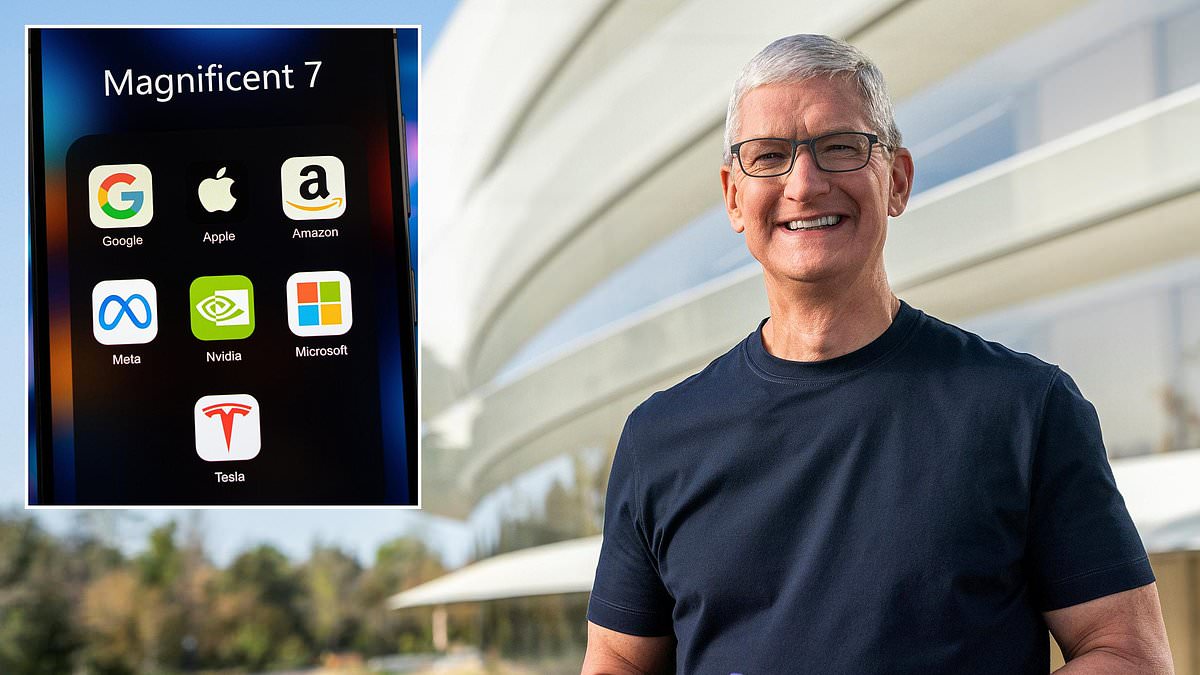

Once hailed as the champions of the global stock market, the “Magnificent Seven” are now facing increased scrutiny. This elite group consists of major US tech giants: Alphabet (Google’s parent company), Amazon, Apple, Meta (which owns Instagram), Microsoft, Nvidia, and Tesla.
These powerful companies, led by billionaire CEOs, are under mounting pressure to justify their hefty investments in semiconductor chips and various facets of artificial intelligence (AI).
Silicon Valley is heavily investing billions in data centers, often referred to as “AI factories,” indicating the scale of commitment to future technologies.
With the first-quarter results just around the corner, there is growing demand for evidence that these expenditures will secure industry dominance, especially as Apple welcomes a new CEO. Unlike its peers, Apple has been more conservative in its AI spending.
Tim Cook, who has overseen a tremendous 20-fold increase in Apple’s share value during his 15-year leadership, is set to transition to the role of chairman. John Ternus, currently heading Apple’s hardware division, will step in as the new CEO.
In his current position, Ternus has played a crucial role in maintaining Apple’s edge with its elegantly designed products like the iPhone, iPad, and Mac. He is also credited for the success of the globally popular AirPods.

Moving on: Tim Cook has presided over a 20-fold rise in Apple shares during his 15-year tenure
But sleek, AI-enabled products will not satisfy those who want to see advances in AI from Apple, or its peers including Alphabet, which has been dubbed the ‘Full-Stack AI King’. Such is its preparation for battle.
The debate over who will emerge as AI winners concerns direct holders of Mag 7 companies and the thousands more who own them through general funds, like the F&C trust.
I am certainly engaged as an investor in two tech trusts – Allianz and Polar Capital.
The companies have already changed our lives. But which are more likely to yield life-changing rewards?
Bet on chips
The cautious may decide that it is too early to know, as history shows early front-runners can finish nowhere.
Stephen Yiu, manager of the Blue Whale fund, says: ‘Google Search now dominates. But
how many other search companies foundered along the way? Who remembers pioneers like Alta Vista?’
The outcome being unclear, Yiu’s strategy is to bet on the companies that provide the AI ‘picks and shovels’.
In the 1848 gold rush more equipment suppliers made fortunes than prospectors.
The quintessential picks and shovels player is Nvidia, the $4.9bn (£3.6bn) behemoth whose reassuringly expensive chips remain AI must-haves, although the competition is hotting up.

Yiu says: ‘The valuation metric we look at is free cash flow (FCF) – that’s the cash left for shareholders after capital spending. In 2026, Nvidia’s FCF of $180billion (£133billion) is about double the FCF of Amazon, Alphabet, Meta, Microsoft and Tesla combined – $90billion (£66.5billion).’
Nvidia shares have leapt by 97 per cent over the past 12 months to nearly $210 – 21,857pc above their level of a decade ago. But they are still seen as a ‘buy’; analysts have set an average target price of $286.
Yiu is enthusiastic about semiconductor firm Broadcom. Its shares are up nearly 22p so far this year.
Again, analysts rate them a ‘buy’. Yesterday the price was just over $421.
Alphabet
Alphabet is a $4trillion (£3trillion) entity encompassing Google and businesses like the Android operating system, YouTube and driverless taxi service Waymo.
Another asset is the DeepMind AI research business. Since its acquisition a decade ago, it has provided a foundation for Alphabet’s AI ventures, as Carolyn Bell, who is the manager of Stonehage Fleming’s Global Best Ideas fund, explains
Bell points out that Android and Google’s billions of users are a ready-made audience for Alphabet’s AI services.
She says: ‘AI-enabled Google searches are already producing higher engagement levels, bringing more revenue.’
What’s more, Alphabet makes its own Tensor chips, with Broadcom, meaning it is less exposed to Nvidia’s steep prices – ‘the Nvidia tax’ as it is known in Silicon Valley-speak.
No wonder then that analysts consider Alphabet shares a ‘buy’ at $424. One analyst is even targeting $730.
Amazon
As many as 68 analysts follow Amazon, the $2.6trillion (£1.9trilion) group which is the world’s largest online retailer. Some 49 regard Amazon as a ‘buy’ at its current price of $262.
This stems from the AI-driven expansion of the cloud computing arm – Amazon Web Services (AWS).
Among those relying on AWS and Amazon’s Trainium chips is Anthropic, whose Claude system is seen as an AI disruptor. Amazon invested $5billion in the start-up this week and may commit more to a firm set for a stock market debut this year.
Apple
Apple shares dipped on the announcement that Cook was stepping back.
But JP Morgan reiterated that the shares are a ‘buy’ at $272. The broker’s target price is $325. Another 23 brokers share that view, but 14 see it as a ‘hold’.
This highlights the sense that Ternus faces an AI reckoning. The company may be about to unveil its AI-enabled smart glasses in four styles, but investors may want more.
Meta
Shares in Meta could rise from their current $677 to $1,015. Or so forecasts one of the 47 analysts who views them as a ‘buy’.
Just last month, Meta was at the centre of what was dubbed a ‘Big Tobacco moment’ over the harmfully addictive nature of its apps: Facebook, Instagram and WhatsApp.
Some declared the company to be ‘uninvestable’.
But others appear persuaded that bumper returns could flow from the prodigious outlay in AI by Meta chief executive Mark Zuckerberg.
This week he said that 10 per cent of the company’s employees would lose their jobs to fund the spending spree.
Meta is felt to be winning the smart glasses war with 7m pairs of Raybans sold last year.
But, once more, evidence of more substantial achievement must soon emerge.
Microsoft
The 13 per cent drop in Microsoft shares to $420 so far this year highlights the concern that this $3.2trillion (£2.4trillion) corporation could be an AI laggard, despite its Azure cloud computing business and its close links with OpenAI, the company behind ChatGPT.
The dip means that analysts have trimmed target prices for the shares.
But most have maintained ‘buy’ recommendations, sending out a message that no one is prepared to predict the winners, so it makes sense to spread your bets.
Tesla
As this week’s better-than-expected results revealed, Tesla is reinventing itself as an autonomous taxi, robotics and all-round AI leader, in an apparent bid to retain its membership of the Magnificent Seven.
The $1.5trillion (£1.1trillion) electric car maker has seemed a poor fit in this charmed circle.
The verdict of analysts probably reflects the way in which Tesla chief executive Elon Musk divides opinion: 29 among a pool of 52 contend shares should be held or sold.
But Musk believers say the shares are a ‘buy’ and could even rise from $375.70 yesterday to $600, which would make the world’s richest man even more of a winner.
DIY INVESTING PLATFORMS
AJ Bell

AJ Bell
Easy investing and ready-made portfolios
Hargreaves Lansdown

Hargreaves Lansdown
Free fund dealing and investment ideas
interactive investor

interactive investor
Flat-fee investing from £4.99 per month
Freetrade

Freetrade
Investing Isa now free on basic plan
Trading 212

Trading 212
Free share dealing and no account fee
Affiliate links: If you take out a product This is Money may earn a commission. These deals are chosen by our editorial team, as we think they are worth highlighting. This does not affect our editorial independence.
Compare the best investing account for you


