
DualShot Recorder has taken the digital world by storm, becoming an instant phenomenon.
Within just 12 hours of its launch, this innovative app soared to the top of the App Store’s paid apps chart. Its meteoric rise was unexpected, but perhaps even more intriguing is the app’s backstory, which traces its roots to a community of endearing squirrels and their devoted caretaker.
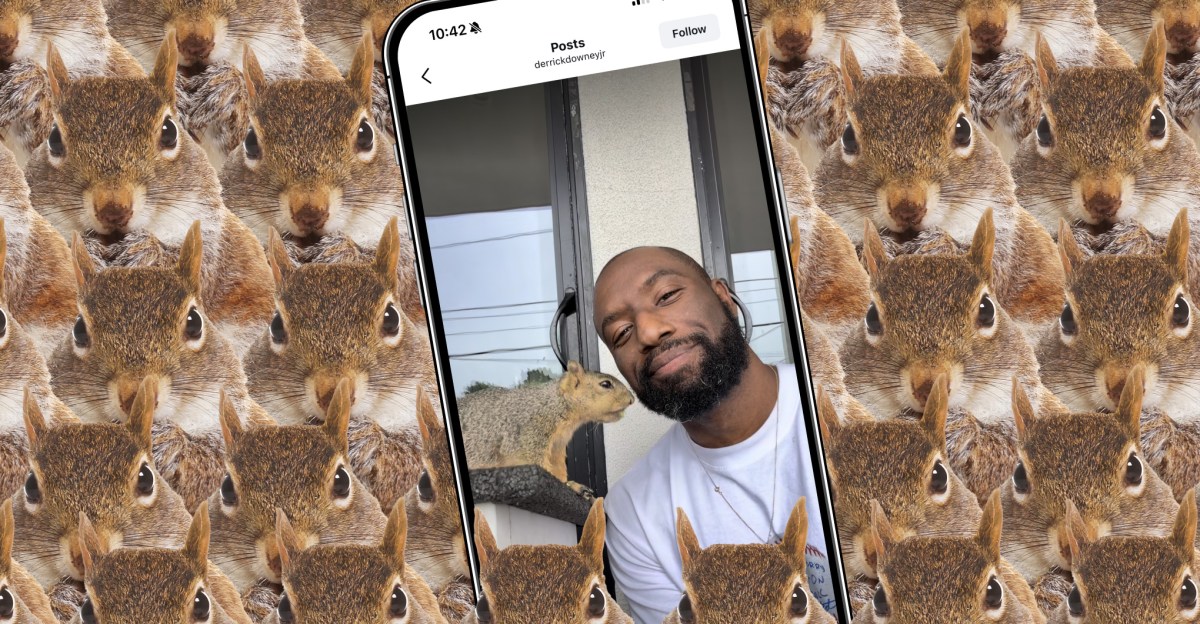
Derrick Downey Jr. gained fame through his engaging short-form videos, capturing heartwarming encounters with the squirrels that frequent his Los Angeles patio. His Instagram and TikTok accounts boast over a million followers each, drawn to the charming antics of regulars like Maxine, Richard, and the occasionally visiting Hoodrat Raymond. Downey’s nurturing extends beyond mere feeding; he constructs shelters and even ensures veterinary care when needed, offering a wholesome and delightful spectacle.
Seeking to expand his content to YouTube, Downey faced the challenge of capturing footage in both vertical and horizontal formats simultaneously. While other creators often resort to using dual devices or cropping clips during editing, these solutions proved cumbersome for Downey. “I tried various devices, rigs, gimbals, and additional phones, but it became overwhelming,” he shared. Cropping in post-production was not ideal either, as it compromises the iPhone camera’s full sensor, resulting in reduced resolution and limited framing options.
Last year, Downey envisioned an app to overcome this hurdle. Although not a software developer, he initially experimented with ChatGPT for coding assistance, but without success. The project was temporarily shelved until earlier this year when a renewed spark of inspiration urged him to try again.
“I delved into the code, the camera activated, and I thought, ‘We might be onto something,'” Downey recounted. By exploring the iPhone camera’s capabilities, he discovered that Apple’s camera API allows developers to access the full sensor, a feature previously utilized by other apps. Seizing this opportunity, Downey devised a solution to capture both horizontal and vertical footage directly from the sensor, preserving resolution without post-processing. After several months of dedicated work and prompt engineering, DualShot Recorder was born, offering creators a seamless filming experience.
“You would think that because you’re giving the prompts to this machine that it would give you accurate data. But I found that not to be the case…”
The project started with ChatGPT, and Downey tried using Google’s Antigravity as well, but he says that Claude was the tool that really made it possible. And like anyone who has worked with AI tools, he learned to deal with its quirks and inaccuracies. “I understand the product that I’m trying to create, I understand the functionality and what I’m looking for, and there have been moments when the response [Claude gave] wasn’t accurate,” he says. “You would think that because you’re giving the prompts to this machine that it would give you accurate data. But I found that not to be the case, so I would then have to correct it.” Recognizing that, he says he double checks and triple audits everything he asks it to do.
With the app ready, he says he looked into the process of putting it on Apple’s App Store. It seemed doable. “I was like, alright, well let’s just put it on there and share it.” He priced it at a one-time cost of $6.99, and within its first 12 hours, DualShot Recorder became the number-one paid app in the store. It remained in that top spot for eight days, Downey recounts, and is still in the top 20 at the time of this writing.
The response was overwhelmingly positive. The price is $9.99 now, but there’s still no subscription and no user data collected, and videos stay entirely on your device. The app also includes plenty of granular controls over quality and resolution, and it also lets you record from two different cameras on the same device at once. It’s a refreshingly simple value proposition. Downey says that it was important to refrain from automatic user data collection, but that has made it harder to pin down and fix bugs. He’s working on adding a troubleshooting feature so users can send an error report when they encounter problems.
It’s been an overwhelming but invigorating change for Downey. “I’ve been losing a lot of sleep, which I don’t mind, really,” he tells me. “I’m all about balance, but when something is fueling you, sometimes you lose sleep over it. And that’s what’s been going on.” He describes the venture as exciting, and giving him a new sense of purpose. But he acknowledges that maintaining a successful app might call for a pivot of some kind. “It’s a lot of new things coming up, and I’m embracing that.”
Downey is open about his mental health with his followers, and he credits his interactions with his squirrel friends as something that helped lift him out of a dark time. At times when his channel has gone quiet, he’ll share an update that he’s not in the right space to create videos. His community is supportive, he says. “They’re like oh, take your time. We’re not going anywhere. We’ll be here.”
Wherever the change that he’s embracing takes him, Downey says that one thing isn’t changing: spending time with the squirrels. With the initial “chaos” as he calls it dying down from the app launch, he’s been able to get back to dedicating time to Richard, Maxine, and his other furry visitors. “They met me in a space when I was going through depression. And that’s family. So even if I really haven’t been able to show up online like I usually do, I’m still taking care of them.”